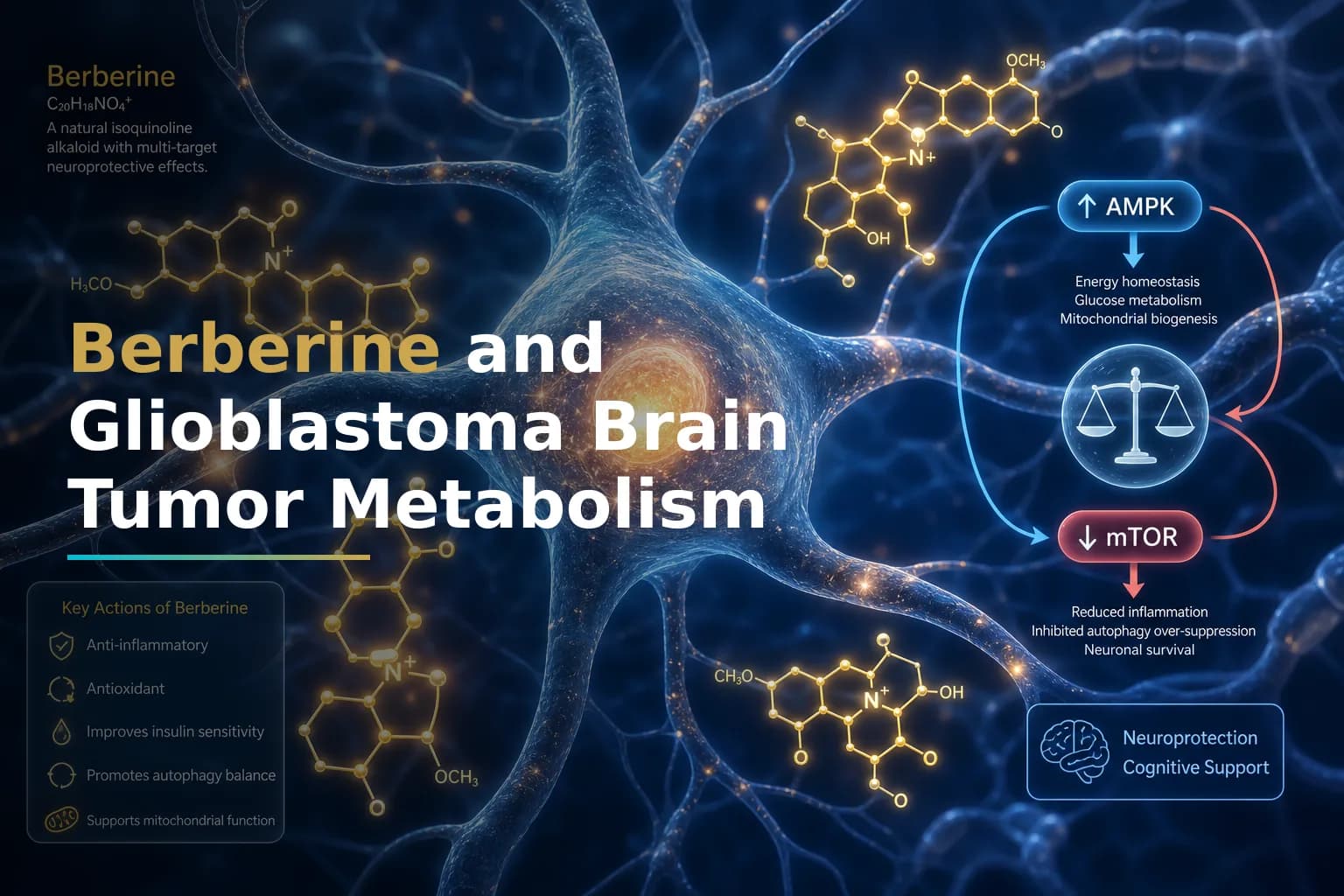
What Is Berberine?
Berberine is a natural compound called an isoquinoline alkaloid. It is found in several plants, including Berberis vulgaris (barberry), Coptis chinensis (goldthread), and related species used in traditional Chinese and Ayurvedic medicine. For centuries, it was used to treat infections and digestive problems. Today, scientists are studying it for its effects on metabolism, blood sugar, cholesterol, and — most relevant to this article — cancer cell biology.
Berberine is widely sold as an over-the-counter dietary supplement, which makes it appealing to patients looking for additional tools. But "natural" does not automatically mean "safe" or "effective" in the context of a brain tumor. The research on berberine in glioblastoma (GBM) is promising but still almost entirely preclinical. Understanding what the evidence does and does not show is essential before drawing any conclusions.
Why GBM Patients Are Interested in Berberine
Glioblastoma is the most aggressive primary brain tumor. Despite multimodal treatment with surgery followed by radiotherapy and chemotherapy with temozolomide, the five-year survival rate for WHO grade IV glioblastoma remains less than 5%. That reality drives patients, caregivers, and researchers to investigate every credible avenue, including plant-derived compounds that may interact with cancer metabolism.
Berberine has well-documented effects on cellular energy pathways, particularly the AMPK/mTOR axis, which is also central to how GBM cells grow and survive. Researchers have begun asking whether berberine can exploit GBM's metabolic vulnerabilities. The answer so far is "possibly, in the lab" — but human trial data is not yet available.
If you are newly diagnosed and still mapping your options, our overview of what to expect in the first 30 days after a GBM diagnosis may help you build a broader picture of your care framework before exploring adjunct strategies.
The Warburg Effect: Why GBM Metabolism Matters
To understand why berberine interests GBM researchers, a brief look at brain tumor metabolism helps. Most normal cells produce energy through efficient oxygen-dependent pathways. GBM cells heavily favor a process called aerobic glycolysis — burning glucose even when oxygen is available. This is called the Warburg effect.
This metabolic shift supports rapid tumor cell growth and also creates a potential weakness: therapies that disrupt glycolysis or alter the energy-sensing pathways behind it may slow tumor proliferation. Berberine has been shown in multiple laboratory models to interfere with exactly these processes. For a deeper look at how dietary changes target the same mechanism, see our article on the ketogenic diet and GBM metabolic therapy.
Key Mechanisms Studied in the Laboratory
1. AMPK/mTOR/ULK1 Pathway and Autophagy
One of the most studied mechanisms involves a central metabolic signaling chain: AMPK activates, mTOR is suppressed, and the cell's self-digestion process (autophagy) is triggered. Research published in Oncotarget showed that berberine has profound effects on the metabolic state of GBM cells, leading to high autophagy flux and impaired glycolytic capacity. These changes reduced invasive properties and proliferative potential, and induced cell death.
The same study found that berberine significantly reduced tumor growth in animal models, demonstrating potential clinical benefits for autophagy-modulating plant alkaloids in cancer therapy. These are meaningful findings — but animal models do not reliably predict outcomes in humans, particularly for brain tumors where the blood-brain barrier adds another layer of complexity.
Metformin, a diabetes drug already widely studied in GBM, shares some AMPK-activating properties with berberine. You can read more about that research in our article on metformin and GBM.
2. EGFR–MEK–ERK Signaling and Cellular Senescence
A second pathway involves epidermal growth factor receptor (EGFR), a protein that is often overexpressed or mutated in high-grade gliomas. Research in Molecular Cancer Therapeutics found that berberine induced cellular senescence in GBM cells primarily by downregulating the EGFR–MEK–ERK signaling pathway. In treated cells, EGFR protein levels dropped sharply and the RAF–MEK–ERK pathway was markedly inhibited.
Senescence is different from outright cell death. A senescent cancer cell stops dividing but remains alive. Whether forcing senescence in GBM cells is ultimately beneficial or creates other problems is still being studied. EGFR's role in GBM biology is a major research area — you can see how it connects to molecular profiling in our guide on understanding your GBM molecular profile.
3. TGF-β Signaling and Tumor Invasion
Glioblastoma is well known for invading surrounding brain tissue. One key driver of that invasion is transforming growth factor-beta (TGF-β), which promotes tumor migration and immune suppression. Laboratory findings show that berberine inhibits tumor cell proliferation by inducing cell cycle arrest, promotes apoptosis and autophagy, and can inhibit the NF-κB and JAK-STAT pathways. A 2022 study found that berberine suppressed human glioma cell progression through the TGF-β1/SMAD2/3 signaling pathway, reducing migration and invasion.
4. Oxidative Stress and Mitochondrial Damage
Several studies found that berberine triggers cancer cell death through oxidative stress — generating reactive oxygen species that damage mitochondria in tumor cells. Research on GBM U87MG cells found that berberine reduced cell viability in a concentration- and time-dependent manner, working through oxidative stress and canonical apoptotic pathways. In laboratory settings, healthy brain cells appear less vulnerable to this effect than tumor cells, though this has not been confirmed in clinical studies.
The Blood-Brain Barrier Problem
For any compound to work against a brain tumor, it first has to get there. The blood-brain barrier (BBB) is a tightly controlled layer of cells lining the brain's blood vessels. It blocks most substances — including many drugs — from entering the brain in meaningful amounts.
This is one of the most important practical questions about berberine in GBM. Some researchers argue it can cross the BBB. Berberine has been described as a multi-target anti-tumor alkaloid with the ability to penetrate the blood-brain barrier and show cytotoxicity to glioma cells in preclinical work. Other analyses are more cautious.
A 2025 systematic review of plant alkaloids in GBM treatment noted that berberine's poor bioavailability suggests the need for novel drug formulations and concluded that progress in assessing BBB penetration among alkaloids remains limited. Getting enough berberine into brain tumor tissue at a therapeutically meaningful level is not a solved problem.
Researchers are working on this. Nanoparticle delivery systems, including glucose-coated berberine nanoparticles, have shown improved brain penetration in animal models. A 2026 study looked at folate receptor-targeted delivery systems designed to improve berberine's uptake in GBM cells. That work acknowledged that berberine's clinical utility is currently hindered by rapid metabolism, low bioavailability, and poor penetration across the blood-brain barrier. These are not minor obstacles — they are why the compound has not yet moved into clinical trials for brain tumors.
What the Evidence Does Not Yet Show
It is worth being direct about the state of the evidence:
- No human clinical trials have tested berberine specifically in GBM patients. All anti-tumor findings come from cell cultures (in vitro) or animal models (in vivo).
- No survival data in humans. There is no trial evidence that berberine extends survival or slows progression in people with high-grade glioma.
- Dose and delivery are unsolved. Lab studies use concentrations that may not be achievable in human brain tissue through standard oral supplementation.
- Interaction with standard treatment is unstudied. Whether berberine helps, hinders, or is neutral when combined with temozolomide and radiation in humans is not known.
This matters because the gap between promising preclinical results and proven human benefit is large — and has closed more slowly in GBM than in almost any other cancer. The broader challenge of translating novel agents into effective GBM therapies is well documented in the neuro-oncology literature.
Safety and Drug Interaction Concerns
Because berberine is sold without a prescription, some patients assume it is risk-free. That assumption is not warranted, especially in GBM patients who are actively on treatment.
Berberine is a potent inhibitor of cytochrome P450 liver enzymes, particularly CYP3A4, CYP2D6, and CYP2C9. Memorial Sloan Kettering Cancer Center's integrative medicine team notes that well-designed trials testing the safety and efficacy of berberine both singly and in combination with other treatments are warranted, indicating that even major cancer centers treat this as an open question requiring more rigorous study.
Key safety considerations for GBM patients include:
- Enzyme inhibition: Berberine may slow the breakdown of drugs processed by liver enzymes. This could raise blood levels of certain medications — including some anticonvulsants frequently used in GBM patients — to potentially problematic levels.
- Corticosteroid interactions: Many GBM patients take dexamethasone to manage brain swelling. The interaction between berberine and corticosteroid metabolism has not been well studied.
- Blood sugar effects: Berberine lowers blood glucose. Patients on steroids often have steroid-induced hyperglycemia; adding a glucose-lowering compound without monitoring creates unpredictability.
- Anticoagulation: Berberine may enhance anticoagulant effects, which matters given the bleeding risk already present in post-surgical GBM care.
- GI side effects: Nausea, diarrhea, and stomach cramping are common with berberine — symptoms that can overlap with and complicate chemotherapy side effects.
The question is not just whether a compound has anti-tumor activity in a test tube, but whether it can be used safely alongside standard-of-care treatment without unintended harm. Our broader review of evidence-based integrative approaches in GBM addresses this in detail.
How This Fits Into a Broader Integrative Strategy
Berberine is one of several natural compounds generating preclinical interest in GBM. Curcumin, resveratrol, and others share a similar profile: compelling laboratory findings, significant delivery challenges, and no completed human trials in brain tumors. Patients researching this space should be aware of that pattern.
Metabolic approaches — whether dietary, pharmacological, or through natural compounds — share a common logic: disrupting the energy metabolism of tumor cells may slow their growth or improve sensitivity to standard treatment. Berberine's AMPK activation and glycolysis impairment fit that logic. But logic is not the same as clinical proof.
Some patients and researchers are also looking at repurposed drugs with overlapping mechanisms. Valproic acid targets HDAC pathways and has some metabolic relevance to berberine's signaling effects. You can read about that research in our article on valproic acid and GBM. Chloroquine, which modulates autophagy, has entered actual GBM clinical trials, making it a useful comparison point for understanding how berberine's mechanism relates to ongoing research. See our article on chloroquine and autophagy in GBM.
What Rigorous Research Would Look Like
For berberine to move from "interesting in the lab" to part of evidence-based GBM care, the following steps would need to happen:
- Phase I trials establishing safe and tolerable doses in GBM patients receiving standard treatment
- Pharmacokinetic studies confirming that meaningful concentrations reach brain tumor tissue
- Phase II trials measuring tumor response, progression-free survival, and overall survival
- Analysis of whether any benefit depends on molecular features such as MGMT methylation status, IDH mutation, or EGFR amplification
As of 2026, none of these steps have been completed for berberine in GBM. Searching ClinicalTrials.gov for registered berberine trials in glioblastoma does not return completed or active Phase I/II studies, confirming that this compound remains in preclinical territory for brain tumor indications.
When to Talk to Your Doctor
If you are considering adding berberine to your regimen, bring it up with your neuro-oncologist or integrative oncology team before starting. Be specific: tell them what you are taking, in what form, and at what dose. Ask directly whether berberine could interact with your current medications, including anticonvulsants, steroids, and chemotherapy. Ask your team to help you distinguish between preclinical evidence and clinical evidence — that distinction matters enormously in GBM, where many promising compounds have failed to move from the lab to the bedside.
Berberine may eventually prove useful as an adjunct in high-grade glioma care. The honest summary right now is: the biology is interesting, the delivery challenges are real, the human safety data is limited, and no survival benefit has been established. That is the foundation from which any patient should evaluate it.
This article is for general information and is not a substitute for medical advice. Always consult your oncologist or care team about your specific situation.