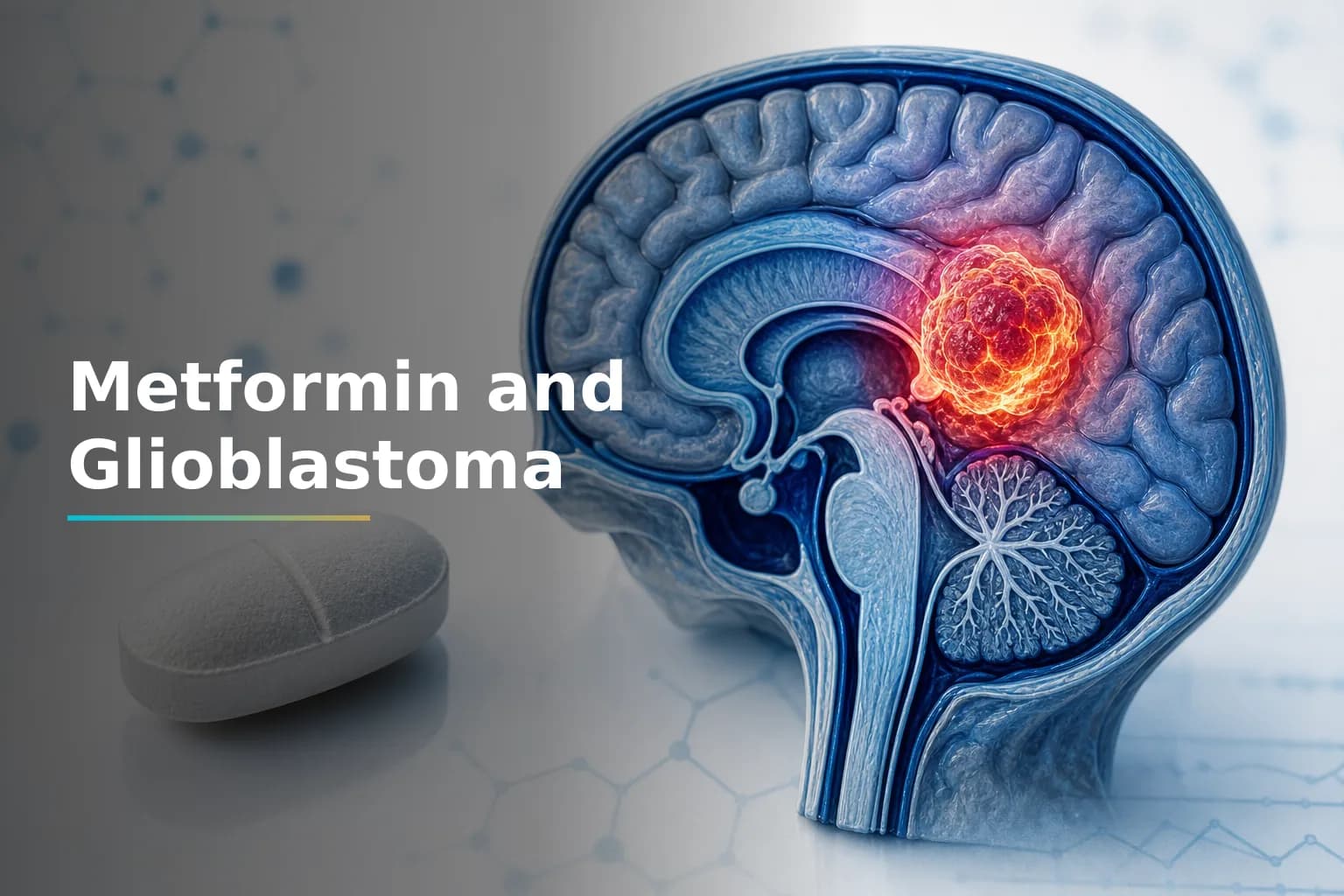
Why Researchers Are Looking at an Old Diabetes Drug for GBM
Metformin is one of the most widely prescribed medications in the world. Doctors have used it to manage type 2 diabetes for more than 60 years. It is inexpensive, well-studied, and has a long safety record.
So why are neuro-oncology researchers interested in it for glioblastoma (GBM)?
The short answer: GBM cells share key metabolic weaknesses with other cancers, and metformin appears to target several of those weaknesses. This overlap has made metformin one of the most actively studied repurposed drugs in brain tumor research. Drug repurposing means taking a medication already approved for one condition and testing it against another — a strategy that can shorten the path to clinical use because the safety profile is already established.
This article explains how metformin works against tumor cells, what clinical trials have found so far, where the research still has gaps, and what questions are worth raising with your oncology team. It does not recommend that anyone take metformin outside of a supervised clinical setting.
For broader context on how metabolic pathways factor into GBM treatment, see our overview of evidence-based integrative and adjunct therapies for glioblastoma.
What Is Metformin, and How Does It Work in the Body?
Metformin belongs to a drug class called biguanides. In diabetes, it works mainly by reducing the amount of glucose the liver releases into the bloodstream. This lowers blood sugar without causing dangerously low glucose levels on its own.
At the cellular level, the picture is more complex. Research published in PMC shows that metformin disrupts the mitochondrial electron transport chain at complex I, which reduces ATP production and raises the ratio of AMP to ATP inside cells. This energy stress activates a protein called AMPK — AMP-activated protein kinase — a central sensor that tells cells to slow down energy-hungry processes like growth and division.
When AMPK switches on, it suppresses mTOR (mammalian target of rapamycin), a key driver of tumor cell growth. Studies reviewed in PubMed confirm that AMPK activation inhibits mTORC1, reducing cell growth, angiogenesis (new blood vessel formation), and the Warburg effect — the tendency of cancer cells to use glucose in a fast but inefficient way — while also triggering programmed cell death.
Why GBM Cells May Be Especially Vulnerable
Glioblastoma is heavily dependent on glucose metabolism. It relies on the Warburg effect to fuel rapid growth and invasion. That dependence may create a specific vulnerability to drugs that disrupt energy supply.
Several mechanisms have been identified in the lab:
- Targeting glioma stem cells (GSCs). GSCs are a subpopulation of tumor cells that resist chemotherapy and radiation and are thought to drive recurrence. A 2024 review in the International Journal of Molecular Sciences found that metformin blocks the LKB1/AMPK/mTOR/S6K1 pathway, causing selective cell death in GSCs and inhibiting the growth of CD133+ cells — a marker of stemness — while having minimal impact on differentiated glioblastoma cells and normal human stem cells.
- Inducing differentiation. Research published in Cancers (2022) showed that metformin can push stem-like glioma-initiating cells toward a more mature cell state and suppress tumor formation through AMPK-FOXO3 activation, making those aggressive cells less dangerous.
- Reducing angiogenesis. GBM is marked by abnormal, excessive blood vessel growth that feeds the tumor. A review in Frontiers in Anti-Cancer Drug Discovery found that metformin has shown antitumoral activity against angiogenic mechanisms, making it a candidate add-on therapy to cut off the tumor's blood supply.
- Overcoming temozolomide resistance. One of the biggest challenges in GBM is that tumors often stop responding to temozolomide (TMZ), the standard chemotherapy. Preclinical studies suggest metformin may help restore sensitivity. Combined treatment with TMZ and metformin synergistically inhibited cell growth and triggered cell death in both glioma cells and GSCs, and also significantly reduced gliosphere formation — a lab measure of stem cell activity — across multiple cell models.
- Crossing the blood-brain barrier. Many potential brain tumor drugs fail because they cannot cross the blood-brain barrier in meaningful amounts. Research has shown that metformin can cross this barrier and accumulate in brain tissue, which is a practical advantage for any CNS drug candidate.
These mechanisms overlap with the metabolic principles behind ketogenic diet research. For a deeper look at the Warburg effect and energy restriction in GBM, our article on the ketogenic diet and glioblastoma metabolic therapy covers that in detail.
What Do Clinical Trials Show?
Preclinical results — in cell cultures and animal models — have been consistently encouraging. The harder question is whether those results translate to meaningful benefit in human patients. Here is where the evidence stands today.
The KNOG-1501 Phase II Trial (Recurrent GBM)
The KNOG-1501 study, published in 2023, was the first randomized, prospective, multicenter, double-blind, controlled phase II trial to test metformin in patients with recurrent or refractory GBM. Patients received either low-dose temozolomide alone or low-dose temozolomide combined with escalating doses of metformin. The trial enrolled 81 patients across twelve hospitals in Korea and used progression-free survival as its primary endpoint. This design provides some of the most reliable human-level data available in this area.
Phase I/II Study in Newly Diagnosed GBM (Japan)
Researchers at the National Cancer Center Japan and the University of Tokyo conducted a dose-escalation phase I study adding metformin to standard maintenance temozolomide for newly diagnosed GBM patients who had already completed concurrent radiation and chemotherapy. No dose-limiting toxicities were observed. The most common side effects were appetite loss, nausea, and diarrhea, all described as manageable. Based on these findings, the study advanced to a phase II trial to formally test whether metformin improves progression-free survival rates 12 months after surgery.
A 2025 update was presented at the American Society of Clinical Oncology (ASCO) Annual Meeting, confirming that this combination is still under investigation. The phase II arm remains ongoing, targeting cancer stem and initiating cells as a way to overcome treatment resistance.
Metformin Plus Simvastatin (Observational Data)
A 2023 study published in eBioMedicine (a Lancet journal) looked at metformin and simvastatin — a common statin — both alone and together in GBM cell models and in a retrospective cohort of 85 patients. The combination appeared to affect multiple cancer-related signaling pathways. Because both drugs already have established safety profiles, the researchers noted that this combination could be tested in patients without introducing many unknowns about side effects.
The Overall Landscape
A comprehensive database review found over 221 cancer-related metformin clinical trials registered on ClinicalTrials.gov, most involving combination therapy with surgery, radiation, or chemotherapy. GBM-specific trials are a subset of this group. The research is genuinely active, but most GBM-specific trials are still in phases I and II, which means they are designed mainly to confirm safety and look for early signs of benefit. Large, definitive phase III trials in GBM have not yet been completed.
The MGMT Connection: Does Your Molecular Profile Matter?
One of the most important factors in GBM treatment is MGMT promoter methylation status. MGMT is a DNA repair enzyme. When the gene's promoter is methylated (switched off), tumor cells cannot repair the DNA damage caused by temozolomide as well, making the drug more lethal to cancer cells. Patients with MGMT methylation generally respond better to TMZ.
Research suggests that variability in metformin's effects may depend on genetic differences such as MGMT promoter methylation status, which points toward a personalized treatment approach. Preclinical work also shows that metformin may be especially useful in TMZ-resistant models — including tumors with unmethylated MGMT — because it can boost TMZ's effect in resistant cell lines. This suggests potential value where standard therapy tends to fall short, though clinical proof is still needed.
To understand how MGMT status and other molecular markers affect your treatment options, see our detailed guide on understanding your GBM molecular profile: IDH, MGMT, EGFR, and why they matter. For the specific challenge of MGMT-unmethylated GBM, our article on paxalisib and the MGMT unmethylated problem covers another emerging strategy.
Safety Profile: What to Know
Metformin has one of the most thoroughly studied safety records of any drug in clinical medicine. Studies have confirmed that it is generally well tolerated in non-diabetic patients, with few serious adverse effects.
The most commonly reported side effects in GBM trials and general non-diabetic use are gastrointestinal: nausea, diarrhea, appetite loss, and mild abdominal discomfort. These effects are usually self-limited and manageable. Rare but more serious concerns include:
- Lactic acidosis. A rare metabolic complication most likely to occur in people with significant kidney impairment. Kidney function must be monitored before and during use.
- Vitamin B12 deficiency. Long-term use can reduce B12 absorption. Levels should be checked periodically.
- Drug interactions. Patients on corticosteroids — commonly used in GBM to reduce brain swelling — should note that steroids can raise blood sugar, which may interact with metformin's glucose-lowering effects.
- Renal contraindications. Metformin is contraindicated in patients with severely impaired kidney function.
At standard doses, metformin does not typically cause hypoglycemia (dangerously low blood sugar) on its own in non-diabetic patients — an important safety distinction from some other diabetes medications.
Key Open Questions
Several important questions remain unanswered:
- What is the optimal dose for anti-tumor effect in humans? Lab studies often use concentrations higher than standard clinical doses. The relationship between dose and anti-cancer benefit in human patients is still being defined.
- Which patients are most likely to benefit? Molecular subtype, MGMT status, IDH status, and baseline metabolic health may all influence response. Identifying the right patient population is an active area of research.
- How does it perform in large randomized trials? Most GBM-specific trials to date have been small or observational. Phase III evidence — the gold standard for proving a treatment works — is still lacking.
- What is the best combination partner? TMZ is the most-studied partner, but combinations with radiation, bevacizumab, statins, or immunotherapies are also being explored.
How This Fits Into a Precision Oncology Strategy
Metformin is a clear example of the drug repurposing approach that has gained traction in neuro-oncology. The rationale is straightforward: GBM relies on metabolic pathways for survival, metformin targets those same pathways, and its known safety record means it can be added to existing regimens without introducing unknown toxicity risks.
For patients already taking metformin for diabetes, whether continued use might also carry tumor-related benefit is worth discussing with your care team. For patients without diabetes, metformin is not a standard-of-care treatment for GBM — it remains investigational — but clinical trial enrollment may be an option.
If you are researching off-label and repurposed drugs being studied in GBM, our article on tamoxifen and glioblastoma covers another widely used medication being tested for brain tumor applications.
When to Talk to Your Doctor
Bring up metformin with your neuro-oncologist if:
- You have type 2 diabetes and are currently taking metformin — your oncologist should know this and factor it into your treatment plan.
- You want to know whether any open clinical trials testing metformin in GBM are accepting enrollment. Search ClinicalTrials.gov for active GBM + metformin trials.
- You have concerns about how your metabolic health — blood sugar regulation, insulin resistance — may be affecting your tumor biology or treatment response.
- You have read about metformin in a patient forum or advocacy group and want to know whether it is relevant to your specific molecular profile.
Do not add metformin to your regimen without your oncologist's supervision. It requires kidney function monitoring, can interact with other medications, and the right dose in the context of GBM treatment has not been standardized outside of clinical trials.
This article is for general information and is not a substitute for medical advice. Always consult your oncologist or care team about your specific situation.