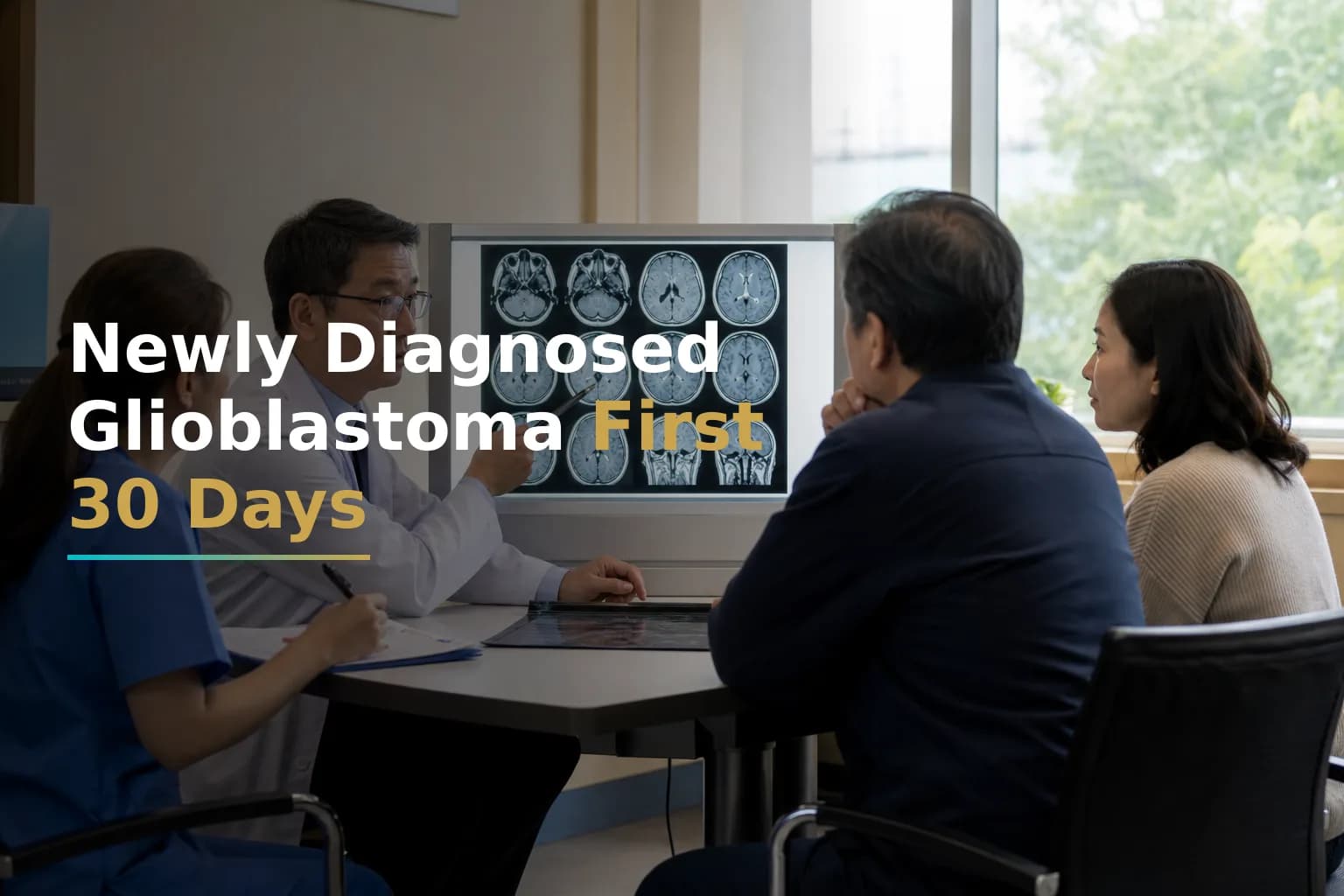
The First Hours: Absorbing the Diagnosis
A glioblastoma (GBM) diagnosis is one of the most disorienting moments a person can face. The American Brain Tumor Association (ABTA) notes that being told you have glioblastoma can feel shocking, and it is normal to leave that first appointment with more questions than answers. This guide offers a clear map of what the first 30 days usually look like — the clinical steps, the decisions, and the questions worth asking — so you can move forward with purpose rather than paralysis.
GBM is the most common malignant primary brain tumor in adults. According to the UCSF Brain Tumor Center, between 2017 and 2021 physicians diagnosed an average of 13,073 cases per year in the United States, with a median age at diagnosis of 65 years. Knowing what is about to happen — and why each step matters — is one of the most practical things you can do right now.
Days 1–7: Confirming the Diagnosis
In most cases, GBM is first suspected after an MRI scan shows a mass in the brain. The ABTA explains that an MRI alone cannot confirm a diagnosis. Other conditions — including strokes, infections, and different tumor types — can look similar on imaging. A biopsy or surgical resection is required to confirm the tissue diagnosis and run the molecular tests that will guide your treatment.
A neuropathologist examines the tumor tissue under a microscope and answers several key questions:
- What type of tumor is this, and what is its WHO grade?
- Are there signs of rapid cell growth or blood vessel formation (necrosis and microvascular proliferation)?
- What genetic mutations does the tumor carry, and how do those affect prognosis and treatment options?
The American Association of Neurological Surgeons (AANS) notes that next-generation sequencing can help profile brain tumors to improve diagnostic accuracy, identify treatment targets, and predict prognosis. This is not extra testing — it is essential information that shapes everything that follows.
One important point: most newly diagnosed patients, even those with GBM, are not facing a surgical emergency that must happen within 24 hours. You usually have enough time — days, not months — to think clearly, ask questions, and seek a second opinion before committing to a course of action.
The Case for a Second Opinion (and a Specialized Center)
GBM is one of the most complex brain tumors to treat. Getting a second opinion from an experienced neuro-oncology center is a reasonable and widely supported step. The ABTA states that a second opinion may introduce you to treatment options or clinical trials you were not aware of. Most physicians support this decision.
Where you receive your first surgery may matter more than you realize. MD Anderson Cancer Center's neurosurgical team has shown that removing as much of the tumor as safely possible — known as maximal safe resection — during the first surgery is associated with better outcomes. Choosing a hospital and surgeon with experience in GBM-specific resection is one of the highest-impact decisions you can make early on.
Days 7–14: Surgery and Maximal Safe Resection
Surgery is usually the first active treatment step. According to the ABTA, surgery lets the medical team confirm the diagnosis, relieve pressure on the brain, and remove as much tumor as safely possible. Because GBM has finger-like extensions that grow into surrounding brain tissue, complete removal is rarely achievable. Microscopic cells almost always remain.
Modern surgical techniques — including awake craniotomy with intraoperative brain mapping, fluorescence-guided surgery, and intraoperative MRI — help surgeons maximize tumor removal while protecting areas that control language, movement, and memory. Ask your neurosurgeon which tools they routinely use and what their approach would be given your tumor's location.
After surgery, you will spend time in the hospital recovering, typically a few days to a week depending on the complexity of the procedure and your overall health. There is also a waiting period before radiation can begin. According to a 2020 consensus review by the Society for Neuro-Oncology (SNO) and the European Society for Neuro-Oncology (EANO), external beam radiation therapy typically requires a wait of 3–5 weeks after tumor resection to allow for wound healing and recovery.
Days 10–21: Molecular Profiling — The Test Results That Matter Most
While you recover from surgery, your care team will be analyzing the tumor tissue at a molecular level. These results are not routine lab work — they are the biological fingerprint of your specific tumor, and they directly influence which treatments may work best for you.
The two most clinically important markers right now are:
- MGMT promoter methylation. Research published in PMC/NIH shows that MGMT methylation status is linked to improved survival and sensitivity to the chemotherapy drug temozolomide (TMZ), and has become part of routine clinical practice for newly diagnosed GBM. When the MGMT gene is "silenced" by methylation, the tumor has a harder time repairing the DNA damage caused by TMZ, making chemotherapy more effective. MGMT is methylated in roughly 50% of newly diagnosed GBM cases.
- IDH mutation status. Glioblastoma is now formally classified as IDH-wildtype (the large majority of cases) or IDH-mutant. IDH-mutant tumors — found in a smaller subset of patients — tend to behave differently and carry a more favorable prognosis. The World Health Organization now classifies brain tumors primarily based on molecular features like IDH status, reflecting how central these markers are to understanding your diagnosis.
Additional markers — including EGFR amplification, TERT promoter mutation, and chromosome 7/10 alterations — may also appear in your pathology report. This molecular profile is the foundation of precision oncology for GBM. For more on what these results mean, see our guide: Understanding Your GBM Molecular Profile: IDH, MGMT, EGFR & Why They Matter.
Days 14–30: Building Your Care Team
Treating GBM requires a coordinated team, not a single doctor. The ABTA recommends a team that typically includes a neurosurgeon, a neuro-oncologist, a radiation oncologist, nurses, and other specialists who work together to plan and manage your care throughout treatment.
Here is what each member broadly contributes:
- Neurosurgeon: Performs or oversees the resection and interprets surgical imaging.
- Neuro-oncologist: The central specialist who coordinates your overall treatment plan, including chemotherapy and clinical trial eligibility.
- Radiation oncologist: Plans and delivers the radiation component of chemoradiation.
- Neuropathologist: Interprets the tissue and molecular results.
- Neuropsychologist / Rehabilitation specialist: Assesses and supports cognitive function, which may be affected by both the tumor and its treatment.
- Social worker / Patient navigator: Helps with logistics, financial assistance, and emotional support resources.
It is reasonable to ask any specialist how many GBM cases they see each year, and whether a multidisciplinary tumor board will formally review your case. Tumor board reviews — where multiple specialists discuss a single patient's case together — are standard at major cancer centers and can surface options that one physician might not raise alone.
Days 21–30: Understanding Standard-of-Care Treatment
Once you have recovered sufficiently from surgery and your molecular results are back, the formal treatment phase begins. The current standard of care for newly diagnosed GBM in fit adults is well established. A foundational review published in PubMed describes it as maximal safe tumor resection followed by concurrent external-beam radiation with daily low-dose temozolomide, then 6 to 12 months of adjuvant temozolomide.
In practical terms, the chemoradiation phase looks like this:
- Radiation is typically delivered 5 days per week for 6 weeks — 30 treatment sessions in total.
- Oral temozolomide (TMZ) is taken daily throughout the radiation period.
- Weekly blood tests monitor for potential side effects, particularly changes in blood cell counts.
- After a short break, adjuvant TMZ continues in monthly cycles, typically for six cycles.
Tumor Treating Fields (TTFields) — a non-invasive device therapy that uses low-intensity alternating electric fields to disrupt tumor cell division — may also be discussed as an addition to maintenance TMZ. The Phase III EF-14 trial in newly diagnosed GBM showed significantly improved progression-free and overall survival when TTFields were combined with maintenance TMZ compared to TMZ alone. Ask your neuro-oncologist whether TTFields are appropriate for your situation.
Treatment is not identical for everyone. Age, functional status, and molecular profile all shape which approach is recommended. Older patients or those with lower functional status may receive a modified, shorter radiation schedule. MGMT-methylated patients may have additional options to discuss. Your neuro-oncologist will tailor the plan to your specific situation.
Clinical Trials: Start Looking Now, Not Later
The first 30 days are also the right time to look into clinical trials — not because you need to rush, but because some trials are only open to newly diagnosed patients who have not yet started standard treatment, and eligibility windows can close quickly.
Clinical trials test combinations of standard therapy with investigational drugs, immunotherapies, targeted agents, and device therapies. For patients interested in immunotherapy approaches, see our overview: The Immunotherapy Landscape in GBM: Beyond Checkpoint Inhibitors. For patients curious about cellular therapies, our guide CAR-T Cell Therapy for GBM: What Patients Need to Know in 2026 covers what is available and where trials currently stand.
You can search open trials at ClinicalTrials.gov by entering "glioblastoma" and your location. The National Brain Tumor Society (braintumor.org) and the ABTA (abta.org) also offer trial-matching resources and patient navigators who can help you sort through options.
Practical Logistics: Don't Underestimate the Preparation Phase
Before chemoradiation begins, several practical preparations are worth thinking about:
- Transportation: Daily radiation for 6 weeks means daily trips to the treatment center. Arrange reliable transport early — fatigue and potential driving restrictions can make this harder than expected.
- Work and leave planning: Many patients reduce or pause work during chemoradiation. Understand your options for medical leave, disability, and financial assistance programs.
- Medication management: Corticosteroids (such as dexamethasone) are often prescribed to reduce brain swelling after surgery and during treatment. Understand what you are taking, why, and when the plan is to taper the dose.
- Seizure precautions: Some GBM patients experience seizures as a presenting symptom or during treatment. Ask your team whether anti-seizure medication is appropriate for you. For a related discussion on a drug that may serve both purposes, see our article on Valproic Acid and Glioblastoma.
- Caregiver support: The treatment period is demanding for family members as well. Identifying who will help with daily care, meals, and appointments before treatment starts reduces crisis moments later. Caregiver wellbeing matters, too; see our piece on Caregiver Burnout During Glioblastoma Treatment.
- Advance care planning: Discussing advance directives and healthcare proxies early — while you are well and thinking clearly — is a practical act of self-advocacy, not a statement of defeat.
Integrative and Complementary Strategies
Some patients and families ask early on about complementary approaches — metabolic interventions, specific supplements, dietary changes, or off-label drugs — that might work alongside standard treatment. These are valid questions, and research in integrative oncology for GBM is active.
The key principle is that no integrative strategy should replace the proven components of standard-of-care treatment (surgery, chemoradiation, and appropriate adjuvant therapy). Some approaches may be worth exploring as additions to standard treatment — always in coordination with your care team. For a thorough look at the current evidence, see our guide: Integrative Treatments for Glioblastoma: Evidence-Based Complementary Therapies That May Help.
When to Call Your Doctor
Contact your care team promptly if you experience any of the following in the first 30 days:
- New or worsening headaches, especially in the morning or with nausea
- A seizure, or a change in seizure pattern if you have already had one
- Sudden changes in speech, vision, strength, or coordination
- Signs of infection around any surgical incision (redness, warmth, drainage, fever)
- Significant mood changes, confusion, or memory problems
- Side effects from new medications, including corticosteroids
Also talk to your doctor before changing your diet, starting supplements, or stopping any prescribed medications. What is safe in one patient's situation may not be appropriate in yours.
This article is for general information and is not a substitute for medical advice. Always consult your oncologist or care team about your specific situation.