
Key Takeaways
- Tamoxifen, widely known as a breast cancer drug, is being studied for glioblastoma — a promising example of drug repurposing that could expand treatment options.
- In glioblastoma, tamoxifen works through a completely different mechanism — at higher doses, it targets PKC (protein kinase C), a growth-signaling enzyme that glioblastoma cells rely on heavily.
- The drug is generally well-tolerated with mild side effects, making it a meaningful option worth discussing with your care team, especially for recurrent disease.
- Whether tamoxifen may be relevant to your specific tumor depends on certain molecular characteristics — and there are ways to find out.
- A Phase 2 clinical trial (NCT04765098) is currently recruiting patients with recurrent glioblastoma, and newer research on endoxifen (tamoxifen's more potent active form) is opening exciting new doors.
Why Is a Breast Cancer Drug Being Studied for Glioblastoma?
If you've come across tamoxifen in your research, your first reaction might be: "Isn't that a breast cancer drug?" You're right — and the fact that it's being explored for glioblastoma is actually encouraging news.
Drug repurposing — using an existing, well-studied medication for a new condition — is one of the most promising approaches in cancer research right now. Because tamoxifen has been used safely for decades, researchers already know a great deal about how it behaves in the body, its side effects, and how patients tolerate it. That head start means it can move through the research process faster than a brand-new drug developed from scratch.
What caught researchers' attention is that at higher doses, tamoxifen appears to work through an entirely different mechanism than it does in breast cancer — one that directly targets the pathways glioblastoma cells depend on to grow and survive.
How Tamoxifen Works Against Glioblastoma: The Basics
In breast cancer, tamoxifen works by blocking estrogen receptors. But in glioblastoma, something quite different — and fascinating — is happening.
At higher doses, tamoxifen acts as a powerful inhibitor of protein kinase C (PKC) — think of PKC as a family of enzymes that act like "go" signals for cell growth and survival. In glioblastoma, these go signals are often turned up much higher than normal, which is part of what makes the tumor grow so aggressively. By blocking PKC, tamoxifen essentially turns down one of the key switches glioblastoma uses to fuel itself.
But that's not the only thing tamoxifen does. Research has shown it can also trigger autophagy in glioblastoma cells — a process where the cancer cells essentially start breaking down their own internal components, which can lead to cell death. Additionally, tamoxifen may make glioblastoma cells more sensitive to other treatments. Laboratory studies have found that when combined with temozolomide — the standard chemotherapy for glioblastoma — the two drugs work together to produce a stronger effect than either one alone.
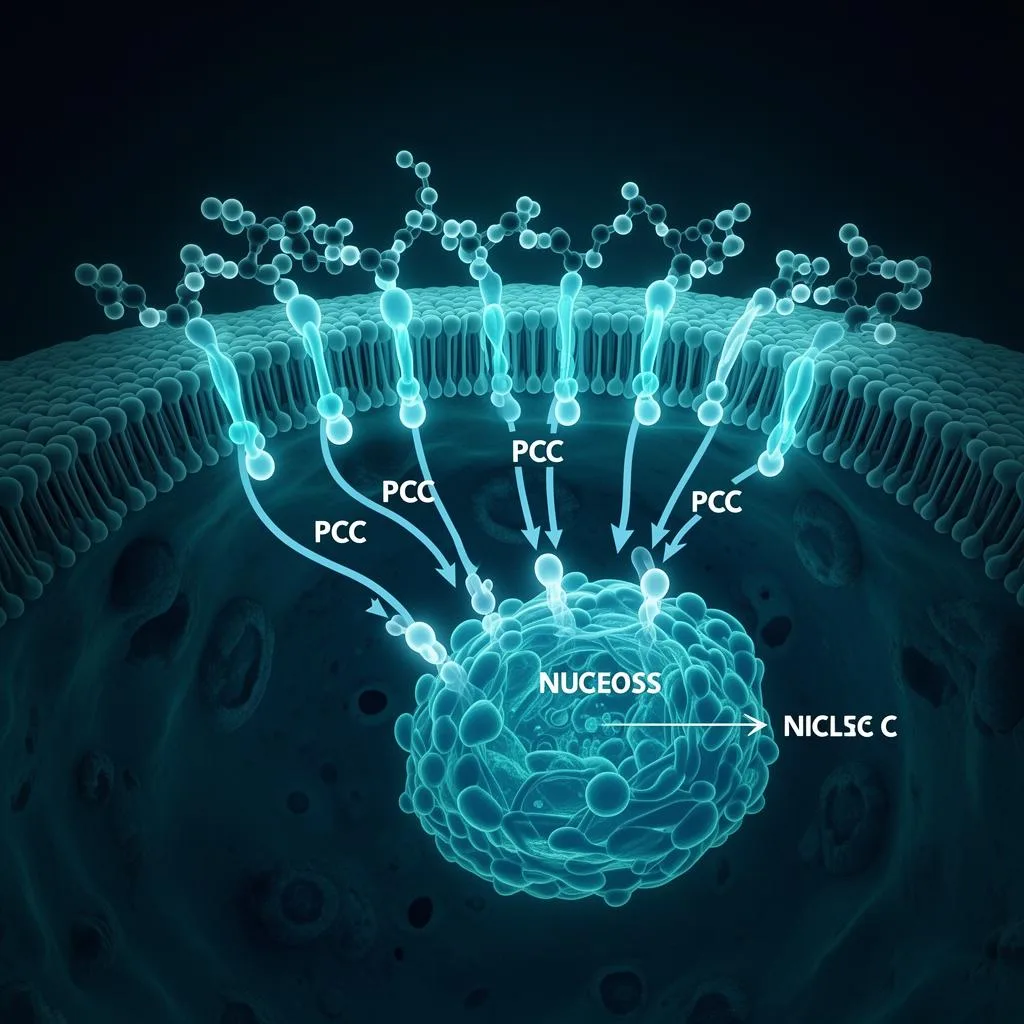
Molecular Pathways: How Tamoxifen Connects to Glioblastoma Biology
This section goes deeper into the science for those who want to understand the molecular details. If you'd prefer the practical takeaways, feel free to skip ahead.
| Mechanism | Role | Details |
|---|---|---|
| The PKC Pathway | Primary mechanism | Tamoxifen → blocks PKC → disrupts calcium signaling → impairs downstream growth pathways → glioblastoma cells lose key survival signals. PKC is a family of enzymes that relay growth signals inside cells. In glioblastoma, PKC activity is commonly elevated. Tamoxifen specifically inhibits PKC-iota (PKC-ι), activating pro-apoptotic pathways (BAD protein) and disrupting cell cycle progression (CDK7 dephosphorylation) — pushing cells toward death. |
| The EGFR Connection | Growth receptor degradation | Tamoxifen → accelerates EGFR degradation → glioblastoma loses a key growth receptor. EGFR is amplified in roughly 50–60% of glioblastomas. Tamoxifen can speed up EGFR degradation through disruption of calcium signaling, causing tumor cells to lose one of their primary growth signal antennas. |
| Autophagy & TMZ Synergy | Multiple attack angles | Tamoxifen pushes glioblastoma cells into cytotoxic autophagy — self-digestion so extensive that cells can't survive it. This is independent from PKC inhibition, providing a second attack vector. When combined with temozolomide, the two drugs produce synergistic PKC-pan inhibition, shutting down growth pathways more effectively than either drug alone. |
| Radiosensitization | Lab finding, mixed clinical data | Laboratory studies showed tamoxifen-mediated PKC-ι inhibition increased radiosensitivity in glioma cells. However, the RTOG BR-0021 clinical trial did not confirm this in patients — a reminder that bench-to-bedside translation is always complex. |
Is This Relevant to My Cancer? A Step-by-Step Guide
Not all glioblastomas are identical at the molecular level. Understanding your tumor's characteristics can help you and your care team make more informed decisions about whether tamoxifen is worth considering.

- PKC Overexpression — What it is: PKC is the primary target tamoxifen acts on in glioblastoma. If your tumor has elevated PKC activity, tamoxifen has a direct mechanism to disrupt it. The test: PKC expression can be measured through immunohistochemistry (IHC) — a standard pathology staining technique. You likely already have stored tumor tissue (paraffin block) from your surgery or biopsy. How to get it done: Ask your neuro-oncologist: "Could we run immunohistochemistry on my stored tumor tissue to check PKC expression levels?" If your hospital doesn't offer this, request a referral to an academic neuro-oncology center — your tissue can be shipped for analysis. If PKC is elevated: Your tumor may be more susceptible to tamoxifen's mechanism. If not elevated: Tamoxifen may still have value through its other mechanisms (EGFR degradation, autophagy).
- EGFR Amplification or Overexpression — What it is: EGFR is one of the most commonly altered genes in glioblastoma (~50–60% show amplification). Tamoxifen can accelerate EGFR degradation, making tumors with high EGFR expression potentially more susceptible. Good news: You may already have this information. EGFR is one of the most commonly tested markers in glioblastoma. Check your pathology report for "EGFR amplified," "EGFR overexpressed," or "EGFRvIII." If EGFR is amplified: Tamoxifen's ability to accelerate EGFR degradation could be particularly relevant, and this also opens up other EGFR-targeted options.
- Comprehensive Genomic Profiling — For the most complete picture of your tumor's molecular landscape, comprehensive genomic profiling analyzes hundreds of genes simultaneously — covering PKC-pathway genes, EGFR, PI3K/AKT/mTOR, and many others. Major providers: Foundation Medicine (FoundationOne CDx), Tempus xT, and Caris Life Sciences (MI Profile). Any oncologist can order these tests using your stored tumor tissue. Results typically return in 2–3 weeks. Insurance: Most major insurers cover comprehensive genomic profiling for cancer patients. Foundation Medicine's patient support line: 1-888-988-3639.
Reading Between the Lines: Indirect Clues
- EGFR amplification as a proxy for PKC activation: EGFR signaling and the PKC pathway are closely linked — when EGFR is activated, it triggers a cascade that includes PKC activation downstream. If your tumor shows EGFR amplification, there's a reasonable scientific basis to think PKC pathway activity may also be elevated.
- PTEN loss: Found in ~30–40% of glioblastomas. PTEN normally brakes the PI3K/AKT pathway. When it's lost, the interconnected PKC signaling tends to be more active.
- Tumor subtype: The classical subtype (strongly associated with EGFR amplification) and the mesenchymal subtype (high inflammatory signaling) both involve PKC family members.
What the Clinical Research Shows
In an early case series, researchers observed treatment responses in 4 out of 20 glioblastoma patients receiving high-dose tamoxifen (160 to 200 mg per day) — an early signal that tamoxifen could have activity against glioblastoma.
A Phase I clinical trial established that the combination of temozolomide and tamoxifen with radiation therapy could be tolerated safely in high-grade glioma patients.
The RTOG BR-0021 Phase 2 trial tested high-dose tamoxifen (80 mg/m² daily) combined with radiation therapy in newly diagnosed glioblastoma. While the combination was well-tolerated, it did not improve survival beyond standard treatment. Importantly, this trial tested tamoxifen with radiation alone, before temozolomide became standard — so the question of tamoxifen combined with today's standard treatment hasn't been fully answered.
For recurrent disease, a retrospective study found tamoxifen was well-tolerated but most patients (~80%) eventually progressed. However, some patients experienced meaningful periods of disease stability — in a setting where options are limited, disease stabilization can have real value.

Endoxifen: The Next Generation
One of the most exciting recent developments is research into endoxifen — the active metabolite that tamoxifen is converted into inside the body. Endoxifen is significantly more potent than tamoxifen itself.
A 2025 study in Scientific Reports used both computational modeling and laboratory experiments to evaluate endoxifen specifically for glioblastoma, with promising results that suggest this more potent form could lead to more effective and targeted treatments in the future.
Active Clinical Trial
Tamoxifen Versus Etoposide After First Recurrence in GBM (NCT04765098)
This Phase 2 randomized controlled trial at the Cross Cancer Institute in Edmonton, Alberta (Canada) is comparing tamoxifen directly to etoposide for patients experiencing their first glioblastoma recurrence. Currently recruiting, expected to complete in 2027.
Measuring: 3-month progression-free survival (primary), plus overall survival, quality of life, and side effects.
Who may be eligible: Adults aged 18–65 with confirmed glioblastoma progressed after first-line TMZ and radiation, with good functional status (ECOG 0–2).
Questions to Bring to Your Oncologist
- Ask about EGFR status — Does my pathology report include EGFR status? If so, does my tumor show EGFR amplification?
- Request PKC testing — Could we run immunohistochemistry on my stored tumor tissue to check PKC expression levels? If our hospital doesn't do this, could we send the tissue to an academic center?
- Discuss comprehensive genomic profiling — Has my tumor had FoundationOne or Tempus profiling? If not, would you recommend it to guide treatment decisions?
- Explore tamoxifen relevance — Based on my tumor's molecular profile, is tamoxifen something we should discuss — either standalone or in combination with other treatments?
- Check trial eligibility — Am I eligible for the Phase 2 trial comparing tamoxifen to etoposide for recurrent glioblastoma (NCT04765098)?
- Consider a second opinion — Would a remote second opinion from a neuro-oncology center be helpful for reviewing my molecular results and treatment options?
Looking Ahead
The story of tamoxifen in glioblastoma is still being written — and there's genuine reason for optimism about where it's heading. While tamoxifen hasn't emerged as a standalone breakthrough, the deepening understanding of how it connects to glioblastoma's molecular pathways is opening new doors. The endoxifen research is particularly encouraging, and the ongoing clinical trial will give us important real-world data about tamoxifen's value in recurrent disease.
You are not alone in navigating these decisions. The fact that you're researching your options and asking these questions is a powerful step. There is a growing community of researchers, clinicians, and fellow patients working toward better outcomes — and every new finding adds to the foundation of progress.
References
- Evaluation of (Z)-endoxifen as a potential therapy for glioblastoma multiforme. Scientific Reports, 2025. Nature
- Tamoxifen Induces Cytotoxic Autophagy in Glioblastoma. PMC
- Phase 2 trial of radiation plus high-dose tamoxifen for GBM: RTOG BR-0021. PMC
- Tamoxifen + temozolomide synergistic PKC-pan inhibition in GBM cells. Biochimica et Biophysica Acta. ScienceDirect
- Radiosensitization of human glioma cells by tamoxifen via PKC-ι inhibition. Oncology Letters. PubMed
- Tamoxifen for Recurrent High-Grade Glioma: Retrospective Study. Scholars Direct
- Phase I Trial: Temozolomide and Tamoxifen With Radiotherapy for High-Grade Glioma. ScienceDirect
- Tamoxifen vs Etoposide After First Recurrence in GBM (NCT04765098). ClinicalTrials.gov
- Tamoxifen inhibits PKC and sensitises glioblastoma cells. PubMed
This content is for informational purposes only and should not replace professional medical advice. Always consult with your healthcare team about your specific situation. Clinical trial availability and eligibility criteria change frequently.