Why Your Molecular Profile Matters: The Short Version
When your neuro-oncologist mentions PTEN loss or PI3K/AKT/mTOR pathway activation, they are describing one of the most common and consequential molecular events in high-grade glioma. This alteration shapes how your tumor behaves, why certain treatments may work less well, and which clinical trials you may qualify for.
This article explains the biology in plain language, reviews what research says about prognosis and resistance, and surveys current targeted therapies and trials. It applies to both glioblastoma (WHO grade IV) and anaplastic astrocytoma (WHO grade III), which can both carry this alteration.
What Is PTEN, and What Does "Loss" Actually Mean?
PTEN — short for Phosphatase and Tensin Homolog — is a tumor suppressor gene on chromosome 10q23. In healthy tissue, it acts as a molecular brake on cell growth and survival signals. It does this by converting a signaling molecule called PIP3 back into PIP2, which keeps the AKT kinase switched off.
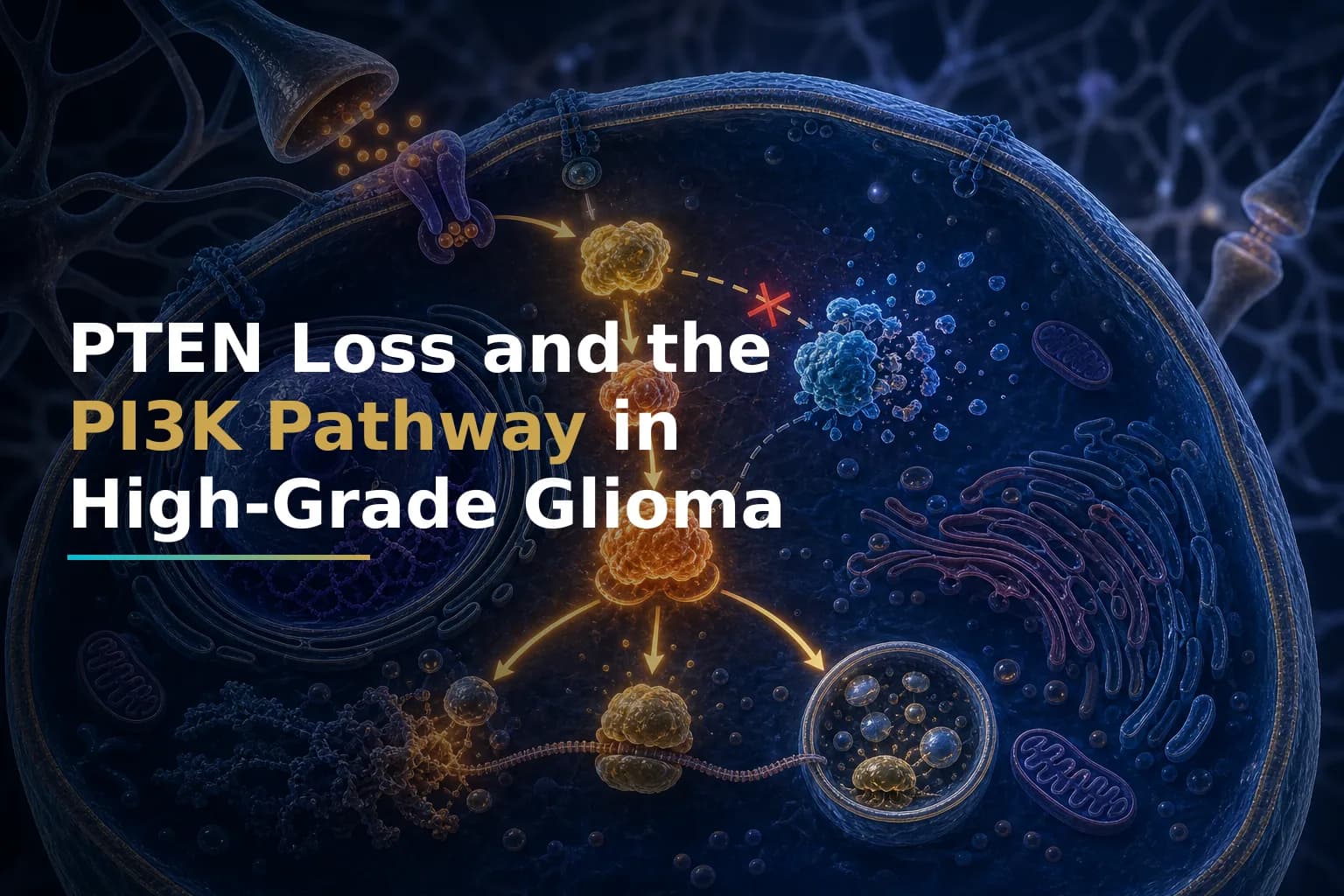
When PTEN is lost — through gene deletion, point mutation, promoter methylation, or other silencing mechanisms — that brake is removed. Research published in PMC explains that PTEN loss raises PIP3 levels and increases activation of the kinases PDK1 and AKT, while also disabling normal regulation of mTORC2. The result is that the entire PI3K/AKT/mTOR signaling axis runs in a near-constant "on" state.
"Loss" can happen in several ways. The gene itself may be deleted from the chromosome (loss of heterozygosity), the protein may carry a disabling point mutation, or the gene promoter may be silenced by methylation. In some tumors, PTEN protein is present but mislocated away from the cell membrane, making it functionally inactive even without a genetic change. Each mechanism produces the same downstream result: an unchecked PI3K pathway driving tumor cell growth, survival, invasion, and blood vessel formation.
How Common Is This Alteration in High-Grade Glioma?
PTEN disruption is one of the most frequent molecular events in glioblastoma and anaplastic astrocytoma. A genomic analysis in Frontiers in Oncology found PTEN significantly altered in 30–40% of GBMs, and when all PI3K pathway disruptions are counted together, roughly 50% of GBMs show somatic alterations somewhere in this signaling axis.
In anaplastic astrocytoma, PTEN mutations are less common than in GBM but still clinically meaningful. A sequencing study published in PMC found PTEN mutations in roughly 23% of anaplastic astrocytomas and 36% of GBMs. Notably, PTEN mutations appeared exclusively in high-grade gliomas, not in lower-grade tumors, suggesting this alteration marks more aggressive disease. A separate comprehensive genomic study found PTEN alterations in up to 60% of high-grade glioma tumors when broader disruption mechanisms were included.
These numbers matter for your clinical team. Knowing your PTEN status — from next-generation sequencing (NGS) or immunohistochemistry (IHC) — provides actionable information about which therapeutic strategies may be most relevant to your tumor.
What Does This Pathway Actually Do Inside Your Tumor?
Think of the PI3K/AKT/mTOR pathway as a command system for cell growth. When it fires normally — triggered by growth factor receptors such as EGFR on the cell surface — it tells the cell to grow, divide, make new proteins, and resist programmed death. Once the signal is delivered, PTEN turns the system off.
When PTEN is lost, that system cannot turn off. A review in PMC describes how PTEN loss increases AKT activity, which then triggers mTOR activity, "thus stimulating cell proliferation and survival." This drives rapid cell division, resistance to cell death (apoptosis), increased tumor invasion, metabolic changes that fuel growth, and new blood vessel formation.
mTOR — the pathway's downstream master regulator — controls protein synthesis and cell metabolism through two distinct complexes called mTORC1 and mTORC2. This two-node structure matters when considering why early mTOR inhibitors often failed as single agents: blocking one complex could paradoxically activate the other through feedback loops.
There is also a meaningful connection to EGFR. EGFR amplification and PTEN loss frequently occur together in GBM, and PTEN loss can effectively bypass any therapy aimed at blocking EGFR upstream — because the pathway stays active regardless of what happens at the receptor level. If you have EGFR alterations alongside PTEN loss, see our related article on EGFRvIII and EGFR Amplification in Glioblastoma, which explains how these two alterations interact therapeutically.
What PTEN Loss Means for Prognosis
The prognostic picture with PTEN loss depends partly on tumor grade and IDH mutation status. In glioblastoma, the evidence is mixed: some studies find no independent survival impact, while others point to worse outcomes, particularly in specific subgroups.
In anaplastic gliomas — including anaplastic astrocytoma — the signal is somewhat clearer. Research on PTEN in malignant gliomas found that "in anaplastic oligodendrogliomas and astrocytomas there was a positive correlation between PTEN alterations and poor prognosis," and that elevated AKT activity has been associated with poor prognosis across glioma types.
A meta-analysis cited in multiple genomics studies found PTEN mutations strongly associated with shorter survival in glioma patients overall. A comprehensive genomic profiling study noted that both TERT promoter mutation and PTEN deletion were independent markers of poor prognosis in IDH-wildtype glioblastoma. For context on how TERT mutations fit into this picture, see our article on TERT Promoter Mutation in Glioblastoma.
Prognosis should not be read in isolation. PTEN status interacts with IDH mutation status, MGMT methylation, 1p/19q codeletion, and other alterations. A PTEN-deficient tumor that is IDH-mutant carries a different outlook than one that is IDH-wildtype. This is why comprehensive molecular profiling matters more than any single marker when building a treatment strategy. For more on how these markers fit together, see Understanding Your GBM Molecular Profile: IDH, MGMT, EGFR, and Why They Matter.
Treatment Resistance: Why PTEN Loss Makes Therapies Harder
The most clinically urgent implication of PTEN loss is its contribution to treatment resistance. Research has identified several specific resistance mechanisms tied to this alteration.
- Temozolomide resistance. PTEN loss promotes pro-survival signaling that can blunt the DNA damage response temozolomide depends on. PTEN-deficient tumors show increased proliferation that can outpace chemotherapy-induced cell death.
- Radiation resistance. Studies have found that PTEN-mediated phosphorylation events contribute to radioresistance in glioma, meaning radiation may be less effective at triggering cell death in PTEN-deficient tumors.
- EGFR inhibitor resistance. Because PTEN loss decouples the downstream pathway from upstream receptor control, EGFR-targeting drugs often show poor effectiveness when PTEN is absent. Clinical trials of erlotinib and gefitinib in GBM illustrated this: even when EGFR was successfully inhibited, downstream targets remained active.
- Anti-PD-1 immunotherapy resistance. PTEN loss has been linked to changes in the tumor immune microenvironment. Research has found that GBM patients with PTEN mutations show no significant response to anti-PD-1 immunotherapy, likely because PTEN loss alters PD-L1 expression and limits immune cell infiltration into the tumor.
- Bevacizumab resistance. A study found that patients with PTEN-negative GBM have shorter survival after starting bevacizumab than those with PTEN-positive GBM. PTEN loss in tumor cells promotes expression of VEGFR-2, which may drive resistance to anti-angiogenic therapy. For more on bevacizumab and its limits, see Bevacizumab for Recurrent Glioblastoma.
- PI3K inhibitor resistance. PTEN loss can itself cause resistance to PI3Kα inhibitors through a process called "convergent loss" — alternative genomic events accumulate that keep the pathway active even when PI3K is blocked.
This broad resistance profile is why PTEN-deficient tumors are being studied as a distinct therapeutic subgroup, and why combination strategies — rather than single-agent therapy — are the focus of most current trials.
Current and Emerging Therapeutic Strategies
Given the complexity of PTEN-driven resistance, the field has moved toward layered strategies that block the pathway at multiple points, or combine PI3K/mTOR inhibition with immunotherapy, standard chemotherapy, or radiation.
Dual PI3K/mTOR Inhibitors
Early trials of rapalogue mTOR inhibitors such as temsirolimus and everolimus — which block only mTORC1 — were largely disappointing in GBM. A key problem: blocking mTORC1 alone can activate a feedback loop that re-engages AKT through mTORC2, effectively counteracting treatment. This drove development of dual PI3K/mTOR inhibitors that block both arms of the pathway at once.
The most clinically advanced agent is paxalisib (formerly GDC-0084), a blood-brain barrier-penetrant dual PI3K/mTOR inhibitor. The FDA has granted a Type C meeting to discuss potential pathways to register paxalisib as a treatment for newly diagnosed glioblastoma, following results from the GBM AGILE platform trial (NCT03970447) showing a clinically meaningful improvement in overall survival in patients with unmethylated MGMT promoter status. Paxalisib has also received FDA Fast Track designation for GBM. Our detailed article on Paxalisib and the MGMT Unmethylated Problem covers this drug's development and trial data in depth.
Biomarker-Selected Trials
One important shift in this field is the move toward molecularly selected trial enrollment — trials that specifically require PTEN loss or PI3K pathway mutations as an entry criterion, rather than enrolling all GBM patients. This design is more likely to identify real benefit in the subgroup whose tumor biology actually depends on the targeted pathway.
One example is the 5G-PEARL trial (NCT07391215), a Bayesian adaptive Phase 1/2 trial of paxalisib combined with temozolomide for malignant brain tumors. The trial specifically enrolls patients whose tumors carry either hyperactivating PI3K mutations in PIK3CA or PIK3R1, or PTEN loss defined as biallelic loss or loss-of-heterozygosity plus a loss-of-function mutation — the populations where pathway dependence is highest.
If you have documented PTEN loss or a PIK3CA/PIK3R1 mutation on your molecular report, a biomarker-selected trial may be a more precise match than a broad unselected study. Searching ClinicalTrials.gov using "PTEN glioblastoma" or "PI3K mTOR glioma" filtered to your tumor type and grade is a useful starting point.
Combination Approaches
Because PTEN-deficient tumors use multiple resistance mechanisms at once, single-agent PI3K or mTOR inhibition has generally been insufficient. Current research is focused on combinations including:
- PI3K/mTOR inhibitors paired with temozolomide, targeting both metabolic and DNA-damage resistance
- PI3K inhibitors combined with EGFR inhibitors, to block both the receptor upstream and the active pathway downstream
- PI3K inhibitors combined with immunotherapy checkpoint blockade, aiming to reverse the immunosuppressive tumor environment created by PTEN loss
- PI3K pathway inhibitors combined with anti-angiogenic agents, given PTEN loss's role in VEGFR-2 upregulation and angiogenic resistance
The blood-brain barrier remains a significant obstacle. Many early-generation PI3K inhibitors did not reach adequate concentrations within brain tumor tissue. Newer agents, including paxalisib, were specifically engineered for brain penetration — a design requirement now considered essential for CNS-relevant PI3K inhibitors.
Integrative and Metabolic Considerations
The PI3K/AKT/mTOR pathway is closely tied to tumor metabolism. mTOR regulates protein synthesis and glucose metabolism, and its activation in PTEN-deficient tumors reinforces the Warburg effect — the tendency of tumor cells to rely on glucose through glycolysis even when oxygen is available. This metabolic dependency has drawn research interest in metabolic approaches as potential adjuncts. The ketogenic diet, for example, aims to reduce glucose availability and may theoretically complement PI3K/mTOR-targeted approaches, though clinical evidence in this specific molecular subgroup remains limited. You can review the current evidence in our article on The Ketogenic Diet and Glioblastoma.
Any integrative strategy should be discussed with and coordinated through your oncology team. No integrative or metabolic approach should replace standard-of-care treatment.
How to Use This Information Strategically
If PTEN loss or PI3K pathway activation appears in your molecular report, here are the most clinically actionable steps to consider discussing with your care team:
- Confirm your full molecular profile. PTEN loss does not exist in isolation. Your IDH status, MGMT methylation, EGFR status, and TERT promoter status all affect how PTEN loss influences your prognosis and treatment options. Ask for comprehensive NGS if you have not had it.
- Ask about clinical trial eligibility. Biomarker-selected trials for PTEN loss or PI3K pathway activation are actively enrolling. Eligibility often depends on documentation of the specific type of PTEN alteration — mutation, deletion, or expression loss by IHC — and tumor grade.
- Discuss resistance implications before starting therapy. If your tumor is PTEN-deficient, your oncologist may want to account for potential EGFR inhibitor or immunotherapy resistance when designing your overall treatment plan.
- Seek neuro-oncology review at a center with molecular tumor board capability. The overlap between PTEN loss and other co-occurring alterations is complex enough that a multidisciplinary molecular tumor board review often uncovers options a single-clinician review might miss.
When to Talk to Your Doctor
Talk to your neuro-oncologist promptly if your pathology or molecular report mentions PTEN loss, PTEN deletion, PI3K pathway activation, or AKT/mTOR hyperactivation and you have not yet discussed what this means for your treatment plan. Ask specifically whether biomarker-selected PI3K or mTOR-targeted clinical trials are available to you, and whether your current or planned treatment accounts for resistance mechanisms related to PTEN status. If you are at recurrence, ask whether PTEN status was re-tested on recurrent tissue — tumors can acquire new PTEN alterations at progression that were not present at initial diagnosis.
This article is for general information and is not a substitute for medical advice. Always consult your oncologist or care team about your specific situation.