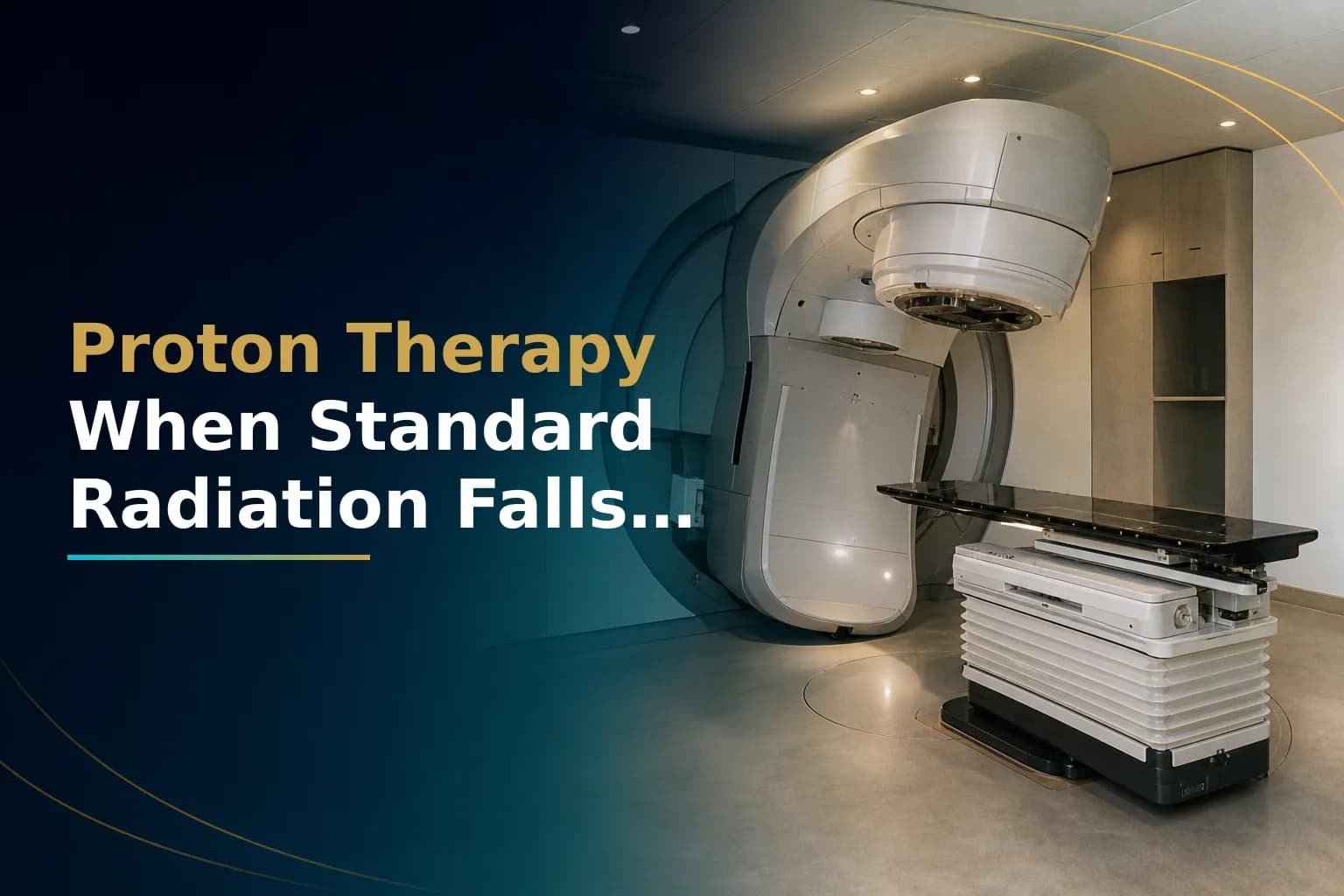
Proton Therapy for Glioblastoma: When It's Indicated, How It Differs from Standard Radiation, and Whether Travel for Treatment Is Worth It
Proton therapy is not standard for glioblastoma. Most newly diagnosed GBM patients get intensity-modulated radiation therapy (IMRT) with photons as part of the Stupp protocol, which remains the standard first-line care. But proton therapy does have a role in specific situations: when tumors are near critical brain structures, for re-irradiation of recurrent disease, and in some clinical trials. If you're weighing this option, the decision should rest on what proton treatment actually does differently, what evidence currently supports it, and whether traveling for it makes sense for your case.
What Makes Proton Therapy Physically Different from Standard Radiation?
Standard IMRT uses X-ray photons - packets of energy that travel through the body. They deliver radiation along their entire path and continue out the other side. That exit dose - radiation that reaches healthy brain tissue beyond the tumor - cannot be eliminated. It can only be shaped and minimized.
Proton therapy works on different physics. Protons are heavy charged particles. As they travel through tissue, they slow gradually and release most of their energy at a precise depth - a phenomenon called the Bragg peak. At that point, energy release peaks sharply and then stops. There is virtually no exit dose beyond the tumor. For a brain tumor near the hippocampus (memory center), the brainstem, or the optic chiasm (vision pathways), that physical difference can matter.
A 2025 review of 15 published studies on proton beam therapy in glioma management found that this advantage produces measurable reductions in radiation dose to nearby healthy brain structures compared with photon-based techniques, with comparable tumor control rates in some settings. (NIH/PMC - Proton Beam Therapy in Glioma Management, 2025)
How Does Proton Therapy Compare to Standard IMRT for Glioblastoma?
| Factor | Proton Therapy | Standard IMRT (Photon) |
|---|---|---|
| How radiation reaches the tumor | Proton particles stop at a defined depth (Bragg peak); virtually no exit dose beyond the target | X-ray photons pass through the body; radiation is deposited along the full beam path, including an exit dose |
| Dose to surrounding healthy brain | Lower total dose; reduced low-dose radiation to uninvolved tissue | Higher dose to tissue beyond the tumor; unavoidable low-dose exposure to a wider brain volume |
| Evidence base in GBM | Growing; strongest for re-irradiation at recurrence and in ongoing clinical trials | Decades of data; current standard of care in the first-line Stupp protocol |
| Typical first-line course length | Similar number of sessions to IMRT; shorter re-irradiation courses possible for recurrent disease | Standard 6-week course; shortened protocols used in elderly and poor-performance-status patients |
| Global availability | Limited centers, concentrated in the US, Europe, and Japan; expanding in Asia and the Middle East | Available at most cancer centers worldwide |
| Cost and insurance coverage | Substantially higher than photon radiation; variable coverage; significant travel and lodging costs for international patients | Lower cost; broadly covered by national health systems and most private insurers |
Sources: NIH/PMC - High-dose proton beam therapy vs. conventional radiation for newly diagnosed GBM, 2023; American Brain Tumor Association - Proton Therapy Guide; National Brain Tumor Society - Treatment Options
The core difference is physics, not tumor biology. Both proton therapy and IMRT kill glioblastoma cells by damaging their DNA - both work the same way against the tumor. The difference is where the radiation goes. That matters most when the tumor is close to structures that cannot tolerate much radiation, or when a patient has already had one radiation course and total brain dose is a concern.
When Is Proton Therapy Actually Indicated for GBM?
Radiation oncologists consider proton therapy in specific scenarios - not for every newly diagnosed GBM patient.
Tumors Near Critical Brain Structures
When a glioblastoma grows close to the optic pathways, brainstem, hippocampus, or speech areas, reducing the low-dose radiation that standard photon treatment delivers to those structures may reduce cognitive and functional side effects. Proton plans consistently show lower dose to uninvolved brain compared with IMRT plans for the same tumor target. The American Brain Tumor Association notes that proton therapy is particularly considered for tumors in vital brain structures where normal tissue sparing is a priority.
Re-irradiation for Recurrent GBM
This is where evidence for proton therapy in glioblastoma is strongest. When a tumor comes back after initial radiation, a second course must stay within the brain's cumulative radiation tolerance. Proton re-irradiation can deliver a meaningful dose to the recurrent tumor while keeping total dose to surrounding tissue lower than a second photon course would achieve.
A prospective study of 143 patients with recurrent malignant glioma who received proton re-irradiation across multiple institutions found a median progression-free survival of 8.1 months and overall survival of 11.2 months from the time of re-irradiation. Acute grade 3 toxicity occurred in 7% of patients and late grade 3 toxicity in 4%. (NIH/PMC - Proton Therapy Reirradiation for Recurrent Malignant Glioma, 2025) A separate analysis from the Proton Collaborative Group Registry of recurrent GBM patients reached similar conclusions about tolerability and efficacy compared with historical photon-based re-irradiation data. (NIH/PMC - Recurrent GBM Proton Reirradiation Registry Analysis, 2020)
These findings come from registry data, not randomized trials. Read them as encouraging signals rather than definitive proof. They are consistent across multiple institutions and suggest that proton re-irradiation is a viable option worth discussing with a radiation oncologist who has specific experience in recurrent GBM.
If you are weighing re-irradiation alongside other salvage strategies, the Recurrent Glioblastoma Salvage Options guide covers how proton re-irradiation fits alongside bevacizumab, re-surgery, and clinical trials.
Elderly Patients and Abbreviated Radiation Courses
A clinical trial at Mayo Clinic is investigating short-course hypofractionated proton therapy for patients aged 65 and older with newly diagnosed GBM. The protocol uses advanced imaging including 18F-DOPA PET to define the tumor target - aiming to deliver an effective but shorter radiation course with reduced cognitive impact compared with a full photon course. (Mayo Clinic News Network) Results are not yet published, but the scientific rationale rests on what is known about cumulative brain dose and neurocognitive function in older patients.
For a broader look at how age shapes radiation decisions in GBM, the article on how age changes GBM treatment strategy covers both standard and abbreviated radiation approaches by age group.
Pediatric and Young Adult High-Grade Glioma
For younger patients where decades of cognitive function are at stake, minimizing low-dose radiation to developing or young brain structures carries more weight. Proton therapy is more commonly considered in pediatric high-grade glioma than in adult GBM for this reason. The same reasoning applies to young adults where preserving long-term function is a central goal of treatment, not just tumor control.
What the Evidence Does Not Yet Tell Us
The key question - does proton therapy extend survival for GBM patients compared with standard IMRT - has not been answered by a large randomized controlled trial. A prospective trial (NCT01854554) comparing proton and photon radiation for newly diagnosed GBM has been underway, and a related trial (BN005) completed enrollment in early 2024. Those results will carry significant weight once published.
Until that data matures, proton therapy's dosimetric advantage is well documented. Whether it translates into longer survival or meaningfully better quality of life for GBM - a disease where the tumor itself is the dominant driver of decline - remains under investigation. Proton therapy is not a proven survival benefit over IMRT in GBM today. It is a tool for reducing collateral radiation damage in situations where that reduction is clinically meaningful for your specific tumor location and history.
Is Traveling for Proton Therapy Worth It?
For many patients and caregivers, this is the hardest question - and the most personal. A few factors help clarify the decision.
First: ask for a dosimetric comparison before you book anything. Have a proton center and your local center both create treatment plans for your tumor. Compare what dose each critical structure receives under each plan. If the proton plan offers only marginal additional sparing for your particular tumor size and location, the case for travel weakens. If the difference is clinically significant - particularly for structures next to your tumor - the physical rationale becomes real, not just theoretical.
Second: consider the duration. A first-line proton course for GBM involves a similar number of daily sessions to standard IMRT - roughly six weeks of weekday treatment. That means six weeks away from home for international patients. Re-irradiation courses for recurrent GBM are often shorter, typically two to three weeks. The logistics of a two-week treatment trip are very different from a six-week stay - particularly if you are supporting a patient who is also managing fatigue and steroid side effects.
Third: account for the full costs. Research on patients referred internationally for proton therapy shows substantial out-of-pocket burden from accommodation, meals, and transportation over a multi-week treatment course - costs that sit on top of the treatment fee itself. Those numbers belong in your planning from the start, not as a late surprise.
Fourth: check whether proton therapy is closer than you expect. Centers have expanded across Asia in recent years, including in India. Parts of the Middle East are also developing proton capacity. The gap between no center near home and the nearest accessible center may be smaller now than a few years ago.
If you are an international patient trying to clarify whether the proton advantage is real for your tumor's anatomy before committing to travel, you can arrange a remote second opinion through Art of Healing Cancer - a clinical review of your imaging and pathology can tell you whether proton therapy is genuinely the right step for your case before any logistics decisions are made.
For a practical look at coordinating care across countries - transferring records, managing remote follow-up, and maintaining continuity between a local team and an international center - the Traveling for Glioblastoma Treatment: A Multi-Country Guide covers those logistics in detail.
Questions to Ask Your Radiation Oncologist Before Deciding
- Can we run a dosimetric comparison between a proton plan and an IMRT plan for my specific tumor? What does each plan show for my hippocampus, brainstem, and optic structures?
- Is my tumor's location one where proton therapy typically achieves meaningful tissue sparing over IMRT, or is the difference likely to be marginal for my case?
- If this is re-irradiation: how many fractions would the proton course be, and which centers have relevant experience in recurrent GBM specifically?
- Are there open clinical trials comparing proton and photon radiation for GBM that I may be eligible for?
- What is this center's annual proton case volume for high-grade glioma?
If you would like an independent review of your imaging and pathology reports before choosing a radiation approach, you can share your case through the Glioblastoma Center patient journey form to request a remote expert review.
When to Talk to Your Doctor
Raise proton therapy with your radiation oncologist if your tumor is close to the optic pathways, brainstem, or hippocampus; if re-irradiation is being discussed for a recurrence; or if you are in an elderly patient protocol where a shortened course is a clinical priority. Ask specifically for a dosimetric comparison before making a final decision - the plan generated for your tumor is what matters, not proton therapy in the abstract. Do not assume your current center cannot refer you to or coordinate with a proton unit; many academic cancer centers have referral pathways even without an on-site machine.
This article is for general information and is not a substitute for medical advice. Always consult your oncologist or care team about your specific situation.