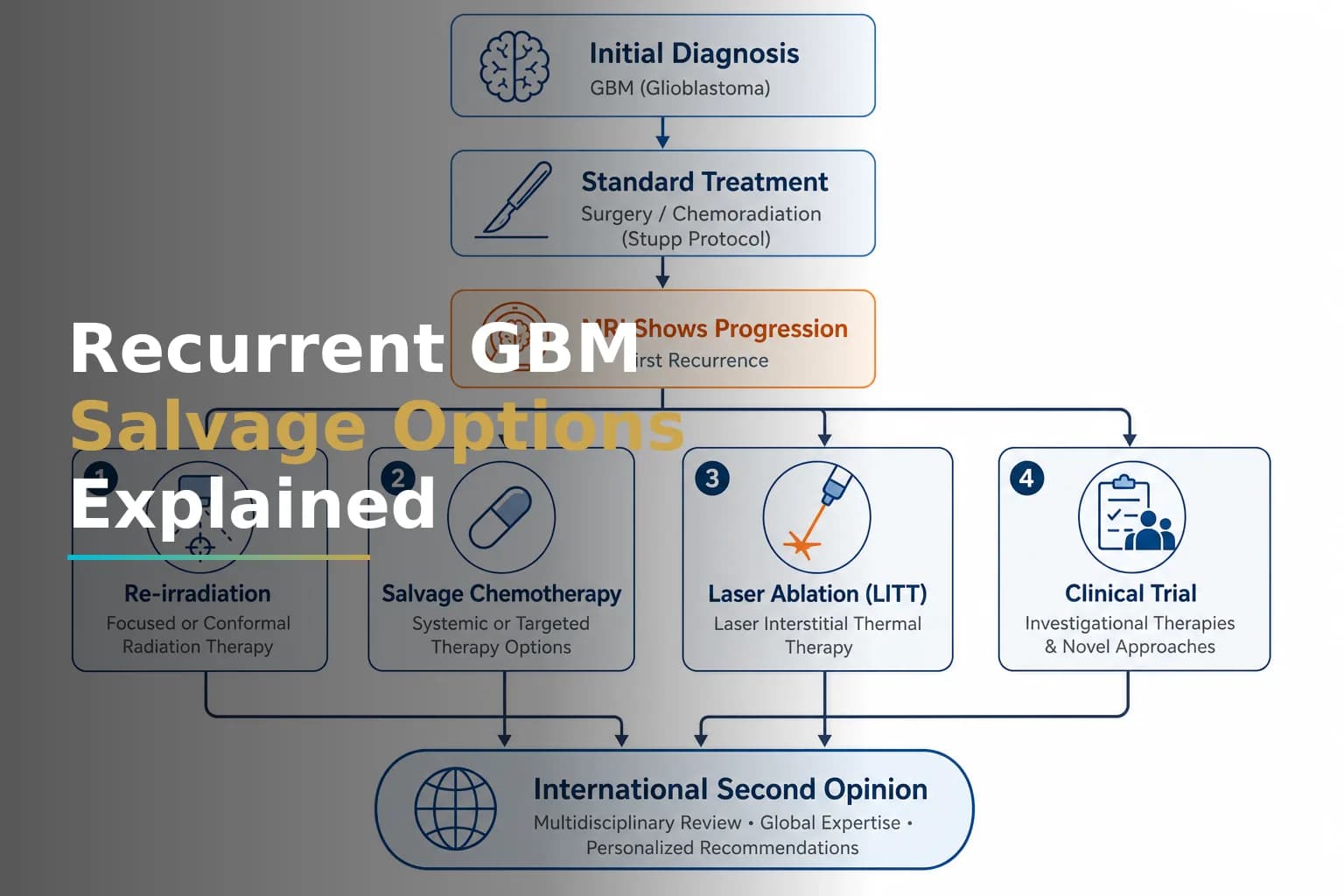
Recurrent Glioblastoma Salvage Options: What You Can Try After First-Line Treatment Fails
What Are the Main Salvage Options for Recurrent Glioblastoma?
When glioblastoma grows back after first-line treatment, the main options include repeat surgery, laser ablation (LITT), re-irradiation, chemotherapy agents such as lomustine or temozolomide rechallenge, bevacizumab, Tumor Treating Fields, and clinical trials. No single approach fits every patient. Molecular re-testing and an expert second opinion can help identify which path is most likely to benefit you.
How Is GBM Recurrence Confirmed?
Most glioblastomas grow back. A comprehensive review published in PMC notes that GBM usually recurs, typically within months of completing the standard surgery, radiation, and chemotherapy. When it does, the disease tends to behave more aggressively than at first diagnosis.
Recurrence is not always straightforward to confirm on imaging. A new MRI showing an enlarged enhancing area can reflect true tumor regrowth, but it can also reflect pseudo-progression - a pattern where tissue looks worse on imaging because it is responding to prior treatment rather than growing. Confirming true recurrence usually requires repeat imaging over several weeks, advanced MRI techniques such as perfusion MRI or MR spectroscopy, and sometimes a repeat biopsy.
This distinction matters clinically. Starting salvage therapy for what turns out to be pseudo-progression can expose you to unnecessary side effects and delay a correct assessment. Once true recurrence is confirmed, the next decisions are among the most important your family will face. It is worth taking time to understand all your options before deciding on a treatment direction.
Surgical Options at Recurrence: Repeat Resection and LITT
Repeat surgery is considered when the tumor is accessible, the patient is in adequate neurological condition, and removing meaningful tissue is feasible. Not every recurrence is operable. Tumor location, involvement of critical brain structures, and overall health all factor into whether surgery offers a real benefit at this stage.
For tumors in hard-to-reach locations, Laser Interstitial Thermal Therapy (LITT) is a minimally invasive alternative. A thin laser fiber is guided to the tumor through a small burr hole in the skull, and heat destroys tumor tissue while real-time MRI monitors the effect. A study published in PMC found a median post-procedure survival of approximately 8.97 months for recurrent IDH wild-type glioblastoma patients treated with LITT, with better outcomes in patients who had MGMT promoter methylation and received adjuvant chemotherapy within 12 weeks of the procedure. LITT is not available at every center, but it is worth asking about if open re-resection is not feasible for your case.
Re-irradiation: A Second Course of Radiation
Re-irradiation - delivering a second course of radiation to tissue that has already been treated - is an option for some patients at recurrence. It carries real risks, including radiation necrosis (cumulative damage to healthy brain tissue from repeated radiation exposure), so patient selection is careful and deliberate.
Modern techniques such as stereotactic radiosurgery (SRS) and hypofractionated stereotactic radiotherapy can target small recurrent tumors with precision, limiting dose to surrounding brain tissue. A 2024 pattern-of-care analysis published in PMC confirmed that re-irradiation is used with increasing frequency in recurrent GBM, though patient selection remains critical. Tumor size, time elapsed since first radiation, and the proximity of the recurrence to sensitive brain structures all factor into the decision. Re-irradiation is sometimes combined with bevacizumab to help manage radiation-related brain swelling during and after treatment.
Chemotherapy and Targeted Agents at Recurrence
Several systemic agents are used when GBM grows back. None has consistently demonstrated large overall survival gains in randomized trials, but each may offer a period of disease control in selected patients:
Lomustine (CCNU): An oral alkylating agent and one of the most studied chemotherapies in recurrent GBM. It is often used alone or in combination with bevacizumab.
Temozolomide rechallenge: Some patients who responded well to temozolomide during initial treatment are re-treated with it at recurrence, particularly after a significant interval has passed. MGMT promoter methylation status - a genetic marker on the tumor - influences the likelihood of benefit from rechallenge.
Bevacizumab (Avastin): A monoclonal antibody that blocks VEGF, a protein tumors use to build new blood vessels. Bevacizumab is FDA-approved for recurrent GBM and can reduce tumor-related brain swelling rapidly, often improving neurological symptoms within days. A network meta-analysis published in PMC found that bevacizumab combined with lomustine may improve progression-free survival compared with lomustine alone, though overall survival differences were modest. Bevacizumab also changes MRI appearances in ways that can complicate recurrence monitoring over time.
Regorafenib: An oral drug that blocks multiple signaling pathways tumor cells use to grow and survive. It has shown a survival signal in some studies and is now included in certain recurrent GBM treatment guidelines as an option worth discussing.
The most appropriate choice depends on your prior treatments, your tumor's current molecular profile, your neurological status, and your oncologist's experience with each agent. These are not interchangeable - each has a different side-effect profile and a different evidence base.
Tumor Treating Fields at Recurrence
Tumor Treating Fields (TTFields), delivered through a wearable scalp device called Optune Gio, are approved for use in recurrent GBM. The device generates alternating electric fields that may interfere with tumor-cell division without the systemic side effects of chemotherapy. TTFields can be continued from initial treatment or started fresh alongside other salvage therapies. For a detailed explanation of how the technology works and what daily life with the device involves, see our guide on Tumor Treating Fields (Optune) for Glioblastoma.
Is a Clinical Trial the Right Next Step at Recurrence?
Many neuro-oncologists consider clinical trial enrollment one of the most important options at recurrence. Standard salvage therapies offer limited overall survival benefit, and trials test approaches that may alter outcomes in ways standard drugs currently cannot. Research areas actively under investigation include:
Immune checkpoint inhibitors: Drugs that release immune-system brakes and allow the body's T-cells to recognize and attack tumor cells. A phase II trial on ClinicalTrials.gov evaluated pembrolizumab in recurrent GBM. Results across the checkpoint-inhibitor field in GBM have been mixed, but researchers are working to identify molecular subgroups - based on tumor mutation burden and other markers - that may respond.
CAR-T cell therapy and cancer vaccines: Approaches that train or modify the patient's immune cells to recognize specific GBM proteins. Early-phase trials are enrolling at major academic centers, and eligibility criteria are highly specific.
Combination strategies: Trials pairing TTFields with checkpoint inhibitors, or combining oncolytic viruses (viruses engineered to infect and destroy tumor cells) with immunotherapy, are among the designs currently under study.
To understand which immunotherapy trials might match your tumor's molecular profile, our article on Immunotherapy for Recurrent Glioblastoma: How Molecular Profiling Determines Checkpoint Inhibitor and CAR-T Cell Therapy Candidacy explains the key biomarkers and eligibility factors in detail. You can search open trials at ClinicalTrials.gov, and the National Brain Tumor Society maintains curated trial listings for GBM patients updated multiple times a year.
Why Molecular Re-Testing Matters at Recurrence
The tumor at recurrence is often genetically different from the original tumor. Treatment with temozolomide can introduce new mutations, and resistance mechanisms may have developed that were not present at first diagnosis. Your MGMT methylation status, EGFR amplification pattern, PTEN loss, or TERT promoter mutation profile may have shifted. Understanding these changes can reveal new trial eligibilities or targeted-therapy options that were not available when you were first diagnosed.
Drug sensitivity analysis - a laboratory test that exposes a sample of your tumor cells to multiple compounds and measures which ones the cells respond to - is one tool that may help guide decisions about repurposed or off-label agents at recurrence. Our article on Drug Sensitivity Analysis for Recurrent Glioblastoma explains when this testing is most useful, what it can and cannot tell you, and how to access it.
When Should You Seek an International Second Opinion?
Recurrence is frightening, and the pressure to start something quickly is real. But most recurrences allow a short window to gather information before treatment must begin. An international or remote second opinion is worth pursuing if any of these apply:
Your current center has limited experience with salvage GBM cases or a low volume of recurrent brain tumor patients each year.
You have been offered only standard chemotherapy without discussion of clinical trials, re-irradiation, LITT, or molecular re-testing of the recurrent tumor.
Your tumor's molecular profile may suggest a targetable mutation or trial eligibility that your local team has not addressed.
You want independent confirmation that recurrence is real, particularly if pseudo-progression has not been clearly ruled out.
Your family is coordinating care from abroad and cannot easily travel for repeated in-person consultations at a distant center.
Seeking a second opinion at recurrence is standard practice at major cancer centers and does not signal distrust of your current team. When recurrence is confirmed, you can arrange a second opinion before starting the next treatment cycle - sharing your pathology report, latest MRI, and molecular results with a specialist who reviews the case remotely and provides an independent perspective on salvage strategy, trial eligibility, and whether a procedure such as LITT or re-irradiation applies to your situation.
What Records to Gather Before a Second Opinion at Recurrence
A useful second opinion at recurrence requires the right documentation. Prepare this package before reaching out to any specialist or center:
All pathology reports from original diagnosis and any re-biopsy, including molecular markers such as MGMT methylation, IDH status, EGFR, TERT, PTEN, and 1p/19q co-deletion status
MRI scans from initial diagnosis, end of first-line treatment, and the scan that raised concern for recurrence - on disc or via secure digital transfer in DICOM format
A treatment summary covering surgery dates, radiation dose and technique used, chemotherapy regimens and number of cycles, and any TTFields use and duration
Current neurological status and any recent performance-status assessments your care team has documented
A current medication list, including steroids (such as dexamethasone) and anti-seizure drugs
With this package, a remote expert can assess salvage strategy, trial eligibility, and whether specific procedures are appropriate for your case. For a full checklist of what expert reviewers actually need, see our guide on Preparing for Your Tumor Intelligence Review.
When to Talk to Your Doctor
Speak with your neuro-oncologist or care team if a follow-up MRI shows new or enlarging enhancement, if your neurological symptoms are worsening between scans, or if you feel the current salvage plan does not address all your options. Ask specifically about molecular re-testing of the recurrent tumor, clinical trial eligibility at your current stage, and what each proposed salvage therapy realistically aims to achieve - whether that is tumor stabilization, symptom control, or extending progression-free survival.
This article is for general information and is not a substitute for medical advice. Always consult your oncologist or care team about your specific situation.