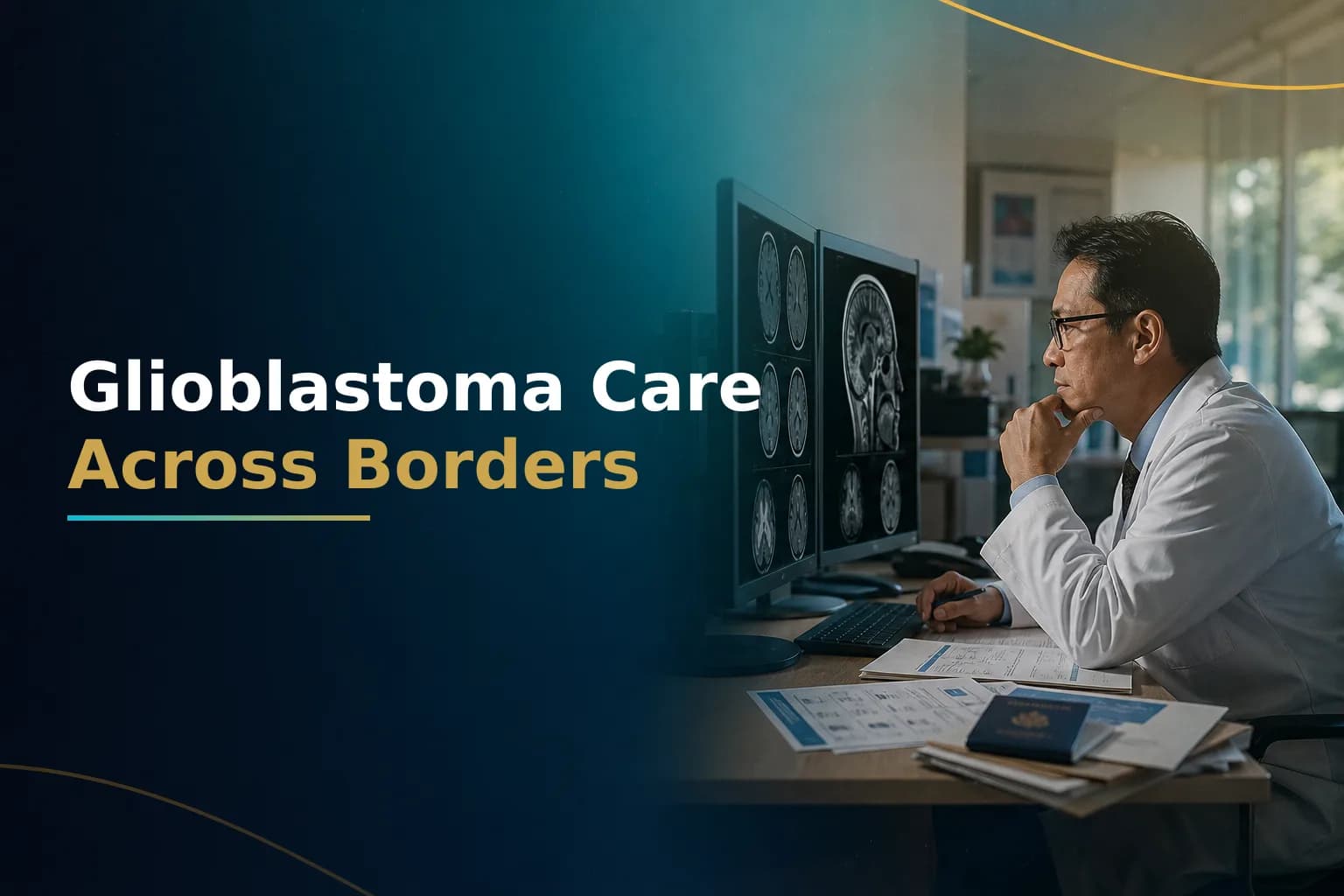
A glioblastoma diagnosis moves fast. Within days of surgery, you face decisions about radiation and chemotherapy. If you want to be treated elsewhere - for access, cost, or other reasons - you might consider traveling for glioblastoma treatment at a specialist center in another country.
This option works for many patients, especially those from countries with limited neuro-oncology services. But it gets complicated. Records may get lost in translation. Scans might arrive in the wrong format. The foreign specialist may not speak to your local oncologist. You can solve these problems if you plan ahead before you travel.
What does traveling for glioblastoma treatment actually mean?
Traveling for glioblastoma treatment means getting part or all of your care at a specialist center in another country. Three common situations exist: full surgery and starting treatment abroad, a specific procedure abroad with follow-up at home, or a remote second opinion from abroad. Each needs different planning, and mixing them up creates gaps in care.
Why patients and families look beyond their home country
Three practical reasons come up most often.
Access to techniques not available locally. Fluorescence-guided surgery using 5-ALA - a dye given before surgery that makes tumor cells glow under blue light - is not uniformly available in all countries. Laser interstitial thermal therapy (LITT), proton radiotherapy, and Tumor Treating Fields devices are similar. If your local hospital does not offer these, traveling to one that does is a good clinical reason.
Cost. For patients in countries where private oncology is expensive or public waiting times are long, treatment in India can cost a fraction of equivalent care in the United States or United Kingdom. Our detailed comparison of glioblastoma treatment costs across the US, India, and Europe covers what is actually included at each price point.
Molecular expertise. Tumor markers like MGMT methylation status and IDH mutation status affect treatment planning. Specialist neuro-oncology centers review more glioblastoma cases and often have better molecular testing than general oncology departments. For patients whose local pathology report is missing these markers, a specialist review can change the treatment plan.
One important note: promises of international treatment sometimes go beyond the evidence. The clearest benefit is access - a technique, clinical trial, or molecular review not available at home. Travel for access makes sense. Travel based on vague promises of better outcomes needs careful thought first.
Build your international care team before you travel
The most common mistake families make is treating the international specialist and the local oncologist as separate. Both need to function as one team, or gaps between visits become dangerous.
Before any trip, establish three things in writing.
A named coordinator at the destination center. This person writes a treatment summary and sends it to your home team when you leave. Major centers like Memorial Sloan Kettering and Dana-Farber have dedicated international patient offices for this. Smaller centers may not. If yours does not, ask: who writes the discharge summary, and in what language?
A named local contact for between-visit management. Usually your home oncologist or a GP with oncology experience. They need to know your full treatment plan before you leave - what medications to continue, what blood tests to monitor, and what symptoms need urgent attention.
A written emergency plan. If you develop a seizure, a severe headache, or signs of infection while abroad, who do you call? Which hospital? Which medication? Write this down before you need it. Patients who travel without this information lose critical time in the worst moments.
What medical records to prepare, and how to format them
Missing or wrongly formatted records are the most common cause of delays when seeking care abroad. Preparing them properly takes a day of work up front and prevents weeks of back-and-forth later.
Most specialist centers need the following:
- MRI scans in DICOM format - the raw digital format, not a printed film or photo. Ask your radiology department for a DICOM export on a USB drive or secure digital transfer. A compressed image won't work for assessing tumor margins or comparing scans over time.
- Full pathology report with molecular markers - specifically MGMT methylation status, IDH mutation status, TERT promoter mutation, and 1p/19q co-deletion if tested. If any marker was not tested, note that clearly - some centers will re-test the original tissue.
- Pathology slides or a tissue block - many neuropathology reviews need the physical glass slides, not just the written report. Coordinate this with your original hospital before traveling. Digital slide uploads are becoming standard and reduce the risk of losing glass slides in transit.
- Operative note from surgery - including how much tumor was removed (gross total, near-total, or partial) and any findings during surgery.
- Full oncology treatment summary - all chemotherapy cycles completed, radiation doses received, and all current medications. If you are taking dexamethasone, a corticosteroid that reduces brain swelling, include the current dose and how long you have been on it - this matters for planning at the new center.
- Recent blood test results - full blood count, liver function, and kidney function, from the time frame required by the treating center.
- English translations of all documents - if your records are in another language, have them professionally translated before sending. Some centers help with this, but it takes time.
For a step-by-step checklist of everything to prepare before a specialist review, see our full records and scans preparation guide.
How remote follow-up works in neuro-oncology
Not every follow-up visit requires a flight. Video consultations work well for stable patients - for symptom review, medication adjustments, and discussing scan results. Initial consultations and visits that need a physical exam typically still need in-person visits.
Remote visits are safe after surgery, especially for patients who travel far. Screen-sharing of MRI images lets the specialist review the scan with the patient in real time - much better than a phone call.
A workable remote follow-up structure looks like this:
- MRI scan performed locally, using the written imaging protocol provided by the treating center before you left
- Local radiologist report available within 48-72 hours
- DICOM files uploaded to the treating center via a secure patient portal
- Video consultation with the specialist neuro-oncologist, who reviews both the local report and the raw scans
- Written summary sent to your local oncologist and GP after each remote session
The weakest link is usually the MRI protocol. A scan taken without the correct sequences cannot be compared to past scans - so you cannot tell if the tumor changed. Before leaving, ask for the MRI protocol in writing. This single document prevents months of confusion later.
Managing the handover when you return home
The switch from international specialist to local team is where patients most often fall through gaps. A formal discharge summary helps but is not enough on its own.
Before leaving, request: a written protocol for home treatment and schedule; enough medication to bridge the gap until your local team can prescribe (some drugs need specialist authority); direct contact for the specialist, not just a clinic inbox; and scheduled remote follow-up visits with specific dates.
Tell your local oncologist before you return home, not after. Send the treatment summary while you are still at the international center so they can ask questions. Many families wait until they land to make this introduction, and by then the treating team has moved on.
If you want a specialist view before traveling, you can arrange a remote second opinion - a practical first step that doesn't require leaving home.
Practical logistics: visa, accommodation, and companion planning
For patients traveling to India from GCC countries, Africa, South Asia, or Southeast Asia, the logistics are manageable with enough planning.
Medical visa. India's e-Medical Visa allows multiple entries with stays of up to 60 days. You need documentation from the treating hospital confirming your appointment. Most hospitals provide this as part of their international patient process. Apply at least two to three weeks before travel. Companions apply for an e-Medical Attendant Visa. See our guide to glioblastoma treatment in India including visa steps and what to expect on arrival.
Accommodation for extended stays. The initial treatment phase usually takes six weeks (radiation and chemotherapy combined). Most major Indian centers have guest houses or hospital accommodation for international families. These are cheaper and more practical than hotels for long stays. Ask the international patient office before you book your own.
Companion planning. Patients should not travel alone. Cognitive changes, fatigue, and medication side effects make it hard to navigate alone. Plan for at least one full-time companion for the first trip. For return visits, check the patient's abilities honestly to decide if one companion is enough.
Travel fatigue and sleep disruption. Long-haul travel from West Africa, the GCC, or North America to India is physically stressful on top of treatment. Jet lag and poor sleep make treatment side effects worse. Talk to your care team about what helps during your stay.
If you are weighing options but not yet committed to traveling
Many families research international treatment without committing - because the decision feels big, because the local team discourages it, or because the patient's condition changes before travel is possible.
A practical first step is a remote record review. You send your MRI and pathology to a specialist center, they review it, and you get a written opinion on your diagnosis and treatment plan. If it confirms what you are doing, you know your plan is sound. If it raises questions, you have them in writing before you decide.
Getting a second opinion before brain surgery makes sense - brain tumors are complex. Our guide to seeking a glioblastoma second opinion abroad explains how remote molecular assessment works and what you get from a virtual expert consultation.
You can upload your MRI and reports at Glioblastoma Center's patient journey page to request a remote review by the team.
When to talk to your doctor
Talk to your oncologist before starting any international treatment coordination. Share your plans specifically - not asking permission, but having a practical conversation about logistics. Ask what information your doctor needs from you and what they need when you return. If your oncologist is resistant to international consultation, ask why. Understanding the concern matters before you commit.
This article is for general information and is not a substitute for medical advice. Always consult your oncologist or care team about your specific situation.