What This Diagnosis Actually Means
When your pathology report comes back with IDH-mutant grade II astrocytoma, two words carry the most weight: IDH-mutant. The IDH (isocitrate dehydrogenase) gene mutation is a molecular marker that separates your tumor from more aggressive IDH-wildtype glioblastoma. Tumors with this mutation tend to grow more slowly and respond better to treatment over the long term. Under the 2021 World Health Organization brain tumor classification, IDH mutation status now defines the diagnosis. It's not just a side note for your prognosis.
Grade II means the tumor cells look relatively organized under a microscope. The tumor doesn't show rapid cell division, dead tissue (necrosis), or abnormal new blood vessels. You'd see those features in higher-grade tumors. Combined with the IDH mutation, a grade II astrocytoma often grows more slowly than many patients expect when they first hear brain tumor.
Slower growth isn't the same as harmless. And it doesn't always mean you should skip additional treatment. The real question your care team faces is: given your specific risk profile, should you get radiation now because the benefits outweigh the risks, or should you monitor closely and treat only if the tumor grows?
Why Active Surveillance Is a Legitimate Medical Strategy
Many newly diagnosed patients hear they'll have scans every few months. They might think their doctor is being too cautious. In reality, surveillance-first comes from decades of clinical trial data. It's only offered to patients who meet specific low-risk criteria.
The EORTC 22845 trial studied patients with confirmed low-grade gliomas. It compared immediate radiation after surgery to radiation given only if the tumor grew. Immediate radiation delayed progression but didn't improve how long patients survived compared to delaying radiation. This finding came before IDH testing existed. It helped shape today's observe-first approach. A review of the RTOG 9802 trial's long-term results showed which low-grade glioma patients benefit from early combined treatment and which can safely delay it.
Biology also supports the surveillance approach. IDH-mutant tumors accumulate a metabolite called 2-hydroxyglutarate that alters gene expression and generally suppresses aggressive tumor behavior. These tumors often remain stable on MRI for months or even years after surgery. Radiation, including modern precision-guided radiation, causes cumulative DNA damage to healthy brain tissue over time. Cognitive function, verbal memory, and processing speed can be affected, sometimes years after treatment ends. For a slowly growing tumor, early treatment may hurt more than help.
How Your Care Team Decides: Risk Stratification
Choosing to watch instead of treating right away is a careful decision. Your neuro-oncologist uses a risk assessment system developed from clinical trial data. Doctors usually recommend observation for low-risk patients. High-risk patients typically get radiation (with or without chemotherapy) sooner.
Risk factors that favor early treatment for IDH-mutant grade II astrocytoma include:
- Age 40 or older at diagnosis
- Subtotal resection, meaning significant tumor remained after surgery
- Pre-operative neurological deficits such as weakness or language problems
- Tumor diameter greater than 6 centimeters
- Tumor crossing the midline of the brain
- Tumor located near or within eloquent brain areas governing language or motor function
A patient younger than 40 who had a complete resection, no pre-surgery symptoms, and little remaining tumor on imaging falls into the low-risk group. Major neuro-oncology guidelines recommend observation as the first step for these patients. This isn't a blanket rule. Your specific team tailors the decision to your imaging and pathology.
Grade II astrocytoma differs from IDH-wildtype grade II gliomas. These wildtype tumors grow faster and have a worse prognosis. If you haven't had complete molecular testing (including IDH status, ATRX, TP53, TERT promoter, and CDKN2A/B deletion), talk to your doctor before you decide on treatment. Learning when you need a second opinion on your tumor genetics can help make sure your molecular profile is complete and correct.
What Active Surveillance Actually Looks Like
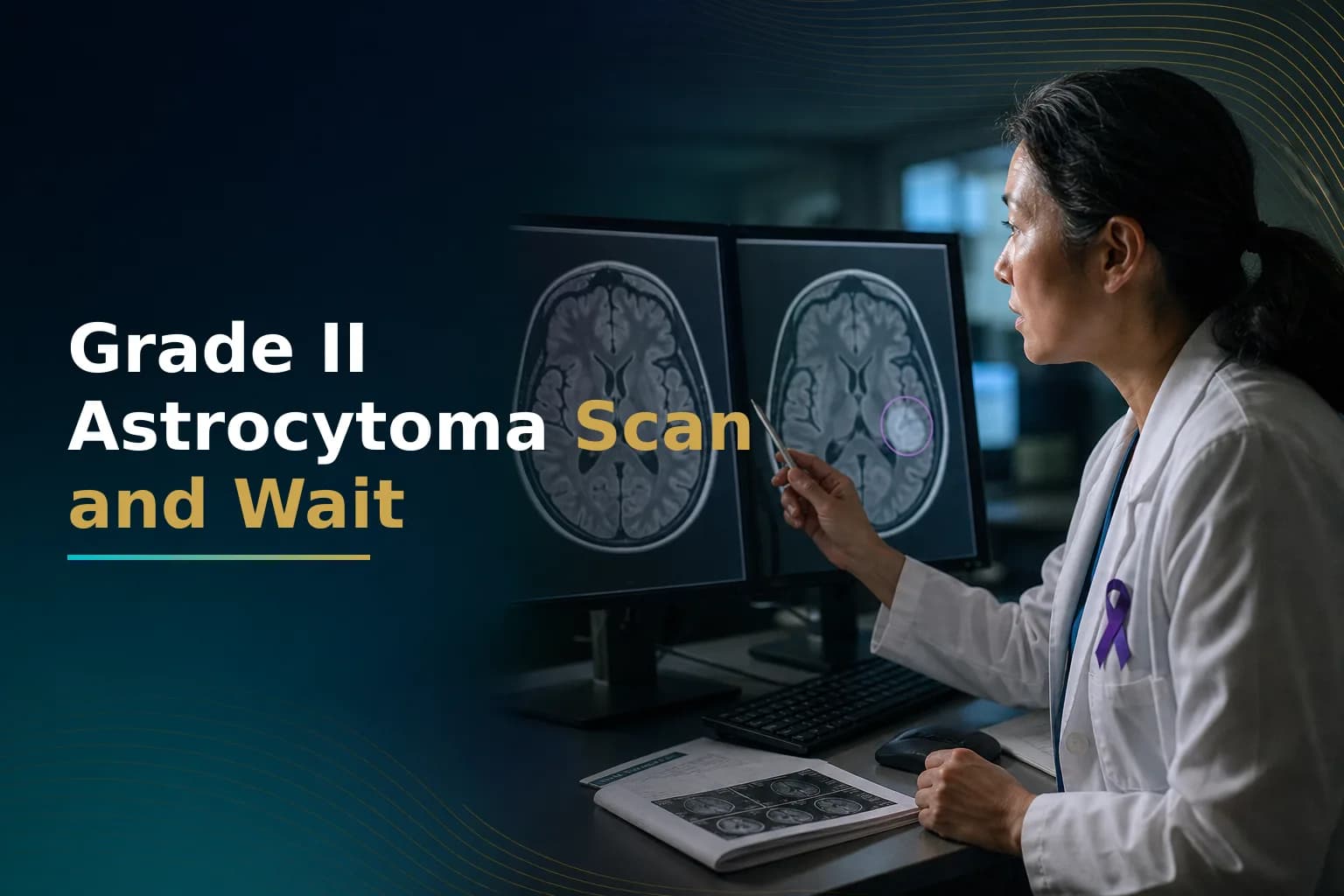
Watching doesn't mean doing nothing. During active surveillance, your team typically schedules brain MRI scans every 2 to 4 months in the first year, gradually spacing them out if the tumor remains stable. Your team compares each scan to your baseline images from right after surgery. Your team looks for:
- Any change in tumor size or signal on FLAIR or T2 sequences
- New contrast enhancement, which may signal malignant transformation to a higher grade
- Growing pressure on surrounding brain tissue
- New or worsening neurological symptoms between scheduled visits
You'll also get regular neurological exams and talk about any symptoms. Contact your doctor right away if you have new seizures, speech changes, worsening headaches, or new weakness. You might need treatment sooner than planned.
The goal is catching growth early, when it's still small and treatable, before it damages your brain. You need to commit to regular imaging and reporting new symptoms for surveillance to work.
When Radiation Does Make Sense: High-Risk Features
Patients with one or more high-risk features usually get radiation rather than surveillance. Clinical trials show these patients benefit from early treatment. The RTOG 9802 trial tested radiation alone versus radiation plus chemotherapy for high-risk low-grade glioma patients. Combined treatment helped patients live longer, showing that treating early and thoroughly works best.
The chemotherapy tested with radiation was a PCV regimen (procarbazine, CCNU, vincristine). Doctors studied this combination before IDH testing was routine. Your neuro-oncologist will discuss which approach fits your tumor's specific molecular profile, your functional status, and your goals. The goal isn't to avoid radiation forever. It's to start radiation when the benefits clearly outweigh the cognitive and fatigue costs.
If you'll get radiation, ask your doctor about how it might affect your thinking and memory before you start. The impact on verbal memory and processing speed is real and varies by radiation field, technique, and individual factors. Ask your neuro-oncologist about dose, fractionation, and any cognitive monitoring protocols at your center.
Vorasidenib: A New Option That Is Reshaping the Conversation
In August 2024, the FDA approved vorasidenib for adults and people aged 12 and older with grade 2 IDH-mutant astrocytoma or oligodendroglioma after surgery. It's the first approved treatment for this tumor type after surgery. The approval came from the phase III INDIGO trial. It studied 331 patients who had surgery 1 to 5 years before enrolling.
Researchers randomly assigned patients to vorasidenib or a placebo during surveillance. The placebo group continued standard watching, which shows what typical care looks like. The National Cancer Institute reported that vorasidenib cut the risk of progression or death to 39% compared to placebo. This is a big, meaningful difference. The National Brain Tumor Society called INDIGO results a major milestone. For the first time, grade 2 glioma patients have an approved treatment option during surveillance.
Vorasidenib is an oral IDH1 and IDH2 inhibitor taken once daily. It isn't a replacement for radiation or chemotherapy. Instead, it's a new option for patients in the surveillance phase. Important: researchers tested it in patients doing surveillance, not as a replacement for radiation in high-risk patients. Eligibility depends on your specific IDH mutation subtype (IDH1 or IDH2), your prior treatment history, liver function, and other factors your oncologist will evaluate.
ASCO pointed out that this changes how doctors handle surveillance for grade 2 IDH-mutant gliomas. It's no longer pure watching and waiting. Now doctors can offer a treatment that might slow or stop the tumor. That shift makes knowing your exact IDH mutation subtype more clinically urgent than ever. Understanding how IDH-mutant glioma differs from glioblastoma explains why this distinction now determines your treatment options, not just your outlook.
The Biological Logic Behind Observation
Clinical trial data supports surveillance, and so does biology. IDH-mutant grade II astrocytomas grow slowly for biological reasons. The IDH mutation disrupts a normal metabolic enzyme, causing tumor cells to produce an abnormal oncometabolite (2-hydroxyglutarate). This oncometabolite interferes with processes that drive aggressive tumor growth and alters DNA methylation patterns across the cancer genome. As a result, IDH-mutant grade II tumors grow slowly and predictably. Growth is often measured in millimeters per year, not rapid expansion.
These tumors don't stay unchanged forever. Over years or decades, additional molecular changes (like CDKN2A/B deletion) may transform the tumor into a more aggressive type. Serial imaging catches these changes at their earliest stage. Surveillance works because doctors can catch transformation early. Treating when the tumor starts to change preserves more options than treating a stable tumor now.
Why some tumors stay stable and others transform matters for all IDH-mutant grade II glioma types. Studies show that some IDH-mutant tumors stay quiet for years while others progress quickly. This research guides surveillance for astrocytoma. Learn why some IDH-mutant grade II tumors stay dormant while others progress. This helps explain the biological forces your care team is watching for on each scan.
Questions Worth Asking Your Neuro-Oncologist
If your oncologist recommends observation after surgery for IDH-mutant grade II astrocytoma, consider bringing these questions to your next appointment:
- What specific features place me in the low-risk category and support observation as the right first step?
- What imaging or clinical findings would prompt you to recommend moving toward radiation or systemic therapy sooner?
- Am I a candidate for vorasidenib during surveillance, and what additional molecular subtyping, if any, would I need?
- How often will I have MRI scans, which sequences will be compared, and who at your center will be reviewing them longitudinally?
- Are there clinical trials enrolling patients at my risk level and IDH mutation subtype?
- Would you recommend a second neuro-oncology opinion before we finalize the post-surgical plan?
When to Talk to Your Doctor
Contact your neuro-oncology team right away if you experience any of the following between appointments. Don't wait for your next scheduled scan. These include a first-time seizure or a seizure that's harder to control than usual, new weakness or numbness on one side of the body, changes in speech or word-finding, worsening headaches that don't get better with your usual treatment, or significant changes in memory or personality. These could mean the tumor is growing or changing into something more serious. See your doctor right away.
This article is for general information and is not a substitute for medical advice. Always consult your oncologist or care team about your specific situation.