What Defines IDH-Mutant Grade II Oligodendroglioma
Not all brain tumors behave alike, even when they share a similar name. Oligodendroglioma is one of the most genetically unique gliomas today. Under the 2021 World Health Organization (WHO) brain tumor classification, a tumor must carry two specific genetic changes to be called an oligodendroglioma: a mutation in the IDH1 or IDH2 gene, and a co-deletion of the short arm of chromosome 1 (1p) and the long arm of chromosome 19 (19q). Without both markers, the diagnosis is something else entirely.
These markers are important. They affect how the tumor grows, how it responds to treatment, and how likely it will stay stable or get worse. According to the National Cancer Institute, oligodendroglioma tends to grow slowly and is often found on brain imaging before severe neurological symptoms develop.
Grade II refers to how the tumor looks under a microscope. Cells are abnormal, but not dramatically so. There are no zones of dead tumor tissue (necrosis) and no chaotic blood vessel growth (microvascular proliferation). There are minimal signs of rapid cell division (mitosis). These features would push a glioma into a higher grade. That calm look does not mean the tumor is harmless. It means the tumor grows slowly, at least for now. Whether it stays that way depends on its molecular profile and secondary genetic changes that accumulate over time.
The Biology of Slow Growth: Why Some Tumors Stay Quiet for Years
The IDH mutation is the founding event in oligodendroglioma. It likely occurs early, possibly in a precursor glial cell, and starts a chain of changes that distinguish this tumor from aggressive gliomas like glioblastoma. When IDH is mutated, the enzyme produces an abnormal metabolite called 2-hydroxyglutarate (2-HG) instead of its normal product. This compound is toxic to normal cells. It disrupts the chemical marks (DNA methylation) that control which genes are active and which are silenced across the genome.
The paradox is that this disruption, while genuinely abnormal, appears to push cells toward a stable state rather than uncontrolled proliferation. IDH-mutant tumor cells seem to have more difficulty activating the growth pathways that fuel aggressive cancer. This is one molecular reason why IDH-mutant gliomas, including grade II oligodendroglioma, tend to grow slowly and carry significantly better outcomes than IDH-wild-type tumors.
The 1p/19q co-deletion adds more stability. This chromosomal event disrupts multiple genes involved in growth regulation on both arms. Paired with the IDH mutation, it contributes to a slow growth pattern. Nearly all oligodendrogliomas also carry a TERT promoter mutation, along with frequent changes in CIC and FUBP1. These genes regulate cell identity and growth. Together, these changes form the oligodendroglioma genetic signature and help explain why some tumors remain stable for years before requiring treatment.
This slow growth pattern is why active surveillance, sometimes called watchful waiting, is a recognized approach for certain patients. This applies especially to younger patients, those with near-complete surgical resection, and those without significant neurological symptoms beyond well-controlled seizures. The American Brain Tumor Association (ABTA) notes that management decisions depend on the extent of surgical resection, the patient's age and health, the tumor's location, and whether symptoms are present or getting worse. There is no single plan that fits every patient.
Watching Without Acting: How Doctors Track Growth on Surveillance
For patients on active surveillance, serial MRI scans are the primary tool. Radiologists and neuro-oncologists measure tumor volume at each scan and track changes over time. Research on IDH-mutant low-grade gliomas during active surveillance found measurable differences in growth rates that matched each tumor's molecular risk profile. Tumors classified as lower-risk grew significantly slower than those carrying intermediate or high-risk features. This shows that molecular characterization can predict growth behavior even during seemingly stable periods.
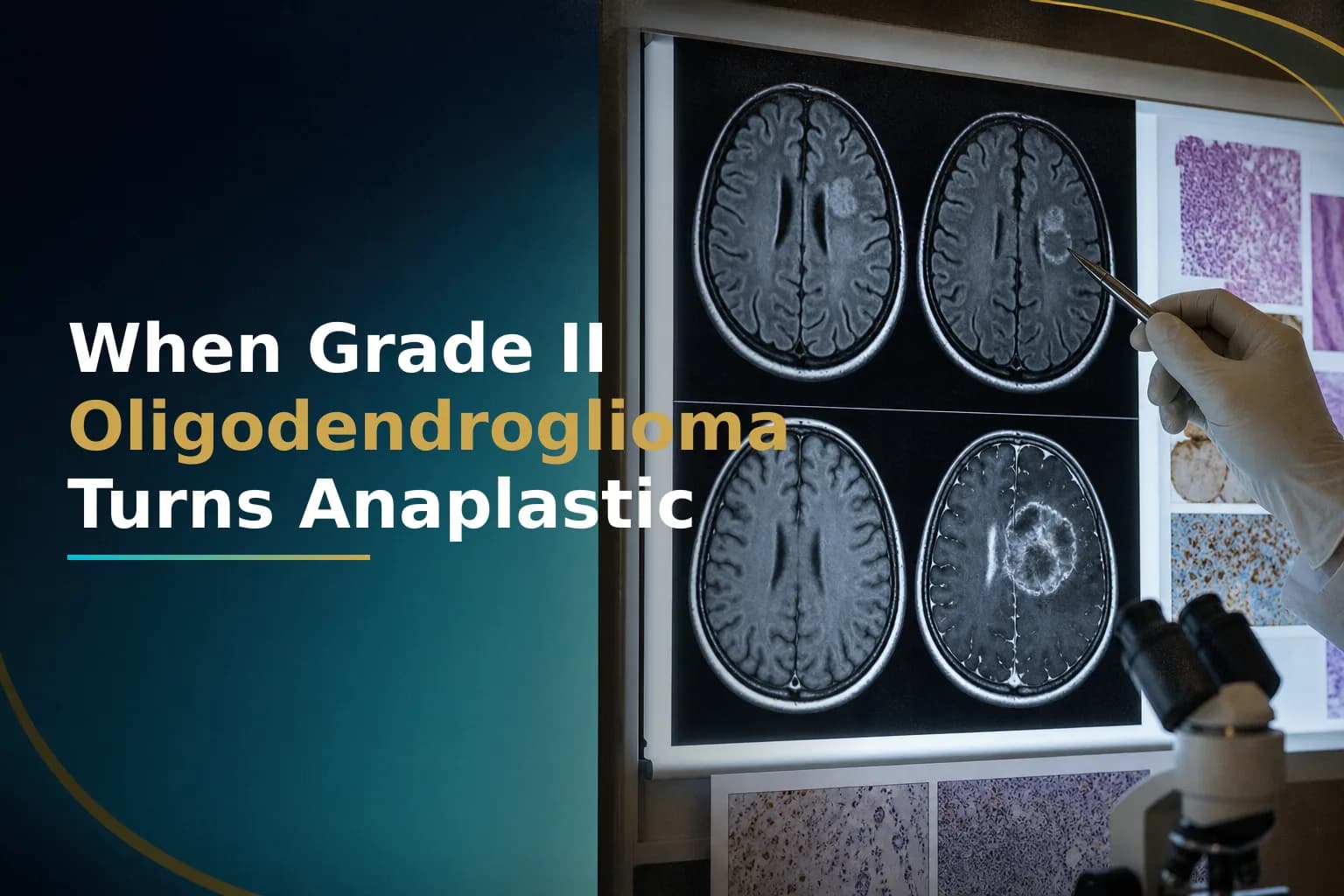
Rapid volume increase on surveillance MRI is one of the most important signals that the tumor's biology may be changing, even if it still looks low-grade on imaging. Other warning signs include contrast enhancement, which shows breakdown of the blood-brain barrier and signals higher-grade activity. New or worsening neurological deficits and increasingly difficult-to-control seizures are also warning signs. Any of these findings should prompt a conversation with your neuro-oncologist about whether surveillance-only remains appropriate.
What Triggers the Shift to Anaplastic Oligodendroglioma
Grade II oligodendroglioma does not stay grade II indefinitely. Over time, additional genetic changes accumulate on top of the founding IDH mutation and 1p/19q co-deletion. When enough secondary changes occur, the tumor gains the capacity for faster growth and more aggressive invasion. This is the transition to grade III, or anaplastic oligodendroglioma.
According to published research, the average time from initial diagnosis to malignant transformation for IDH-mutant, 1p/19q-codeleted oligodendrogliomas was approximately 78.1 months, or roughly six and a half years. This is considerably longer than the transformation time in IDH-mutant astrocytomas, reflecting the slower nature of oligodendroglioma overall. However, that average hides wide individual variation. Some tumors transformed in under two years, while others remained grade II for more than a decade.
The secondary genetic changes most commonly linked to transformation include:
- Loss of chromosomal arms 9p and 10q: These deletions remove genes that normally limit cell growth. Their loss removes critical checkpoints, allowing the tumor to accelerate.
- CDKN2A/B homozygous deletion: The CDKN2A gene encodes cell-cycle regulators that restrict cell division. When both copies are deleted, cells can divide more rapidly and resist death signals. This deletion is rarely seen in grade II oligodendroglioma but becomes more common in grade III tumors and is associated with worse outcomes.
- RB1 loss: The retinoblastoma protein normally restricts cell division. Its loss allows uncontrolled proliferation and may signal approaching transformation.
- Widespread chromosomal changes: Multiple genomic gains and losses across chromosomes show a genome that is breaking down. This is a recognized sign of malignant progression.
No single event triggers transformation in every patient. Rather, the accumulation of secondary changes over time collectively weakens the tumor-suppressive effects of the IDH mutation and 1p/19q co-deletion. This is why two patients with the same grade II oligodendroglioma diagnosis may follow very different clinical paths.
Can Early Treatment Slow or Prevent Transformation?
Early radiotherapy was associated with delayed transformation and prolonged survival. This is consistent with results from the landmark RTOG 9802 trial, which found that radiation followed by PCV chemotherapy significantly extended both progression-free and overall survival in high-risk low-grade glioma patients compared to radiation alone.
Standard treatment for oligodendroglioma, when active treatment is needed, involves surgery followed by radiation therapy and chemotherapy. The most common chemotherapy is the PCV regimen (procarbazine, lomustine, and vincristine) or temozolomide. Memorial Sloan Kettering Cancer Center reports that chemotherapy reduced seizures in approximately 90 percent of patients with grade II oligodendroglioma and tumor-related epilepsy. Treatment helps with both tumor control and quality of life.
For patients on active surveillance who are not yet receiving treatment, it is reasonable to ask whether integrative strategies or lifestyle approaches may slow growth. However, no integrative or metabolic therapy has demonstrated transformation-delaying effects in a prospective clinical trial specific to oligodendroglioma. These approaches may still support overall wellness. Always discuss any complementary strategies with your care team before starting them.
Reading Your Molecular Report: What to Look For
A diagnosis of grade II oligodendroglioma should be supported by a pathology report confirming both IDH mutation and 1p/19q co-deletion. These are the diagnostic pillars. A comprehensive molecular panel can tell you more about your individual tumor's risk profile. Key markers to ask about include:
- TERT promoter mutation: Present in nearly all oligodendrogliomas. Its presence is diagnostically confirmatory but not independently concerning in this context.
- CDKN2A/B deletion: Homozygous deletion signals higher biological risk and may influence when surveillance should intensify or when treatment should begin.
- 9p and 10q chromosomal status: Losses on these arms may show that the tumor is further along the molecular pathway toward transformation.
- Ki-67 proliferation index: A measure of how many tumor cells are actively dividing. Higher values generally mean faster growth.
- MGMT promoter methylation: Primarily relevant in glioblastoma, but often included in comprehensive glioma panels. It can help predict how well you'll respond to certain chemotherapy drugs.
If your initial pathology report did not include a full molecular panel, or if your diagnosis was made at a center without dedicated neuro-oncology expertise, a second pathology review may be appropriate. Our article on pathology review and molecular verification for glioma patients explains when and why a second opinion on tumor genetics can meaningfully change your treatment plan.
For patients whose tumors have already shown signs of progression toward anaplastic disease, treatment sequencing becomes the next critical question. Our article on radiation versus chemotherapy sequencing for newly diagnosed grade III oligodendroglioma covers how treatment decisions change when tumor grade shifts and what current evidence says about optimal treatment order.
For patients looking ahead at what happens if anaplastic transformation leads to recurrence after initial chemoradiation, our article on treatment options after anaplastic oligodendroglioma recurrence outlines the salvage strategies currently available at that stage.
Living With Long-Timeline Uncertainty
One of the hardest parts of a grade II oligodendroglioma diagnosis is the uncertainty that comes with its long course. Survival can stretch well over a decade from diagnosis, which is genuinely good news. But it also means living with a known brain tumor for years. Often there are long periods of watchful waiting and anxiety with each MRI. Some patients describe being in an in-between state: feeling sick enough to worry, but not sick enough to need active treatment right now.
Understanding your tumor's molecular profile helps. Knowing its genetic landscape, the growth rate trend on serial imaging, and the presence or absence of high-risk secondary markers can change how you think about uncertainty. Instead of I have a brain tumor, you can think I have a tumor with these specific characteristics, and here is what the research says about tumors like mine. That precision does not eliminate uncertainty. But it gives you something concrete to work with alongside your clinical team.
When to Talk to Your Doctor
If you have been diagnosed with grade II oligodendroglioma, consider raising the following with your neuro-oncologist or tumor board:
- Does my pathology confirm both IDH mutation and 1p/19q co-deletion? Was a comprehensive molecular panel performed, including CDKN2A/B, 9p status, and Ki-67?
- Based on my molecular profile and post-surgical imaging, am I a candidate for active surveillance or should treatment begin now?
- How often should I have MRI scans, and what specific changes on imaging would prompt a shift in management?
- What symptoms between visits should lead me to contact your office promptly?
- Are there clinical trials for grade II or anaplastic oligodendroglioma that may be relevant to my situation?
This article is for general information and is not a substitute for medical advice. Always consult your oncologist or care team about your specific situation.