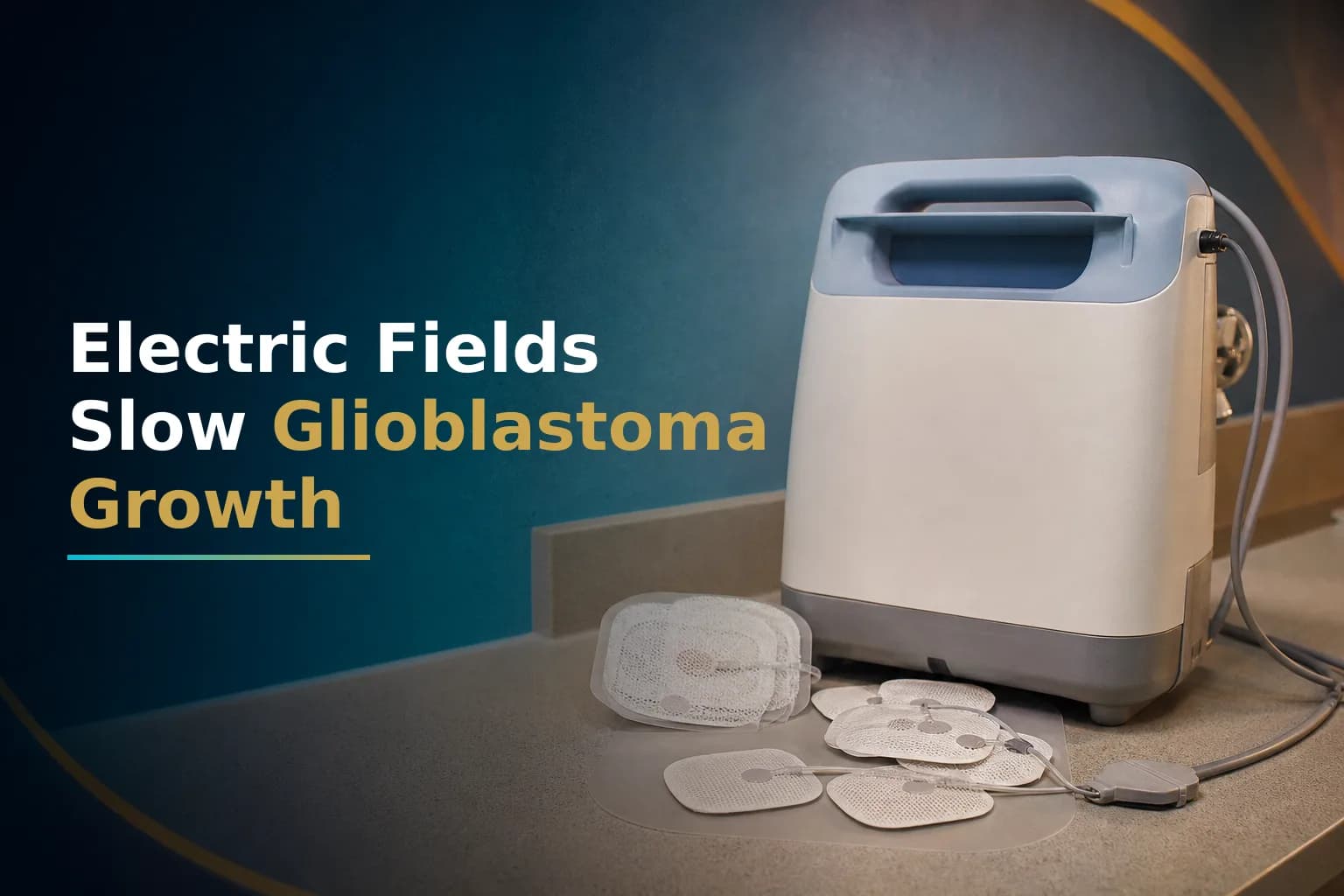
A glioblastoma diagnosis is overwhelming. You are processing news about surgery, chemotherapy, and radiation all at once, and then your doctor mentions a wearable device that delivers electric fields through patches on a shaved scalp. That sounds strange. But Tumor Treating Fields (TTFields), sold as Optune, has the strongest clinical evidence of any add-on therapy for glioblastoma in the past 20 years. This article explains how the technology works, what the key trial showed, and what wearing the device is like day to day.
What Are Tumor Treating Fields?
Tumor Treating Fields (TTFields) is a non-invasive treatment that delivers low-intensity, alternating electric fields to the brain. Four soft adhesive pads, called transducer arrays, are placed on a shaved scalp. For glioblastoma, the device operates at 200 kHz, a frequency that disrupts rapidly dividing cancer cells while leaving slower-dividing healthy brain cells relatively unaffected. Optune, made by Novocure, is the FDA-approved device used for this therapy. It received FDA clearance for recurrent glioblastoma in 2011, then for newly diagnosed glioblastoma in 2015.
How Does Optune Interfere With Tumor Cell Division?
Glioblastoma cells divide rapidly and almost constantly. During division, proteins called microtubules assemble into a scaffold that pulls copied DNA toward opposite ends of the cell before it splits. TTFields destabilize this scaffold. When the alternating electric field cycles at the right frequency, microtubules cannot orient correctly, chromosomes segregate abnormally, and the daughter cells often fail to survive.
The fields also interfere with septin proteins. Septins form a contractile ring that pinches a dividing cell in two. When septin filaments are disrupted, cells may form bleb-like membrane protrusions and fail to complete division.
According to a 2023 review of the current understanding of TTFields for glioblastoma, this mechanism may simultaneously impair DNA damage repair inside tumor cells, reduce cell migration, and generate tumor debris that could prime the immune system to recognize cancer cells. Researchers believe this combination is why TTFields complements chemotherapy and radiation rather than simply overlapping with them.
What Did the EF-14 Trial Show?
The EF-14 trial is the pivotal study that established TTFields as a standard option for newly diagnosed glioblastoma. It enrolled 695 patients who had completed surgery followed by concurrent chemoradiation with temozolomide. Patients were then randomly assigned 2:1 to receive either TTFields plus maintenance temozolomide or maintenance temozolomide alone.
Results published in 2017 showed:
Median overall survival of 20.9 months in the TTFields plus temozolomide group versus 16.0 months in the temozolomide-alone group
Median progression-free survival of 6.7 months versus 4.0 months
Five-year survival rates of 13% with TTFields plus temozolomide versus 5% with temozolomide alone
A compliance analysis published as a subgroup analysis of the EF-14 phase III trial found that patients who wore the device for more than 90% of recommended hours had the longest survival outcomes. Those who wore it less than 50% of the time showed little survival benefit beyond temozolomide alone. Based on the EF-14 results, the National Comprehensive Cancer Network (NCCN) lists TTFields as a Category 1 recommendation (its highest level of evidence) for newly diagnosed glioblastoma with supratentorial disease and good performance status, used alongside maintenance temozolomide.
Who Is a Candidate for TTFields?
Your neuro-oncologist will determine candidacy based on your specific tumor profile and medical history. In general, TTFields is considered for patients who:
Have a confirmed newly diagnosed or recurrent glioblastoma (Grade 4 glioma)
Have completed initial surgery and concurrent chemoradiation with temozolomide
Have a good performance status, meaning they can manage most daily activities independently
Do not have an implanted electrical device such as a pacemaker, cardiac defibrillator, or deep-brain stimulator
Are willing to commit to wearing the device for at least 18 hours per day
Patients with significant skull defects, active scalp infections, or confirmed sensitivity to the conductive hydrogel in the arrays are generally not candidates. If you are newly diagnosed and trying to organize these decisions, the guide on building your treatment strategy in the first 30 days after a glioblastoma diagnosis covers how to work through the key questions systematically.
What Does a Day With Optune Actually Look Like?
The Optune system is designed for home use. Understanding the daily routine before you start helps caregivers and patients plan ahead.
Scalp preparation
Before the arrays go on, the scalp must be fully shaved. This is repeated every three to four days when the arrays are changed. Most patients set a regular schedule for the change, either doing it themselves, using a caregiver, or working with a visiting nurse. The scalp is cleaned, dried, and mapped before fresh arrays are applied.
Placing the transducer arrays
Four flexible, self-adhesive pads are positioned on the shaved scalp according to a treatment map created from your MRI. The layout is designed to maximize the electric field strength directly at the tumor site. The arrays connect via thin cables to the portable Optune unit, which you carry in a shoulder bag or wear in a dedicated vest.
Daily use
The goal is at least 18 hours of active device use every day, and the data favor even more. You can sleep in the device, move around the house, work from home, and in most cases go to public places. The main breaks are a daily shower (roughly 30 minutes) and the array-change session every three to four days, during which you have several hours without the device.
The device runs on battery power with overnight charging from a standard outlet. A portable backup battery extends range for outings away from power. Novocure provides device training, dedicated device support specialists available by phone, and array supplies shipped to your home.
What Are the Most Common Side Effects?
The most common adverse event is skin irritation under the transducer arrays. A peer-reviewed article on managing skin reactions with TTFields found that mild to moderate reactions occurred in about 43% of patients, while severe reactions were seen in roughly 2%. Reactions may include redness, peeling, or small sores at the contact sites.
Practical measures that may help reduce skin reactions include:
Rotating the exact position of each array slightly with every change to avoid sustained pressure on the same skin points
Keeping the scalp fully dry before reapplying fresh arrays
Using prescribed topical treatments on irritated areas during the array-free change window
Reporting worsening reactions to your care team early, before they become severe
For more information on scalp skin care during brain tumor treatment, see the article on managing scalp irritation and hair loss during glioblastoma radiation, which covers principles that apply to TTFields scalp care.
Other effects include headaches, fatigue, and in some patients, mild anxiety or sleep problems during the first few weeks. Unlike chemotherapy, TTFields does not cause nausea, nerve damage, or immune system damage. Serious device-related adverse events are rare.
Does Compliance Really Matter?
Yes, and the evidence is clear. The EF-14 compliance analysis showed that patients who used the device for more than 90% of recommended hours had the longest survival, while those below 50% showed minimal benefit. A 2025 review of recent advances in TTFields therapy confirms that wearing the device more hours generally improves outcomes, and this pattern is one of the most consistent findings in TTFields research.
This makes device management part of the treatment, not just a logistics task. Many caregivers monitor device hours, schedule array changes, and fix problems. Having support in place before the device arrives makes the first weeks easier.
If you are also taking temozolomide alongside TTFields, cognitive changes during the maintenance phase are worth monitoring carefully. The article on chemo brain and cognitive changes during glioblastoma temozolomide treatment explains what to watch for and when to flag symptoms to your team.
Is Optune Available Outside the United States?
The device has FDA approval in the United States and CE marking for Grade 4 glioma in Europe. It also has regulatory approval in Canada, China, Israel, Japan, and Australia. Despite these approvals, access is mainly available in the United States. Studies show that roughly twice as many patients receive TTFields in the U.S. as in the rest of the world combined, and that fewer than two-fifths of surveyed treatment centers worldwide have the device available. Device cost is a major factor.
Patients in resource-limited regions frequently ask whether TTFields is accessible where they live. You may get access through specialty centers that import it, through clinical trials testing TTFields with other treatments, or by arranging part of your treatment abroad. The guide on glioblastoma treatment in India - costs, visa steps, and what to expect explains how to arrange treatment from outside the U.S., including considerations for international patients.
Questions to Ask Your Neuro-Oncologist Before Starting TTFields
Before committing to Optune, it helps to have specific answers:
Am I a candidate given my tumor location, skull condition, and current medications?
Is TTFields covered by my insurance or health plan, and what financial support does Novocure offer?
How will the transducer array layout be customized to my specific tumor location using my MRI?
What should I do if a skin reaction under the arrays is not improving after the standard measures?
Can I use TTFields alongside a clinical trial or integrative protocol I am considering?
What does the available data show for patients with my MGMT methylation status who add TTFields to temozolomide?
If you want an expert review of whether TTFields is right for you, or if the device is not available where you live, you can upload your MRI scans and pathology reports to HealthUnwired for a video consult with a neuro-oncology specialist, typically within 48 hours. An expert review can tell you if you're a candidate and explain your options before you begin treatment.
When to Talk to Your Doctor
Tell your neuro-oncologist before you stop wearing TTFields for any reason, including travel, a skin reaction, or a device problem. A planned break is always safer than an unplanned one. Report worsening scalp reactions, open skin sores, or a new seizure while using the device on the same day they appear. If TTFields has not been discussed as part of your treatment plan and you believe you may be a candidate, ask directly at your next appointment.
This article is for general information and is not a substitute for medical advice. Always consult your oncologist or care team about your specific situation.