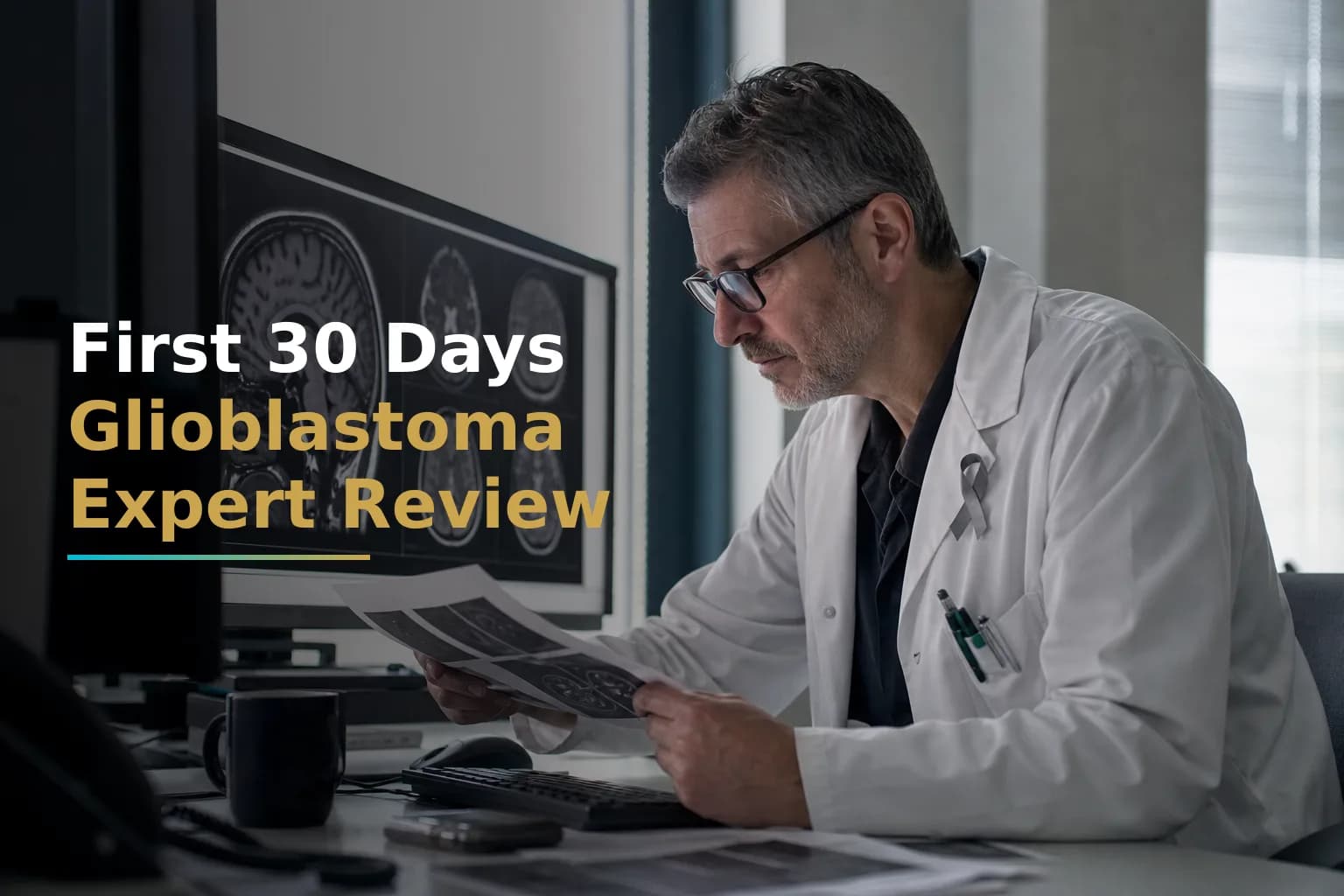
A glioblastoma diagnosis brings urgent decisions. Within hours, most families schedule neurosurgical consultations, manage hospital admissions, and review consent forms. Treatment planning moves quickly. Understanding your tumor's biology often gets less attention than it should.
The first 30 days after diagnosis involve more than surgery. This is the most important time to build a clear picture of your specific tumor's biology. Patients in London, New York, Sydney, Toronto, Dubai, Berlin, and elsewhere can get this information from multiple hospitals and teams, not just one.
This article explains what happens during those first 30 days, why tumor biology matters before treatment begins, and how an international expert review conducted remotely alongside your local team can help you and your physicians make better decisions.
What Happens Immediately After a Glioblastoma Diagnosis
After imaging shows possible glioblastoma, most patients see a neurosurgeon within days. Surgery is usually the first treatment step. The goals are to confirm the diagnosis using tissue, remove as much tumor as safely possible, and relieve pressure on the brain if needed.
According to the American Brain Tumor Association, the standard treatment for glioblastoma combines surgery followed by radiation therapy with chemotherapy, then more chemotherapy over time. Tumor Treating Fields (TTFields), which uses electrical fields delivered through a wearable cap, received FDA approval in 2015 for newly diagnosed glioblastoma and may be part of your treatment plan.
This treatment plan works well for many glioblastoma patients. But it treats all patients the same way. It does not account for the specific molecular features of your tumor, features that vary between patients and may change how well certain treatments work for you.
Why Every Glioblastoma Is Biologically Different
Glioblastoma is not one disease. Two patients can have tumors with the same name, in the same location, and that look nearly identical on an MRI. Yet they can have completely different genetic profiles. These differences matter for treatment choices.
The National Cancer Institute has shown how better molecular classification of brain tumors is changing how doctors understand and treat them. The 2021 World Health Organization update defined glioblastoma as IDH-wildtype. Tumors that were called glioblastoma but have an IDH mutation are now classified differently because they act differently and respond differently to treatment.
That single difference can change a prognosis and a treatment strategy. IDH status is one of many molecular markers worth knowing. Each tumor carries specific genetic changes in genes such as EGFR, PTEN, CDKN2A, and TERT. These changes shape how it grows and how it may respond to treatment.
What Standard Pathology Often Cannot Reveal
After surgery, doctors create a pathology report. This document describes what the tissue looks like under a microscope: cell type, grade, and key markers like MGMT and IDH if they were tested. At many hospitals, this is where molecular testing stops.
MGMT promoter methylation is one of the most important markers in glioblastoma. According to the National Brain Tumor Society, when the MGMT gene promoter is methylated, the tumor may respond better to temozolomide chemotherapy. Patients whose tumors have methylated MGMT tend to do better with standard chemotherapy. Knowing your MGMT status before starting treatment is useful clinical information.
But standard pathology reports often do not test much beyond this. Markers such as EGFR amplification, PTEN loss, CDKN2A deletion, and TERT promoter mutation may not be included in a routine diagnostic report. Whole exome sequencing and RNA sequencing, which map the full genetic landscape of the tumor, are rarely part of standard diagnostic testing. Each of these findings tells you about treatment response, clinical trial eligibility, and biological vulnerabilities that your oncologist might want to know before you commit to a plan.
A pathology report that confirms glioblastoma, IDH-wildtype, with MGMT methylation status is a starting point, not the complete molecular picture of your tumor.
The Role of Molecular Profiling in Your Treatment Picture
Molecular profiling goes beyond standard pathology. It looks at the tumor's genetic and molecular structure in more detail by examining mutations, gene expression patterns, copy number variations, and other biological signals that a standard diagnostic report misses.
Whole exome sequencing analyzes the protein-coding regions of the tumor's DNA. RNA sequencing looks at how genes are being expressed. Drug sensitivity analysis can test which compounds the tumor's biology may respond to. Together, these tools can surface biological insights that matter for treatment planning.
For patients working with a local oncology team, a more detailed molecular profile provides additional context. It is not meant to replace your local team's plan. Instead, it gives you information to discuss with them. As the National Brain Tumor Society notes, identifying specific gene changes may make you eligible for targeted therapies or clinical trials built around those vulnerabilities. You can only find that eligibility if the relevant testing has been done.
Tumor Treating Fields and the Expanding Treatment Landscape
The approved treatment plan for newly diagnosed glioblastoma has grown beyond surgery, radiation, and chemotherapy alone. TTFields therapy is an important addition. This approach delivers electrical fields to the scalp through a wearable cap, targeting dividing tumor cells without extra systemic chemotherapy.
A landmark randomized clinical trial, with results available through PubMed Central, found that adding TTFields to standard maintenance chemotherapy improved both progression-free survival and overall survival in newly diagnosed glioblastoma patients compared to chemotherapy alone. Your oncologist will consider whether TTFields is appropriate for you.
Clinical trials are another option that molecular profiling may open up. A tumor with specific mutations or amplifications may qualify for a targeted trial that standard testing would have missed. Knowing your tumor's molecular makeup before your treatment plan is finalized gives your team the information to determine whether a trial might work for your case.
How Precision Analysis May Support Your Discussions With Your Physicians
Precision oncology analysis works alongside your treating team, not in place of it. A detailed molecular review of your pathology report, MRI findings, surgical notes, and tumor tissue can raise useful questions for your oncologist. Those questions might involve the order of treatment, off-label drug choices, or clinical trial eligibility based on specific mutations your tumor carries.
For patients who want to walk into their next oncology appointment with better-informed questions, that kind of outside review can be useful. It can also highlight differences between what standard testing found and what deeper molecular analysis reveals, differences worth knowing about before you finalize treatment decisions.
You can read more about why this review window matters in the related article on why newly diagnosed glioblastoma patients benefit from having their pathology reviewed before treatment begins.
International Expert Review - Geography No Longer Limits You
For patients in the United Kingdom, United States, Australia, Canada, Germany, France, the UAE, and New Zealand, accessing expert neuro-oncology input is not limited to your local hospital. Remote review processes let you get expert input from international precision-oncology teams without traveling.
MRI scans transfer as DICOM files. Pathology reports and surgical notes upload securely. Molecular testing results are reviewed by specialists with deep experience in glioblastoma biology. Initial consultations happen by video. Many families from Manchester to Melbourne, Toronto to Dubai, and Birmingham to Berlin now seek this kind of parallel expert review while their local team plans treatment.
According to the National Brain Tumor Society, a second opinion from a specialist who frequently operates on your tumor type and works with a multidisciplinary tumor board is worth pursuing before major treatment decisions happen. That specialist does not have to be in your city or your country.
The goal is to enter treatment with the fullest possible biological picture of your specific tumor and with clarity that comes from additional expert perspectives on your case. This supports your local team rather than delaying treatment or undermining them.
For a practical overview of how this remote process works, the related article on how remote molecular assessment and virtual expert consultation work for glioblastoma patients seeking a second opinion abroad explains the steps involved.
What Reports Should You Gather Before Seeking an Expert Review?
If you are considering an expert review - whether from a specialist at another center or from a precision-oncology team - gathering the right documents first makes the process faster and more useful. The key documents to collect are:
- Pathology report - including tumor grade, cell type, and IDH and MGMT status if tested
- Histopathology report - the detailed microscopic description of the tissue sample
- MRI brain reports - the written radiology report and ideally the DICOM image files
- Surgical notes - the operative report describing what the surgeon found and removed
- Molecular testing results - any genetic or biomarker testing already completed
- Current treatment plan - what your oncologist has proposed and the timeline
- Previous treatment history - if this is a recurrence, all prior treatment records
Having these documents ready before a consultation helps reviewers provide more specific and useful information. For a detailed breakdown of what is needed and why, the article on preparing for your tumor intelligence review covers every item in the checklist.
Your Next Step: Understanding Your Tumor's Full Biology
Every glioblastoma is biologically unique. A standard pathology report starts your understanding, not finishes it.
If you or a loved one was recently diagnosed with glioblastoma, gathering your pathology report, MRI scans, surgical notes, and any molecular testing results is a practical first step. Many families in the UK, US, Australia, Canada, the UAE, and across Europe choose to have those reports reviewed by a precision-oncology team as part of their decision-making process while their local treatment proceeds in parallel.
A detailed review of your tumor's molecular biology can reveal insights worth discussing with your treating physicians. It may find vulnerabilities that standard testing missed. It may clarify clinical trial eligibility. It may help you and your care team move forward with a more complete picture of the tumor you are treating.
International patients often start with a virtual consultation and a report review. Travel is not required. A precision-oncology team can assess your case remotely and provide a structured biological analysis you can bring to your next oncology appointment.
Common Mistakes Families Make in the First 30 Days
The most common mistake is assuming a standard pathology report tells the whole story. It confirms the diagnosis and notes a few standard markers. It does not capture the full molecular landscape of the tumor.
Another mistake is waiting too long to get additional input. The first 30 days are the most important window for this work. Once treatment starts, some decisions have already been made and some tissue may not be available for further testing.
Geography should not be a barrier. In today's digital medicine landscape, expert review does not require a plane ticket. Scans transfer in seconds. Reports upload in minutes. The first consultation happens on a video call.
Many families also assume their local oncologist has already considered every available option. Most experienced oncologists welcome specialized molecular reviews. They do not resist additional input. The goal is to give that team more complete information about the specific tumor they are treating, not to create conflict.
Questions to Ask Your Oncology Team
Before or shortly after surgery, consider raising these questions with your oncologist or neurosurgeon:
- What molecular markers will be tested on the tumor tissue, and what is not routinely included in your panel?
- Will MGMT promoter methylation and IDH mutation status both be assessed?
- Is there enough tissue available for additional molecular testing if it is needed later?
- Are there clinical trials I might be eligible for based on my tumor's molecular profile?
- Would you be open to reviewing findings from an independent molecular profiling analysis?
- How long do I have to consider additional expert input before treatment must begin?
- What is the planned treatment sequence, and when does each phase start?
These questions are not confrontational. They are the kind of questions a well-informed patient or caregiver asks. Any experienced neuro-oncologist should be able to answer them clearly.
When to Talk to Your Doctor
If you are within the first 30 days of a glioblastoma diagnosis, talk with your oncologist as soon as possible about additional molecular profiling. Ask what was tested and what was not. Ask about tissue availability for further testing. Ask whether clinical trials are being considered based on your tumor's molecular findings. If you plan an independent expert review, let your local team know. Most oncologists welcome the additional biological information it provides.
This article is for general information and is not a substitute for medical advice. Always consult your oncologist or care team about your specific situation.