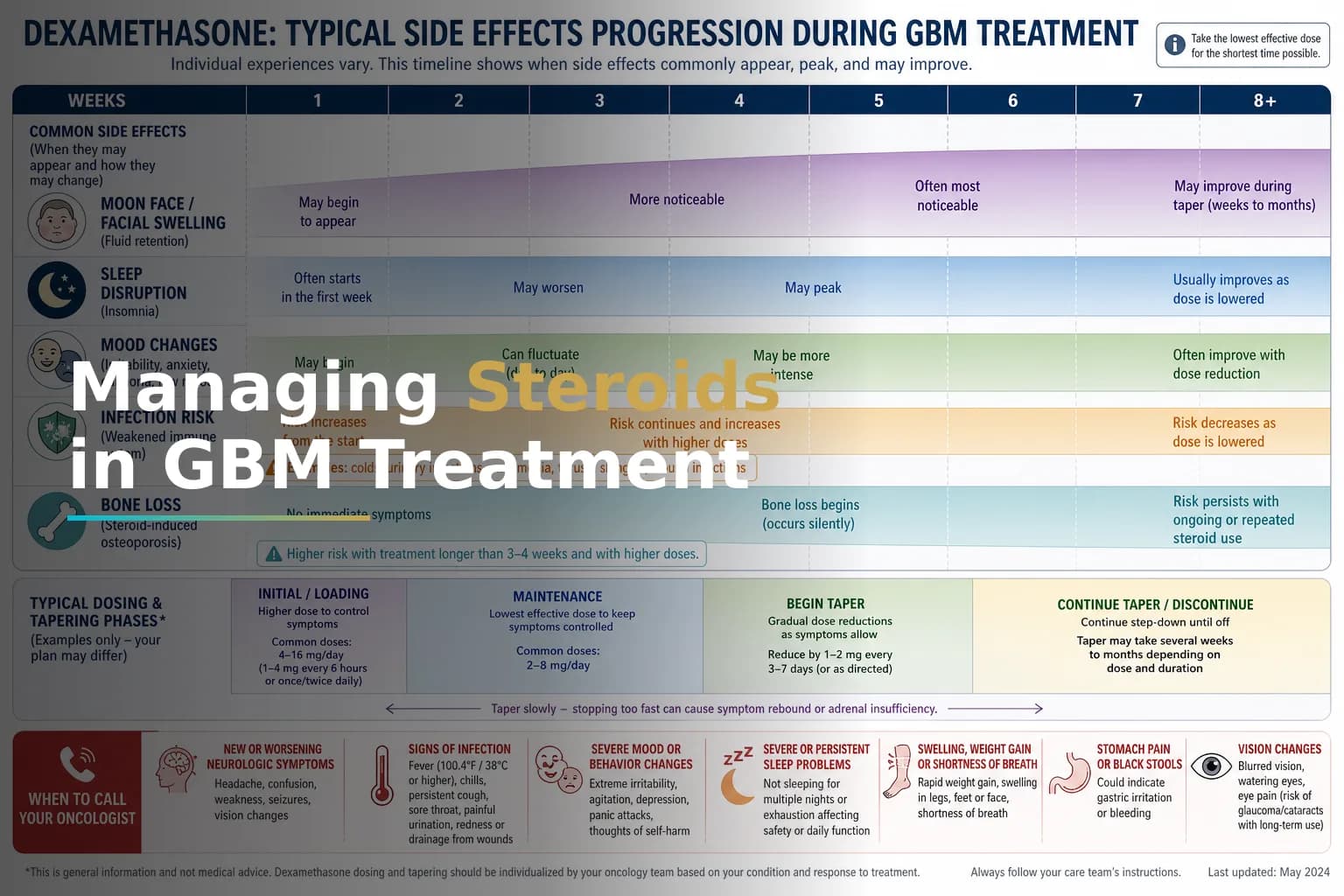
Dexamethasone is often the first medication prescribed to a glioblastoma patient - sometimes before surgery, sometimes in the recovery room, and frequently throughout the months of chemoradiation that follow. When brain swelling is driving headaches, confusion, or weakness, it can bring noticeable relief within a day or two. But over weeks and months its side effects accumulate, and managing those becomes a treatment challenge in itself.
If you are a caregiver handling much of the research and coordination, understanding what dexamethasone does - and what it costs - helps you ask the right questions at every oncology appointment.
What does dexamethasone do in a glioblastoma patient's brain?
Dexamethasone is a synthetic corticosteroid - a lab-made form of cortisol, the stress hormone the adrenal glands produce naturally. In glioblastoma, its primary job is to reduce vasogenic edema: the swelling that builds when the tumor disrupts the blood-brain barrier.
The blood-brain barrier is the sealed layer of cells that normally prevents fluid from leaking into brain tissue. Glioblastoma produces growth factors - including one called VEGF (vascular endothelial growth factor) - that make tumor blood vessels abnormally leaky. Fluid seeps into surrounding brain tissue and raises pressure inside the skull. That pressure is responsible for many of the neurological symptoms GBM patients experience: headaches, nausea, one-sided weakness, speech difficulties, and confusion.
According to research on glucocorticoid mechanisms in peritumoral brain edema, dexamethasone works partly by restoring the tight junction proteins - claudin-5, occludin, and ZO-1 - that normally keep the blood-brain barrier sealed. Symptom relief is often noticeable within 12 to 48 hours of starting the drug.
When does the oncology team prescribe it?
Dexamethasone appears at several stages during glioblastoma treatment:
- Before surgery: To reduce swelling and lower intracranial pressure before the craniotomy, making the procedure safer.
- After surgery: To manage post-operative swelling at and around the surgical site.
- During chemoradiation: Radiation can temporarily increase brain swelling in some patients. Dexamethasone is used when symptoms emerge or worsen during the Stupp protocol - the standard concurrent course of temozolomide and radiation.
- At recurrence: When tumor regrowth causes new or worsening neurological symptoms, dexamethasone is often restarted or its dose increased to help maintain function.
A comprehensive review of corticosteroid use in brain cancer patients indicates that dexamethasone should be prescribed only in patients with active symptoms, not given routinely as a preventive measure during radiation when the patient is asymptomatic. The guiding principle is the lowest effective dose for the shortest necessary duration.
Benefits and side effects
Dexamethasone is medically necessary when brain swelling is causing real harm. But its prolonged use carries risks that should factor into how the care team approaches dosing. Several analyses of large clinical trial datasets have found that patients who need higher or longer-duration dexamethasone tend to have worse survival outcomes in glioblastoma, even after accounting for factors like clinical status and disease burden.
A systematic review and meta-analysis published in 2024 found that dexamethasone use was significantly associated with reduced overall survival and progression-free survival in GBM patients. Researchers propose that this is partly because dexamethasone is broadly immunosuppressive - it reduces the activity of immune cells that may target tumor tissue, and it may blunt the effectiveness of immunotherapy treatments if those are being explored. This is not a reason to refuse steroids when the oncologist recommends them. Uncontrolled intracranial pressure is a medical emergency. The principle is to keep the dose as low as symptoms allow, and to taper as quickly as the clinical picture permits. If you want an independent view of how the steroid dose fits within the full treatment picture, you can consult with experts at Art of Healing Cancer about your case - remote case reviews are available for families who want expert input without traveling.
Side effects: what to watch for
The side effects of dexamethasone fall into several categories. Some are nearly universal with prolonged use. Others are less common but more serious.
Blood sugar and metabolic changes
Dexamethasone raises blood glucose and can trigger steroid-induced diabetes, even in people who've never had diabetes before. Reducing simple carbohydrates and sugary drinks may help keep levels more stable during treatment, though medication to control blood sugar is sometimes needed. The care team may recommend regular blood glucose monitoring for any patient on a prolonged steroid course.
Muscle weakness
Steroid myopathy - muscle wasting that typically begins in the thighs and upper arms - is one of the most disabling long-term side effects. Patients describe difficulty climbing stairs, rising from a chair, or lifting their arms above shoulder height. Gentle, appropriate physical activity, when possible, may help slow this process. Report any weakness that seems to be progressing faster than you'd expect from the tumor.
Mood changes and sleep disruption
Steroids frequently cause irritability, anxiety, mood swings, and insomnia - particularly when doses are taken in the afternoon or evening. Published reviews estimate that neuropsychiatric effects occur in roughly 5 to 10 percent of patients on corticosteroids, ranging from mild mood disturbance to, in rare cases, steroid-induced psychosis. Taking the full daily dose in the morning, with the prescriber's approval, can reduce how much the drug disrupts sleep at night. For caregivers, knowing that sudden irritability or anxiety is frequently drug-related - rather than a permanent personality shift - can help you understand these changes and reduce household tension. Our article on cognitive and mood changes during glioblastoma treatment covers how steroid-related effects overlap with chemotherapy-related brain fog. For patients whose sleep is significantly disrupted during a steroid course, Ayurvedic sleep aids are available commercially - though any supplement should be cleared with your oncologist before starting.
Gastrointestinal symptoms
Stomach pain, acid reflux, and in some cases gastrointestinal bleeding are possible with prolonged steroid use. Many oncologists co-prescribe a proton pump inhibitor - a stomach-acid-reducing drug such as omeprazole - alongside dexamethasone to lower this risk. Avoid non-steroidal anti-inflammatory drugs such as ibuprofen without checking with the care team first. The combination of NSAIDs and corticosteroids significantly raises the risk of stomach ulcers.
Increased infection risk
Dexamethasone suppresses the immune system. Patients on prolonged steroid courses are at higher risk for infections, including some opportunistic infections not normally seen in otherwise healthy people. Pneumocystis jirovecii pneumonia - a fungal lung infection abbreviated as PCP - is one example that neuro-oncologists sometimes prescribe preventive treatment for during extended dexamethasone courses. Any new fever, productive cough, or unusual infection should be reported to the care team promptly. Patients on dexamethasone are often managing other medications at the same time - our article on seizures and medication safety in glioblastoma explains how multiple drugs interact during treatment.
Bone loss and fluid retention
Long-term steroid use reduces bone density and raises the risk of fractures, particularly in older patients. The characteristic rounding and puffiness of the face - often called moon face - along with fluid retention in the limbs is common and tends to improve as the dose is reduced. The care team may discuss calcium and vitamin D support for patients on prolonged steroid courses, though the choice to add supplements depends on each patient's full clinical picture.
Tapering: why you cannot stop dexamethasone suddenly
If a patient has been on dexamethasone for more than a few days, stopping it abruptly can be dangerous. Prolonged steroid use signals the adrenal glands - the organs that produce the body's natural cortisol - to reduce their own output, because the body detects that high levels of synthetic steroid are already present. When dexamethasone is removed suddenly, the adrenal glands may not respond quickly enough to meet the body's basic needs for cortisol. This is called adrenal insufficiency. Symptoms include severe fatigue, dizziness, nausea, and low blood pressure, which can be difficult to distinguish from tumor-related changes.
According to published guidance on the medical management of brain tumors, dexamethasone is typically reduced gradually over a schedule set by the medical team based on how long the patient has been on steroids, the current dose, and whether neurological symptoms remain under control. Rebound edema - a worsening of brain swelling as steroids are reduced - is a real possibility and is one reason the taper must be monitored closely rather than managed at home without guidance. If you are trying to understand how steroid management fits into the early weeks after diagnosis, our overview of the first 30 days after a glioblastoma diagnosis outlines the sequence of priorities.
Questions worth raising with the oncology team
- Is the current steroid dose still necessary, or can a reduction be tried?
- Should blood sugar be monitored at home, and if so, how often?
- Has a stomach-protecting medication been prescribed alongside dexamethasone?
- Is physical therapy appropriate to help address muscle weakness?
- What is the tapering plan, and what symptoms should prompt the family to pause or slow the reduction?
- Are there other approaches - such as bevacizumab, which targets the VEGF pathway - that might help control edema while reducing steroid dependence in this specific case?
When to contact the care team
Contact the neuro-oncology team promptly if you notice any of the following: a new fever or signs of infection; severe stomach pain or blood in stools; a sudden significant change in mood or behavior; increasing weakness in the legs or arms that seems beyond what the tumor explains; or symptoms suggesting low blood pressure such as dizziness, fainting, or extreme fatigue - especially if a steroid dose was recently missed or the taper was accelerated. These could indicate complications that need prompt medical assessment rather than watchful waiting at home.
If you would like the full treatment plan - including how steroids are being balanced against the rest of the protocol - reviewed by another expert, you can upload MRI scans and treatment records at Glioblastoma Center to request a remote case review by the team.
This article is for general information and is not a substitute for medical advice. Always consult your oncologist or care team about your specific situation.