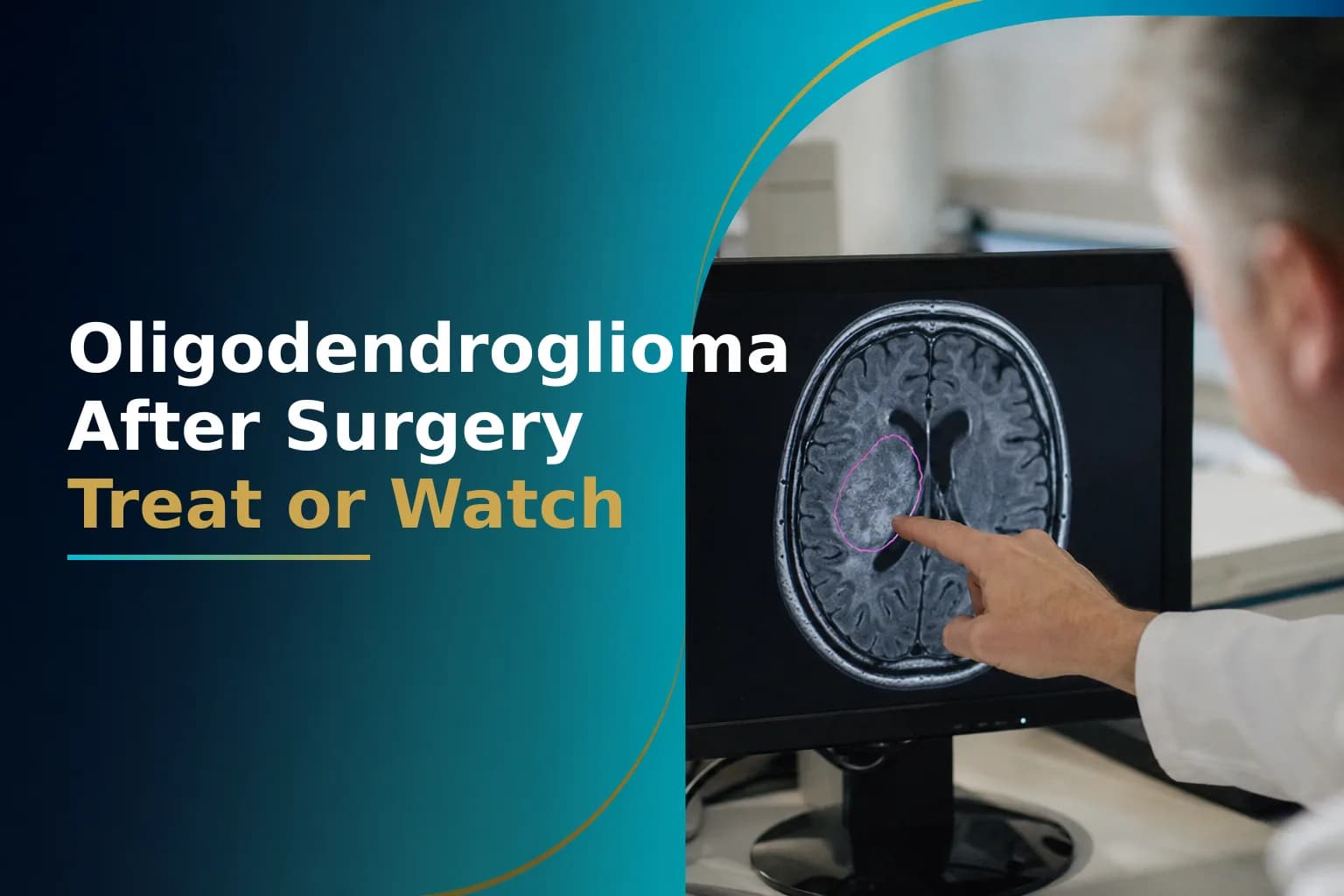
The Question Every Patient Has After Surgery
Your surgeon removed as much of the oligodendroglioma as was safely possible. Now your oncologist is outlining next steps. Some patients hear that radiation and chemotherapy should start soon. Others are told to wait and watch. That gap can feel confusing and alarming.
The decision is not random. Neuro-oncologists use a set of studied factors to determine who benefits from immediate additional treatment and who can safely monitor for a time. Understanding these factors helps you work with your care team more effectively.
What Makes Oligodendroglioma Unique
Oligodendroglioma is a brain tumor that grows from cells called oligodendrocytes. For a tumor to qualify as oligodendroglioma under current World Health Organization (WHO) guidelines, it must carry two specific molecular changes: a mutation in the IDH gene and a co-deletion of chromosome arms 1p and 19q. Both must be present. These markers are important because they affect how your tumor responds to chemotherapy compared to other brain tumors.
The American Brain Tumor Association explains that oligodendrogliomas are graded as WHO grade 2 (lower-grade) or WHO grade 3, also called anaplastic oligodendroglioma. Grade is one of the most important variables in deciding what treatment follows surgery.
Surgery: The Starting Point
Surgery is almost always the first step after diagnosis. The goals are to relieve pressure inside the skull, collect tissue for testing, and remove as much tumor as the brain location allows. How completely the surgeon removes the tumor, called the extent of resection, directly affects what comes next.
A gross total resection (GTR) means imaging after surgery shows no detectable tumor remaining. A subtotal resection (STR) leaves visible residual tumor. A biopsy collects only a small tissue sample without significant removal. Each scenario changes the risk calculation, which shapes the treatment recommendation.
Risk Stratification: The Framework Behind the Decision
After surgery, your neuro-oncology team will evaluate your risk for early tumor progression. That assessment shapes the treatment recommendation. Several factors are consistently used across clinical guidelines.
Factors that generally indicate higher risk and support an earlier start to treatment include:
- Age 40 or older at diagnosis
- Incomplete surgical removal — subtotal resection or biopsy only
- Tumor diameter larger than approximately 6 centimeters on imaging
- Tumor crossing the midline of the brain
- New or worsening neurological symptoms present before or after surgery
- WHO grade 3 (anaplastic) designation on pathology
Factors that may support active surveillance include younger age (commonly under 40 in clinical trial risk schemas), gross total resection, smaller tumor volume, no significant neurological symptoms, and a grade 2 classification. The ASCO-SNO joint guideline for diffuse astrocytic and oligodendroglial tumors in adults is the evidence guide that most major neuro-oncology centers use for this risk assessment.
The Watch-and-Wait Approach: Who Is It For?
Active surveillance, also called watch and wait, means delaying radiation and chemotherapy after surgery and monitoring with regular MRI scans instead. It is not doing nothing. It is a strategy for patients whose tumors are slow-growing and whose long-term health may benefit from waiting on treatment side effects for now.
For younger patients with grade 2 oligodendroglioma who had a gross total resection, have no significant neurological deficits, and whose tumor has no additional high-risk features, surveillance may be a reasonable path. Grade 2 oligodendrogliomas can be slow-growing. The side effects of radiation and chemotherapy over time may be worse than the benefit of waiting to start treatment before the tumor shows clear signs of growth.
A debate published in Neuro-Oncology Practice examined both sides of this question for newly diagnosed oligodendroglioma patients with small residual disease. The authors noted evidence supporting early treatment. They also said that surveillance with regular imaging may be appropriate for carefully selected patients who understand the risks and benefits.
A recent study comparing watch-and-wait versus treatment in grade 3 IDH-mutant gliomas, including oligodendroglioma, found that observation after complete surgical removal may be an option in carefully selected patients without hurting survival. The authors made clear, however, that this is not standard practice and requires careful tumor board review. To understand why some grade 2 oligodendrogliomas stay quiet for years while others progress, see our article on IDH-mutant grade II oligodendroglioma dormancy and anaplastic transformation.
Watch and wait is less common for grade 3 (anaplastic) oligodendroglioma. At that grade, the evidence for prompt treatment is much stronger, and most guidelines support treating right away.
When Adjuvant Radiation and Chemotherapy Are Recommended
For patients with higher-risk features or with grade 3 tumors, the standard of care after surgery combines radiation therapy with chemotherapy.
Key evidence comes from the RTOG 9802 clinical trial. According to the National Cancer Institute's summary of RTOG 9802, patients with high-risk lower-grade gliomas who received radiation followed by six cycles of PCV chemotherapy had a median overall survival of 13.3 years. Patients who received radiation alone had a median overall survival of 7.8 years. This result changed guidelines for higher-risk lower-grade glioma patients, including those with oligodendroglioma.
The PCV regimen combines three drugs: procarbazine, lomustine (CCNU), and vincristine. Doctors give it in cycles after radiation is completed. PCV has real side effects, including low blood counts, fatigue, and peripheral neuropathy, and not every patient can complete all planned cycles. Some centers offer temozolomide (TMZ) as an alternative for patients who may not tolerate PCV well. Current ASCO-SNO guidance says PCV has more evidence for oligodendroglioma specifically, while TMZ may be considered an option in certain cases.
For grade 3 (anaplastic) oligodendroglioma, guidelines strongly favor combined chemoradiation. At that grade, the question shifts from whether to treat to how to sequence therapy. Radiation first or chemotherapy first? Our related article on treatment sequencing for grade III oligodendroglioma: radiation versus chemotherapy first explores those options.
What Radiation Looks Like for Oligodendroglioma
Radiation for oligodendroglioma typically uses external beam radiation therapy (EBRT) delivered in small daily doses, called fractions, over several weeks. The total dose and field size depend on your tumor location, grade, and how much the surgeon removed. Modern planning techniques including intensity-modulated radiation therapy (IMRT) focus the dose closely on the tumor while limiting exposure to healthy brain tissue.
Cognitive side effects, particularly problems with memory and processing speed, are a concern with brain radiation. Ask your radiation oncologist whether hippocampal-avoidance techniques or other approaches to protect cognitive function are possible for your tumor location and treatment plan. These are not always available but are worth discussing.
An Evolving Option: IDH-Targeted Therapy
A drug called vorasidenib, taken as a pill once a day, targets the mutant IDH1 and IDH2 proteins that drive oligodendroglioma. The FDA approved it for adults with WHO grade 2 IDH-mutant gliomas after surgery. A randomized trial showed it significantly delayed disease progression compared to placebo in patients who had not yet received radiation or chemotherapy after surgery.
For some grade 2 patients with lower risk, vorasidenib may offer a way to delay radiation and chemotherapy while still slowing tumor growth. It does not replace decades of survival data for chemoradiation. Whether it is right for your situation is a conversation to have with a neuro-oncologist who specializes in IDH-mutant gliomas.
Patients considering clinical trials, including studies comparing vorasidenib to standard chemoradiation or testing new combinations, will find that their molecular markers determine which studies they can join. Our article on finding the right clinical trial for newly diagnosed oligodendroglioma explains how your 1p/19q and IDH status affect which trials you can enter.
Monitoring During Active Surveillance
If you and your team choose surveillance after surgery, you will have MRI scans every three to six months at first. Your care team will look for tumor growth, new contrast enhancement (which can suggest higher-grade change), and new symptoms you report between appointments. They should also define upfront what imaging changes or clinical shifts would lead to a recommendation to start active treatment.
The surveillance decision is not locked in. Starting radiation and chemotherapy after a period of monitoring is still an option if the tumor grows or your situation changes. Some patients who initially chose surveillance change their mind as new data emerge or new treatment options become available. The plan stays flexible based on what the tumor does.
Questions to Bring to Your Neuro-Oncology Appointment
- What is my tumor's confirmed WHO grade, IDH mutation status, and 1p/19q co-deletion status?
- How complete was my surgical resection, and how does that factor into your recommendation?
- Based on my risk profile, what is the expected benefit of starting treatment now versus monitoring?
- What are the short- and long-term side effects of radiation and PCV or temozolomide for someone my age?
- Is vorasidenib or a clinical trial appropriate given my specific molecular markers and grade?
- If we choose surveillance, how often will I need MRI scans, and what finding would trigger a shift to active treatment?
When to Talk to Your Doctor
Contact your care team right away if you notice new or worsening headaches, a new seizure, changes in speech, memory problems, weakness on one side, or any other new neurological symptom, whether you are on surveillance or actively in treatment. These signs may point to tumor activity that needs prompt imaging and should not be ignored.
This article is for general information and is not a substitute for medical advice. Always consult your oncologist or care team about your specific situation.