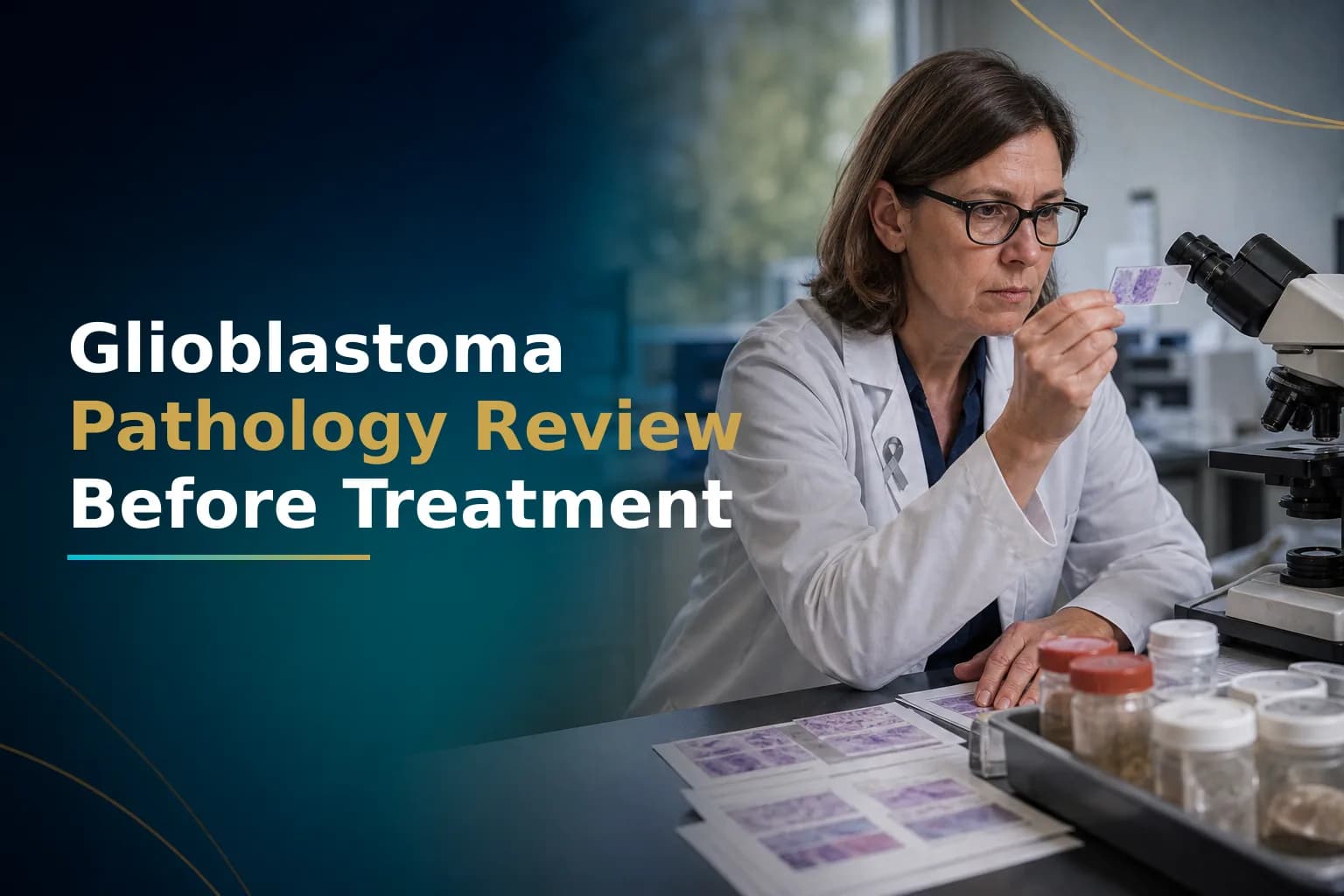
The Question Most Families Ask — and the One They Should Ask First
When a glioblastoma diagnosis arrives, the first instinct is to start treatment immediately. Every day feels urgent. Every delay feels dangerous. Families typically rush to schedule surgery, meet with the oncologist, and start chemotherapy.
That urgency makes sense. But many patients skip a crucial step that can shape every treatment decision that follows.
Before treatment begins, it is worth asking: does your team have a complete molecular picture of your tumor?
Standard pathology confirms the diagnosis and shows what the tumor looks like under a microscope. But it may not show how the tumor behaves at the molecular level: what genetic changes it has and how it might respond to chemotherapy.
Molecular testing provides that deeper layer of information. For newly diagnosed glioblastoma patients, it can change critical treatment decisions made before chemotherapy starts.
What a Standard Pathology Report Does — and Does Not — Tell You
After surgery or biopsy, a tissue sample goes to a pathology lab. A pathologist looks at it under a microscope and writes a report. The report confirms the tumor type, grade, and basic features of the cancer cells.
For glioblastoma, looking at cells under a microscope matters. But it's only part of the picture.
The 2021 World Health Organization (WHO) classification for brain tumors made molecular testing essential for an accurate glioblastoma diagnosis, not optional. Today, IDH mutation status, MGMT promoter methylation, TERT promoter mutations, EGFR amplification, and chromosomal changes are required parts of a complete tumor classification.
A pathology report that only uses microscopic appearance, without molecular markers, can give an incomplete or misleading picture of the tumor type.
This matters because molecular testing can affect treatment choices, clinical trial eligibility, and how doctors measure treatment results.
Why Glioblastoma Is Not One Disease
Glioblastoma is a category, not a single disease. Each tumor is biologically different. Two patients with the same diagnosis might have different genetic changes that affect treatment planning.
The most important molecular markers are:
- MGMT promoter methylation — This epigenetic change silences a DNA repair enzyme. When the MGMT promoter is methylated, the tumor may be less able to repair damage caused by temozolomide chemotherapy. MGMT methylation is an important predictor of how tumors respond to chemotherapy. Research shows that patients with methylated MGMT have different survival rates than those without it when treated with standard chemotherapy.
- IDH mutation status — IDH mutations typically indicate a biologically different tumor with a distinct natural history. Under the 2021 WHO classification, IDH-mutant tumors are now classified separately from IDH-wildtype glioblastoma. This matters for prognosis and potential targeted treatments.
- TERT promoter mutation, EGFR amplification, chromosome 7/10 changes — These markers can move a tumor that looks lower-grade under a microscope into the glioblastoma category, which changes treatment planning.
- CDKN2A/B deletion, PTEN loss, TP53 status — These alterations affect tumor growth pathways and may affect treatment resistance and clinical trial eligibility.
Not all hospitals test for all these markers, and not all reports include the full picture. Expert review and comprehensive testing may uncover information the initial workup missed.
Why Expert Neuropathology Review Can Make a Difference
Glioblastoma is rare. Most community hospitals see few brain tumor cases each year. Neuropathology is the field focused on brain tumor classification. It requires handling many cases to recognize the small but important differences in how tumors behave.
The American Brain Tumor Association recommends that newly diagnosed patients seek care at centers with dedicated neuro-oncology teams and neuropathologists who specialize in brain tumor classification. Expert review of pathology samples is a standard first step for patients who want to confirm their diagnosis before starting treatment.
The National Brain Tumor Society has highlighted in expert interviews that neuropathology teams at specialized centers routinely perform additional molecular testing on tumor tissue, including methylation profiling, that can change how a tumor is classified and how it is treated.
The National Cancer Institute has noted that more precise molecular classification of brain tumors helps clinicians understand patient outcomes, and this precision depends on testing that goes beyond standard histology alone.
An expert review may confirm the first report or find a different classification, a missed marker, or a detail that changes the picture. Either way, it helps patients plan their treatment.
The Window Before Treatment Starts
Most newly diagnosed glioblastoma patients have surgery or biopsy, then a recovery period, then chemoradiation. This recovery period usually lasts several weeks. That time is actually an opportunity.
This is when you can do comprehensive molecular testing, get expert review of your slides, and work with a precision oncology team to understand your tumor before treatment starts.
Once treatment starts, things get more complicated. Waiting until the cancer comes back to ask these questions means you'll be under more pressure, have fewer choices, and might not have enough tumor tissue left to test.
For patients who want to understand their tumor and discuss it with their oncology team before making major decisions, the time between surgery and treatment is the best moment to act.
You can learn more about why timing matters in our related article: Why Molecular Testing Should Happen in the First 6 Weeks After Your Glioblastoma Surgery — and What Goes Wrong When It Doesn't.
What Reports Should You Gather Before Seeking an Expert Review?
If you're considering expert review, gathering the right documents is the first step. You'll need these documents:
- Pathology Report — Your diagnosis from biopsy or resection, including the WHO grade and any molecular tests already done.
- Histopathology Report — The detailed microscopic description of your tumor (sometimes included with the pathology report, sometimes separate).
- MRI Brain Reports — Brain imaging from before and after surgery, ideally with full-resolution images in addition to the written summary.
- Surgical Notes — Your surgeon's operative report, including how much tumor was removed and where it was located.
- Molecular Testing Results — Any tests already done (MGMT, IDH mutation, TERT, EGFR amplification, or others).
- Current Treatment Plan — Your oncologist's proposed treatment schedule, including radiation, chemotherapy, and other planned medications.
- Previous Treatment History — If you've already started treatment, a record of what was given, when, and at what dose.
For a detailed checklist, see: Preparing for Your Tumor Intelligence Review: The Complete Checklist of Reports, Scans, and Data Your Expert Team Actually Needs.
Common Mistakes Families Make in the First Weeks After Diagnosis
The first weeks after a glioblastoma diagnosis are confusing and frightening. Some common patterns can limit a patient's choices later.
Assuming the first pathology report is complete. Initial reports come out fast to confirm the diagnosis and get treatment started. They don't always include all molecular tests. It's reasonable to ask which molecular markers were tested.
Waiting until recurrence to seek a second opinion. Many families wait for expert review until treatment fails. By then, you have fewer choices and may not have enough tumor tissue left. Getting expert review before treatment is better.
Not gathering copies of reports early. Medical records can be hard to transfer, especially across borders. Gather copies of all your reports, scans, and surgical notes early, before you plan expert review. This makes everything easier and faster later.
Assuming geography limits access to expertise. Expert review can happen remotely. You can share pathology reports, MRI scans, and test results online. Initial consultations can be done by video. Patients anywhere — in London, Sydney, New York, Dubai, Toronto, or Berlin — can get expert review without traveling.
Questions to Ask Your Oncology Team Before Treatment Begins
These questions may help you understand how complete your molecular workup is before starting treatment:
- Has MGMT promoter methylation been tested? What were the results?
- Has IDH mutation status been confirmed? Was it assessed by sequencing or immunohistochemistry?
- Were TERT promoter mutations, EGFR amplification, or chromosome 7/10 changes assessed?
- Was the pathology reviewed by a neuropathologist with expertise in brain tumor classification?
- Is there enough remaining tumor tissue for additional molecular testing if needed?
- Are there any open clinical trials my tumor's molecular profile may make me eligible for?
- Has my case been reviewed by a multidisciplinary tumor board?
Most neuro-oncologists appreciate patients who ask informed questions. Bringing these up may help your doctor consider additional testing before treatment.
To learn how molecular testing can change your diagnosis, see: Why Your Glioblastoma Grade Might Change After Molecular Testing: How Molecular Classification Reveals Treatment Options Your Histology Report Missed.
When to talk to your doctor: If you've recently been diagnosed and haven't started treatment, talk to your neuro-oncologist about what testing has been done and whether more is needed before treatment. If you're not sure your pathology report uses the latest WHO 2021 standards, ask your care team or an expert at a specialized center.
This article is for general information and is not a substitute for medical advice. Always consult your oncologist or care team about your specific situation.