The Question That Follows Every Pathology Report
You received a diagnosis. The pathology report said "glioblastoma" or perhaps "grade III astrocytoma." Weeks later, new testing comes back and the classification changed.
This is not a mistake. It is science catching up to your specific tumor.
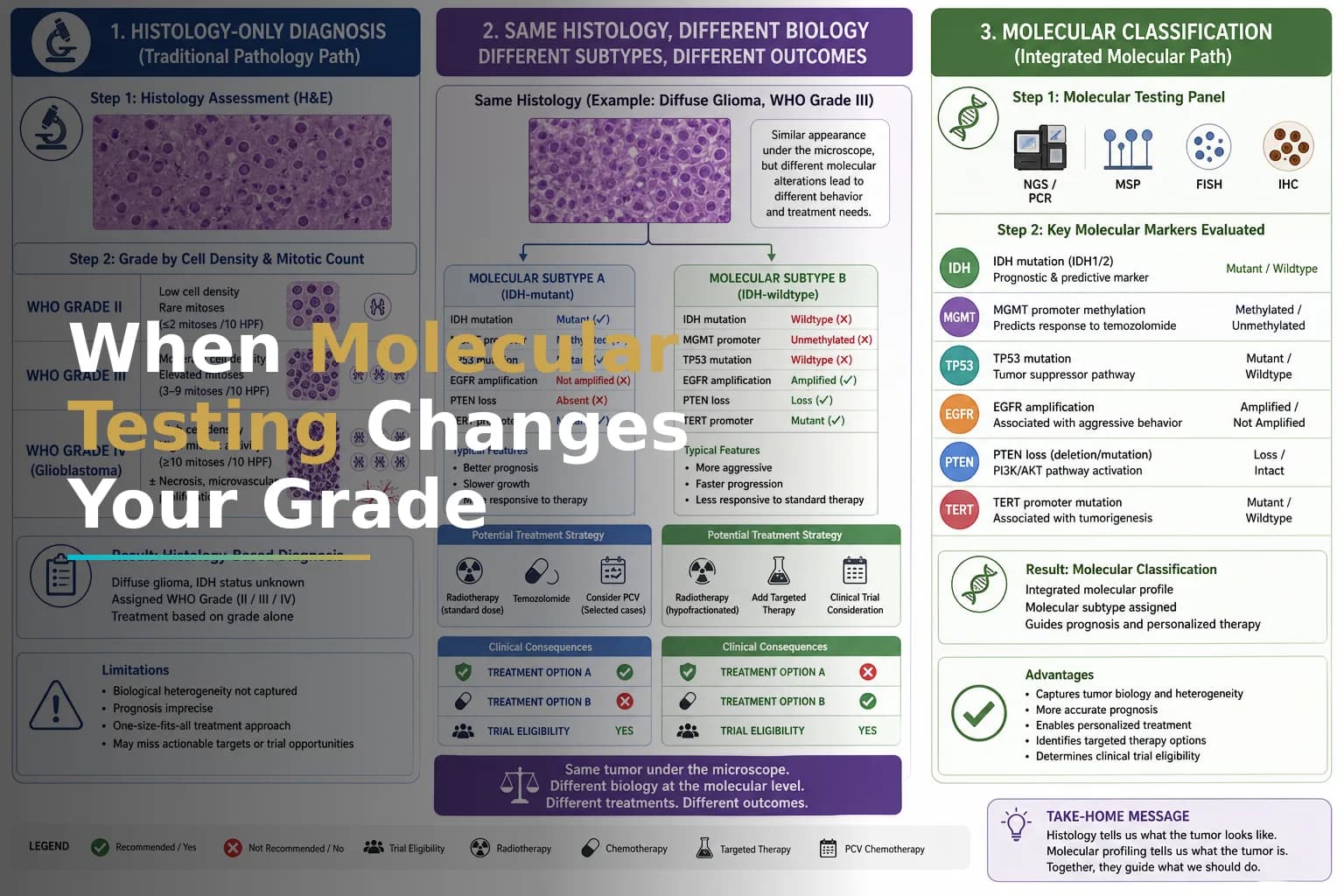
How doctors diagnose glioblastoma has changed significantly in recent years. Microscope-based analysis (histology) has long been the first step in classifying brain tumors. But histology alone misses important information. Molecular testing goes deeper. What it finds can change the diagnosis, shift the grade, and sometimes open new treatment options.
Why this matters goes beyond theory. For many patients and families, it means choosing between a standard treatment plan and one tailored to their specific tumor's biology.
How Brain Tumors Were Graded Before Molecular Testing
For decades, pathologists graded brain tumors based on what they saw under a microscope. They looked at cell division rates, signs of tissue death, and how abnormal the cell centers appeared.
This approach worked as a starting point. But it had a weakness. Two tumors that looked nearly identical under a microscope could behave very differently in patients. One might respond well to chemotherapy. The other might not respond at all.
The reason is genetics. And the genetics of a tumor cannot be seen through a microscope.
The 2021 WHO Classification — A Turning Point for Glioblastoma Patients
In 2021, the World Health Organization updated how central nervous system tumors are classified. The new guidelines made molecular markers (not just microscope appearance) central to diagnosis and grading. It was one of the biggest changes in brain tumor treatment in decades.
This shift was particularly important for patients with glioblastoma.
Under the new system, a tumor is only classified as glioblastoma if it is IDH-wildtype. Tumors previously called "glioblastoma" that have an IDH mutation are now reclassified as "astrocytoma, IDH-mutant, grade 4." The biology differs. Treatment may differ. Prognosis may differ.
According to a real-world reclassification study examining the practical significance of the 2021 WHO criteria, a proportion of tumors previously labeled glioblastoma multiforme were reclassified under the updated system. Some were confirmed as true IDH-wildtype GBM, others moved into distinct molecular categories. In every case, the treatment conversation changed.
This is not theory. It changes how treatment is planned from day one.
What Histology Can and Cannot Tell You
A histology report shows what the tumor's cells look like under a microscope. It reveals how aggressive they appear. It can spot structural features like tissue death and abnormal blood vessel formation that suggest high-grade tumors.
What histology cannot tell you:
- Whether the tumor carries an IDH mutation
- Whether the MGMT promoter is methylated
- Whether EGFR is amplified
- Whether there is a TERT promoter mutation
- Whether chromosome 7 has been gained or chromosome 10 has been lost
- Whether there are other actionable molecular alterations that may affect clinical trial eligibility
Each marker affects how your tumor behaves and how it responds to treatment. None are visible under a standard microscope.
The Markers That Can Change Your Grade — and Your Treatment Conversation
IDH Mutation Status
IDH1 and IDH2 mutations are key markers in glioma biology. Under the 2021 WHO system, IDH status determines whether a tumor is classified as glioblastoma. A tumor that looks like GBM under a microscope but has an IDH mutation is reclassified as astrocytoma, grade 4, not glioblastoma. Treatment for IDH-mutant tumors may differ from true IDH-wildtype glioblastoma.
MGMT Methylation
MGMT is a DNA repair gene. When methylated, it stops working. The American Brain Tumor Association reports that about 35 to 40 percent of glioblastomas have MGMT promoter methylation. This affects how the tumor responds to certain chemotherapy drugs. MGMT status is the most established marker for predicting response to temozolomide in IDH-wildtype glioblastoma. According to current clinical guidance on molecular testing in gliomas, whether your MGMT is methylated shapes chemotherapy decisions early in treatment.
EGFR Amplification and TERT Promoter Mutation
A tumor that looks like a lower-grade astrocytoma under the microscope can be classified as glioblastoma if molecular testing shows EGFR amplification, a TERT promoter mutation, or a specific pattern of chromosomal changes on chromosomes 7 and 10. This means a patient told they have a grade II or III tumor based on appearance alone may actually have a biologically aggressive GBM. Treatment strategy needs to reflect that. The opposite also happens: a tumor that looked like GBM may have molecular features that put it in a different category.
For a detailed breakdown of what each marker means in practice, the guide to interpreting your glioblastoma molecular report covers the key results and their clinical significance.
The Gap Between a Standard Pathology Report and a Full Molecular Picture
Many hospitals include IDH and MGMT testing in standard pathology. These are now baseline. But not all centers run a complete molecular panel. Testing for EGFR amplification, chromosome copy number changes, TERT mutations, and extended panels may need extra steps or a specialist review at a brain tumor center.
Published research analyzing real-world patient cohorts under the 2021 classification has described meaningful differences in biological behavior between histologically defined and molecularly defined glioblastoma, underscoring why the integrated approach to diagnosis matters in clinical practice, not just in research settings.
Patients diagnosed at a general hospital may have gaps in molecular testing if comprehensive screening is not available. If you are unsure whether your report included full testing, the article on molecular tests for newly diagnosed glioblastoma explains what a complete panel includes.
What Full Molecular Profiling May Reveal Beyond Standard Testing
Comprehensive molecular profiling (whole exome sequencing and RNA sequencing) goes beyond standard pathology panels. A pilot study on personalized glioblastoma treatment using whole exome sequencing found that molecularly matched approaches may identify treatment options standard assessment would miss.
What expanded molecular analysis may reveal:
- Rare mutations not found on standard panels
- How the tumor may respond to different drugs
- Information that affects clinical trial eligibility
- Signs of resistance that could guide treatment if cancer returns
- Multiple mutations that affect how treatment combinations work
These findings are not treatments by themselves. They are information that may sharpen questions for your oncology team and help identify options worth exploring.
Common Mistakes Families Make After Diagnosis
Families facing glioblastoma often move fast. Surgery happens within days. Treatment starts within weeks. There is rarely time to pause. But several patterns repeat that matter before making major decisions.
Stopping at the initial report. Many families take the first pathology report as complete. Standard reports may not include all molecular markers under the 2021 WHO system, especially if the center hasn't fully adopted the new guidelines.
Not asking about MGMT. MGMT methylation testing is standard at many cancer centers, but not all. If the report does not mention it, ask specifically whether it was performed.
Conflating grade with prognosis. Grade matters, but molecular subtype matters too. Two grade 4 tumors can behave very differently depending on IDH status, MGMT methylation, and other markers. A number alone doesn't tell the full story.
Delaying a pathology second opinion. A specialist brain tumor center may add precision to an initial diagnosis or occasionally change it. More details are in the article on second opinion glioma pathology and molecular verification.
What Reports Should You Gather Before Seeking an Expert Review?
If you want additional clarity on your molecular profile or are considering expert review, gather these documents so any specialist has a complete picture:
- Pathology Report — the full report, not just the summary page
- Histopathology Report — including detailed findings from the neuropathologist
- MRI Brain Reports — scans from before surgery, after surgery, and all follow-up scans
- Surgical Notes — including how much tumor was removed and findings during surgery
- Molecular Testing Results — IDH, MGMT, EGFR, TERT, and any next-generation sequencing results
- Current Treatment Plan — radiation schedule and chemotherapy plan
- Previous Treatment History — all prior treatments if the tumor has returned
A complete guide to gathering these documents is in the tumor intelligence review preparation checklist.
Many families seek additional clarity before major treatment decisions. A detailed review of pathology and molecular results may reveal insights to discuss with your care team.
What International Patients Need to Know
Patients and families in London, Manchester, Birmingham, New York, Sydney, Melbourne, Toronto, Dubai, and Berlin regularly seek expert review after glioblastoma diagnosis. Not because local doctors are wrong, but because glioblastoma is complex. Extra precision oncology input can clarify molecular classification and treatment options.
Geography is no longer a barrier. Pathology reports can be reviewed remotely. MRI scans can be read online. Molecular results can be interpreted by specialists no matter where testing happened. Initial talks can happen online. What matters is the depth of molecular analysis and accuracy of interpretation, not where the expert is located.
Many families start with a virtual consultation and report review. This adds to local care rather than replacing it, giving information that can lead to clearer conversations with your local team.
Questions to Ask Your Oncology Team
Before your next appointment, ask your care team:
- Has my tumor been tested for IDH mutation status?
- Does my report include MGMT promoter methylation testing?
- Were EGFR amplification and TERT promoter mutation assessed?
- Did you check for copy number changes on chromosomes 7 and 10?
- Does my diagnosis follow the 2021 WHO classification system?
- Are there molecular markers that might affect my clinical trial eligibility?
- Did a brain tumor specialist review my pathology?
These are not challenges to your care team. They are the kind of focused questions that a good oncology team expects and welcomes.
When to Talk to Your Doctor
If you have received a pathology report and aren't sure whether full molecular testing was done, ask at your next appointment. If you're considering expert review of your molecular profile, gather your reports and discuss this with your care team. A good oncology team will support additional specialist review. Understanding your tumor's biology deeply is not a distraction from treatment. It's part of making clear treatment decisions.
This article is for general information and is not a substitute for medical advice. Always consult your oncologist or care team about your specific situation.