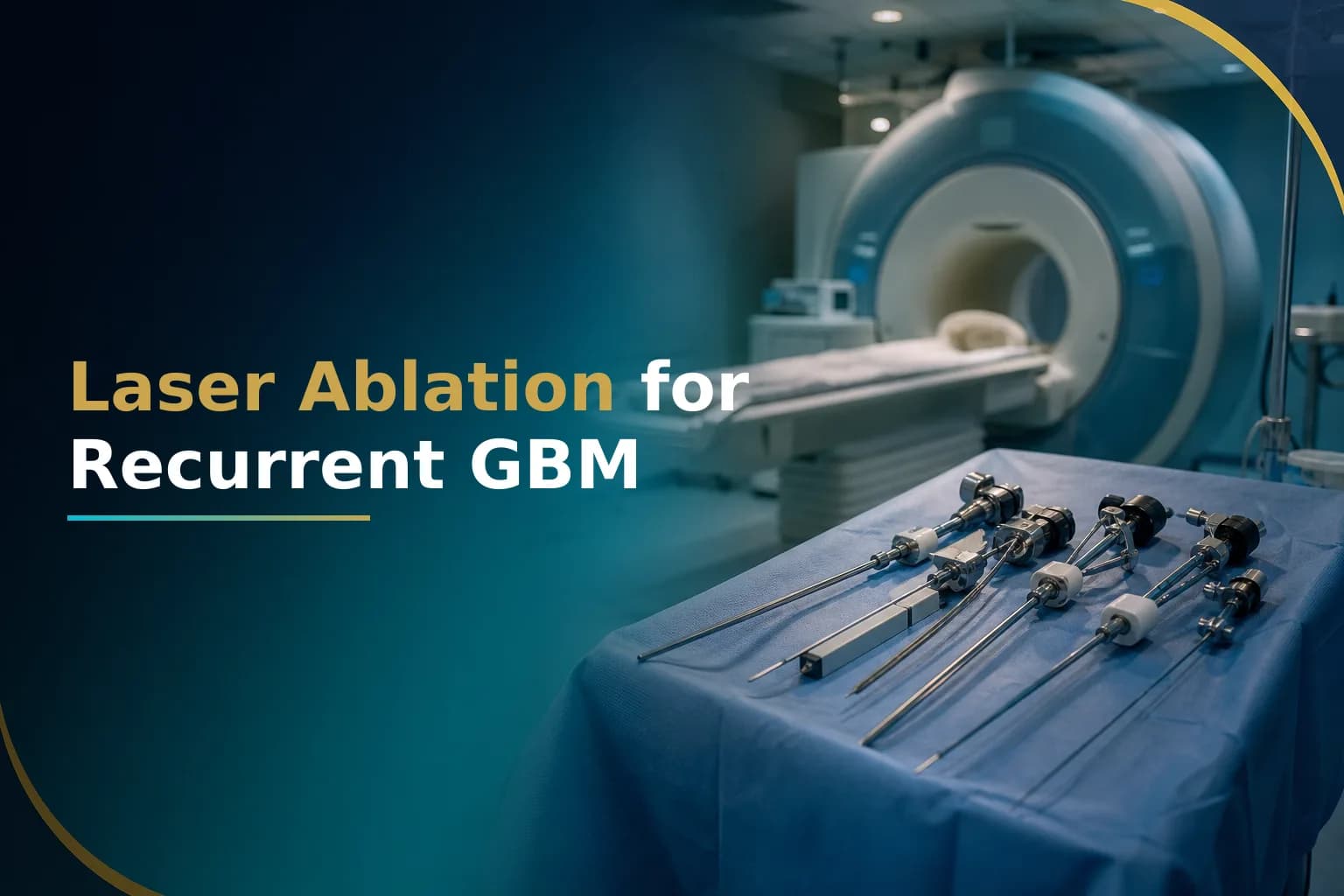
When glioblastoma returns after treatment, LITT (laser interstitial thermal therapy) or laser ablation is a possible option for some patients. The procedure uses a thin laser probe inserted through a small hole in the skull to heat and destroy tumor tissue. A doctor watches the treatment on an MRI screen in real time. For the right patient, it can reach tumors that regular surgery cannot safely reach. It also avoids giving more radiation to a brain that has already received maximum radiation dose. This guide explains how laser ablation for recurrent glioblastoma works, who can get it, and how it compares to re-irradiation at first recurrence.
If you are still working through the broader landscape of options after a recurrence, the recurrent glioblastoma salvage treatment guide on this site covers the full range of approaches from bevacizumab to clinical trials.
How does laser ablation compare to re-irradiation for recurrent glioblastoma?
Both LITT and re-irradiation are local treatments. They target the recurrence site rather than the whole brain. But they work differently, fit different patients, and leave different options for future treatment. The table below shows the main practical differences.
| Factor | LITT (Laser Ablation) | Re-Irradiation (SRS / FSRT) |
|---|---|---|
| Procedure type | Minimally invasive surgery; requires a brief hospital admission | Outpatient radiation; no incision required |
| Typical candidate | Single lesion roughly 1-4 cm; deep-seated or in eloquent cortex; prior radiation dose limits already reached | Small to moderate recurrence with adequate distance from prior radiation field; open surgery not preferred |
| Typical hospital stay | 1-3 nights (approximately 2.8-3.5 days in published cohorts) | Outpatient; 1-5 short sessions depending on technique (SRS vs FSRT) |
| Main risks | Thermal injury to surrounding tissue; seizure; transient neurological deficit; morbidity approximately 6.4% in pooled data | Radiation necrosis; brain swelling; cumulative radiation dose to previously treated healthy brain tissue |
| Median OS after procedure | Approximately 9-10 months in prospective studies; varies by patient selection | Varies by technique and patient selection; see our re-irradiation comparison guide for full detail |
| Opens door to further treatment | Temporary blood-brain barrier disruption may enhance immunotherapy or chemotherapy uptake in the weeks after ablation | Does not inherently disrupt blood-brain barrier permeability |
Hospital stay and morbidity data sourced from a 2021 pooled analysis of LITT for recurrent glioblastoma (PubMed) and a prospective multicenter registry published in Neuro-Oncology Advances (2022). Re-irradiation data in the right column reflects qualitative characterizations across published series rather than a single primary source.
Neither approach works best for everyone. LITT is often chosen when prior radiation limits have been reached, when the tumor sits in a location where open surgery is risky, or when the team wants to keep the option of immune-based therapy in the weeks after ablation. Re-irradiation is often chosen when the prior radiation field still allows more dose, when surgery is not available, or when the patient prefers a procedure without an incision. The two approaches can also work together. Some teams have used LITT followed by a short course of stereotactic radiation, or radiation followed by LITT at a later recurrence.
What exactly is LITT and how does the procedure work?
LITT stands for laser interstitial thermal therapy. The neurosurgeon drills a small hole, roughly the width of a standard pencil, through the skull. A thin, flexible laser fiber is inserted and guided to the tumor using real-time MRI navigation. Once positioned inside or near the tumor, the fiber delivers concentrated laser heat that destroys tumor cells in a controlled zone. MRI thermometry, which maps tissue temperature in real time, monitors heat in the surrounding structures continuously. This allows the surgeon to stop heating before nearby healthy tissue reaches dangerous temperatures.
The technology is FDA-cleared for ablating abnormal soft tissue in the brain. What sets it apart from traditional surgery is the size of the opening. There is no large skull opening, no pulling back of brain tissue, and no long surgery under anesthesia. Most patients are up and moving within a day and go home within 1-3 nights, according to prospective multicenter registry data in recurrent IDH wild-type glioblastoma patients.
The trade-off is reach. LITT works best on a single, well-defined lesion roughly 1 to 4 centimeters across. Very large tumors or spread-out recurrences are hard to ablate completely because the heat cannot safely cover a wide area without damaging surrounding brain. Most clinical trial inclusion criteria cap tumor volume at approximately 10 cubic centimeters.
Who is a candidate for LITT at recurrence?
Patient selection is where LITT and re-irradiation differ most clearly. Most neuro-oncology teams consider LITT when several conditions are met.
- The recurrence is a single, focal lesion, not a spread-out or multifocal infiltration
- The lesion is small, generally under 4 cm in its widest diameter
- The location is deep-seated, near eloquent cortex, or in a region where open surgery carries high risk of permanent neurological deficit
- The patient has already received full-dose first-line radiation (typically 60 Gy over six weeks with the Stupp protocol), making additional external beam radiation unsafe at the same site
- Performance status is reasonably preserved. Most published series and clinical trials require a Karnofsky Performance Score above 60
Re-irradiation with stereotactic techniques is more often considered when the tumor is not deep-seated, when the prior radiation field still allows more dose, or when the patient prefers to avoid any surgical procedure. Some teams use a combination approach: LITT followed by a short course of stereotactic radiation, or radiation at first recurrence followed by LITT at a later one. These sequences are still being evaluated in prospective studies.
Decisions at recurrence are not straightforward. What looks like a clear recurrence on MRI can sometimes be pseudoprogression or treatment-related inflammation rather than true tumor regrowth. Before committing to any local therapy, it is worth having your imaging reviewed carefully. If there is genuine uncertainty about what the scan shows, speak with the Art of Healing Cancer team about your case. A remote imaging review can sometimes clarify the picture without requiring travel.
What does the evidence actually show?
The honest answer is that LITT evidence for recurrent GBM is largely retrospective. No large randomized trial has compared LITT directly against re-irradiation or against bevacizumab alone. What exists are single-center series and pooled analyses, which show broadly consistent results across institutions.
A 2021 pooled analysis of available LITT literature found a median progression-free survival of approximately 5.6 months and median overall survival of approximately 10.2 months after the procedure in recurrent GBM patients. A prospective multicenter registry of recurrent IDH wild-type GBM reported a median post-procedure survival of approximately 8.97 months (95% confidence interval: 6.94 to 12.36 months), published in Neuro-Oncology Advances in 2022.
These numbers are broadly similar to what is reported with re-irradiation in comparable patients. This makes a meaningful head-to-head comparison difficult without randomized data. What matters clinically is less a population-level median and more which option fits the individual patient's tumor location, prior treatment history, and downstream treatment goals.
The safety profile of LITT looks favorable in published series. Pooled data show the overall morbidity rate at approximately 6.4%, with seizure, transient motor deficit, and wound complications being the most frequently reported adverse events. Median hospital stays across studies fall consistently in the 2.8 to 3.5 day range.
Why LITT may open a window for immunotherapy
One of the more scientifically interesting aspects of LITT is what it does to the blood-brain barrier. This is the tight cellular layer that normally stops most drugs and immune cells from reaching the brain. LITT causes a temporary disruption of this barrier in the tissue surrounding the ablation zone. Research published in PLOS One found that this peritumoral disruption resolves within approximately 4 to 6 weeks in most patients. During that window, barrier permeability is meaningfully elevated.
This observation has prompted clinical investigators to time immune checkpoint inhibitors, drugs that activate the immune system to attack residual tumor cells, to begin in the weeks immediately after ablation. The logic is to use LITT to destroy the bulk of the recurrence, then exploit the open-barrier window to deliver immune therapy while T cells and drugs have better access to the tumor environment. Several trials are testing this strategy. One active example is NCT03022578, which evaluated LITT combined with lomustine chemotherapy for recurrent GBM. A newer study (NCT07620548) is examining LITT combined with cemiplimab, a PD-1 checkpoint inhibitor, in recurrent glioblastomas.
Re-irradiation does not produce the same blood-brain barrier disruption effect. If a treatment team is planning downstream immunotherapy trial enrollment, that biological distinction may influence which local treatment they recommend first. This is worth asking about explicitly when you discuss your options with your neuro-oncologist.
For a broader overview of how to search for trials that match your tumor's molecular profile, the clinical trial search strategy guide on this site walks through how to identify studies you may actually qualify for.
Practical questions to ask before choosing laser ablation
If LITT is being proposed or if you want to raise it with your team, these questions help clarify whether it is a realistic fit for your situation.
- Is this recurrence confirmed on imaging, or could it be treatment effect or pseudoprogression? A second MRI read or advanced imaging such as MRI perfusion or amino acid PET may be warranted before any surgery.
- Is the tumor volume within the range your center can effectively ablate with LITT?
- Has the prior radiation dose at this location reached the safe threshold for re-irradiation? If not, re-irradiation may still be a viable alternative.
- How many LITT procedures for glioblastoma has your neurosurgeon completed? Volume matters for both accuracy and complication rates.
- Is there a clinical trial combining LITT with another agent at your center or a nearby academic medical center that you may qualify for?
- What is the plan if the ablation is incomplete? Can the team follow with radiation, additional chemotherapy, or a trial?
When to talk to your doctor
Raise the question of LITT or re-irradiation with your neuro-oncologist at the first sign of radiographic progression. Both options require input from a multidisciplinary team. A radiation oncologist, a neurosurgeon experienced with MRI-guided laser ablation, and your medical oncologist should all weigh in before a decision is made. If your current center does not perform LITT, ask for a referral to an academic medical center that does, or request that your imaging be reviewed by a center with LITT experience. Getting a second opinion at recurrence is standard practice in neuro-oncology. You can also upload your most recent MRI reports and pathology at glioblastoma.center/patient-journey to request a remote review of whether laser ablation or another local treatment approach may be appropriate for your specific situation.
This article is for general information and is not a substitute for medical advice. Always consult your oncologist or care team about your specific situation.