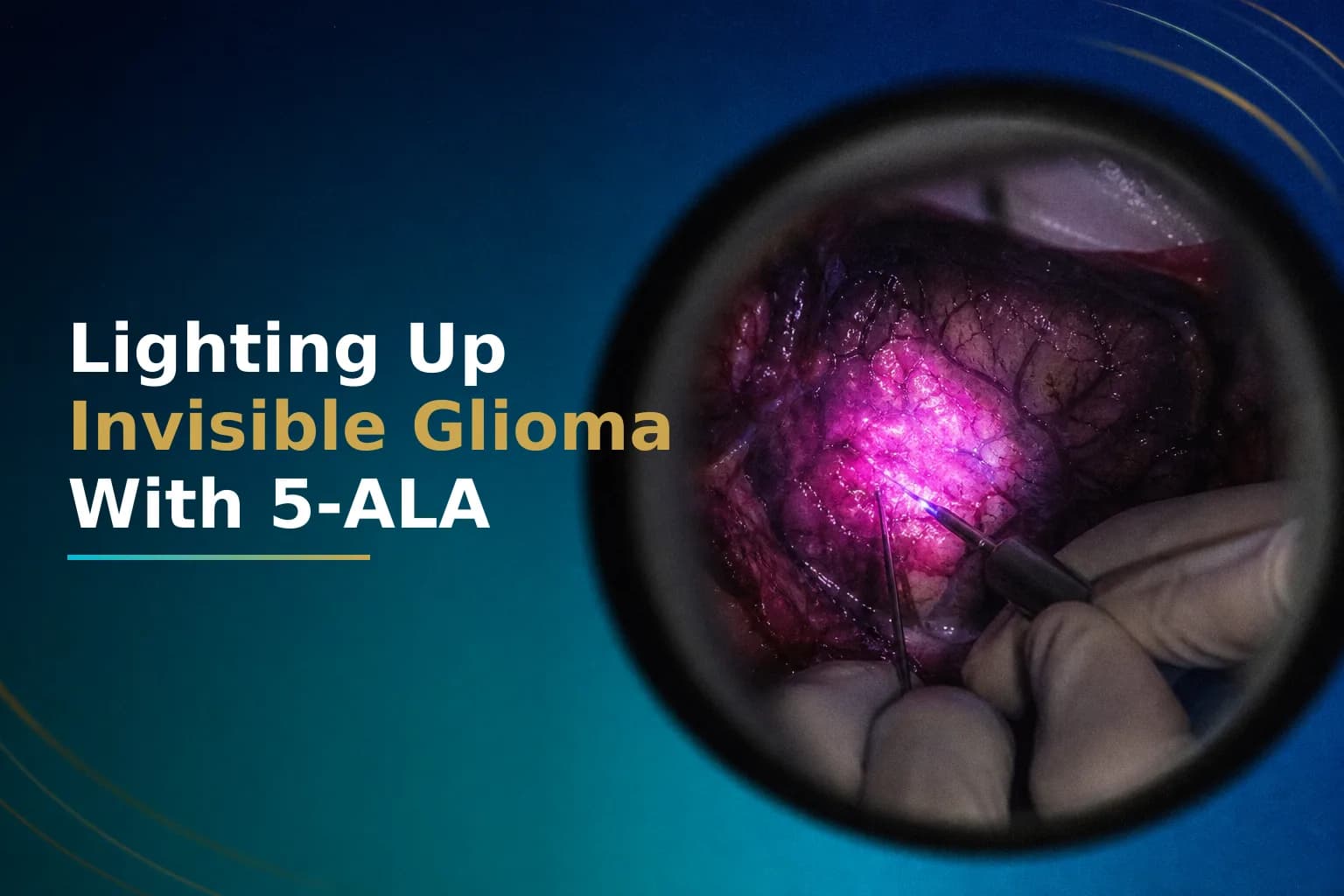
What Is Fluorescence-Guided Surgery?
Standard brain surgery relies on white light and the surgeon's trained eye. The problem with high-grade gliomas is that they do not have clean edges. Tumor cells spread into surrounding brain tissue in ways that MRI cannot always fully reveal before the operation. A neurosurgeon can remove what looks like all visible tumor and still leave behind thousands of cancer cells.
Fluorescence-guided surgery (FGS) gives surgeons another way to see. The patient drinks a special dye a few hours before the operation. When the surgeon switches to a blue light setting on the operating microscope, tumor tissue glows pink or violet. Normal brain stays dark. That color contrast helps the surgeon find and remove cells they might otherwise have missed during the craniotomy.
The Dye: What Is 5-ALA and How Does It Work?
The agent used in this technique is 5-aminolevulinic acid, known as 5-ALA. Gleolan is its brand name. The U.S. Food and Drug Administration approved Gleolan in June 2017 as the first optical imaging agent for visualizing cancer during brain tumor surgery, specifically for tumors with suspected WHO grade III or IV classification. It was the first agent of its kind approved in the United States for this purpose.
5-ALA is a naturally occurring amino acid your body uses to make heme, the molecule inside red blood cells. When you take it by mouth, it enters your bloodstream and crosses the blood-brain barrier that high-grade gliomas often damage. Inside tumor cells, it converts into a fluorescent compound called protoporphyrin IX, or PpIX.
Normal brain cells also process 5-ALA, but tumor cells accumulate PpIX at a much higher rate. Studies in peer-reviewed journals show that uptake in WHO grade III and IV glioma tissue is roughly six times greater than in normal brain. When the surgeon activates the blue light mode on the operating microscope (using wavelengths between 375 and 440 nanometers), those PpIX-filled tumor cells emit a bright pink-red glow (at wavelengths of 620 to 710 nanometers). You can see the contrast immediately, with no waiting for laboratory results.
How the Procedure Works, Step by Step
Understanding the process can help you prepare and ask better questions of your surgical team.
- Before surgery: You drink an oral 5-ALA solution (a standard dose of 20 mg per kilogram of body weight) approximately three hours before anesthesia starts. Timing matters because peak fluorescence in tumor tissue builds up over several hours after you take it.
- During surgery: The neurosurgeon works with a specially equipped microscope that has a blue light source and optical filters. At any point during the operation, the surgeon can toggle between white light (for standard tissue viewing and protecting blood vessels and nerves) and blue light to check if any remaining tissue still glows pink, which signals active tumor cells.
- After surgery: Because 5-ALA temporarily makes your skin light-sensitive, you'll stay in a dimmed room for roughly 24 to 48 hours after the procedure. Hospital staff will lower the lighting in your recovery area. Your team will advise you to avoid direct sunlight and strong indoor lighting during this time to prevent a sunburn-type skin reaction.
What the Clinical Evidence Shows
The evidence for 5-ALA comes from a large, multicenter, phase III randomized trial that led to FDA approval. That study found that surgeons using 5-ALA removed the entire tumor significantly more often than surgeons working under white light alone, with better results during surgery.
A review of multiple studies on high-grade glioma patients found that 5-ALA surgery was linked with better progression-free survival and overall survival compared to conventional white-light surgery, though the improvements varied across individual studies. Read the systematic review and meta-analysis on NIH PubMed Central.
A more recent head-to-head analysis found that about 75% of patients who had 5-ALA surgery had their entire tumor removed, compared to about 54% in the white-light surgery group. Median progression-free survival reached approximately 8.1 months in the 5-ALA group versus 5.4 months in the white-light group. Median overall survival was approximately 15.2 months versus 12.3 months. See the full comparative clinical outcomes analysis.
Researchers emphasize that 5-ALA alone does not produce these results. The survival data shows how fluorescence-guided surgery fits within a complete treatment plan that includes radiation and chemotherapy after surgery. Removing more tumor gives the follow-up treatments a smaller target. That is the core reason for trying to remove as much tumor as safely possible.
Who Is a Candidate for 5-ALA Surgery?
Gleolan is FDA-approved for patients with suspected WHO grade III or IV gliomas when surgery aims to remove all or most of the tumor. That includes glioblastoma and anaplastic astrocytoma, among other high-grade subtypes.
Not everyone qualifies. The procedure is generally not appropriate for people who have:
- A known allergy to 5-ALA or to porphyrins, a related class of molecules
- A diagnosis of porphyria, a group of metabolic disorders affecting how the body handles porphyrin compounds
- Significant liver impairment, with enzyme levels above defined thresholds
- Reduced kidney function, with creatinine clearance below approximately 30 mL per minute
- An active pregnancy
Your care team will review your blood tests, medical history, and imaging before confirming whether 5-ALA is appropriate for your surgery.
What 5-ALA Cannot Do: Limitations to Know
5-ALA is an important advance in glioma surgery, but patients should understand its limits.
It does not light up all tumor cells equally. 5-ALA works best on rapidly growing, high-grade tumor cells. Some infiltrating cells at the tumor margin, even in grade IV gliomas, may not accumulate enough PpIX to glow detectably. Studies suggest that roughly 20% of grade II gliomas show any fluorescence at all under 5-ALA, meaning surgeons might miss lower-grade infiltrating zones. The surgeon still depends on preoperative MRI data and intraoperative judgment for those areas.
Specialized equipment is required. The technique requires an operating microscope that has a specific blue light source and optical filters. Not every hospital has this equipment. Studies suggest that surgeons need to perform roughly 10 to 15 cases before they reach consistent proficiency with the technique, a factor that can affect quality at lower-volume centers.
Proximity to critical brain structures still limits resection. Even when tumor cells glow, the surgeon must weigh removal against the risk of injuring motor, language, or other critical brain areas. Fluorescence shows which cells are tumor, but it does not override the need to protect vital brain tissue. This is why surgeons often pair FGS with awake craniotomy and cortical mapping when the tumor is near functional regions.
For a broader look at how 5-ALA compares with other fluorescent agents now under study, a recent analysis examined multiple intraoperative fluorescence approaches in high-grade glioma surgery. Read the comparative fluorescence techniques analysis.
How 5-ALA Fits With Other Intraoperative Tools
At experienced brain tumor centers, fluorescence-guided surgery is one part of a combined intraoperative strategy. Other tools surgeons commonly use alongside 5-ALA include:
- Intraoperative MRI (iMRI): A real-time MRI scan taken while the patient is still on the table, used to evaluate how much tumor remains before the wound is closed.
- Intraoperative ultrasound: A real-time imaging approach that helps visualize tumor boundaries continuously throughout the procedure.
- Awake craniotomy with cortical mapping: The patient remains conscious during parts of the surgery so the team can monitor motor or language function while removing tumor near functional areas.
- Neuronavigation: A GPS-like system that maps preoperative MRI data onto the surgical field, helping the surgeon stay oriented throughout the resection.
Together, these tools support what surgeons call maximal safe resection, removing as much tumor as possible while protecting the brain tissue that controls your movement, speech, and memory. The goal is not simply removing tumor but removing the most tumor without causing new neurological deficits.
If you are exploring other procedure-based options for high-grade glioma, particularly for recurrent cases where a traditional craniotomy may not be the best fit, see our article on Laser Interstitial Thermal Therapy (LITT) for recurrent anaplastic astrocytoma, a minimally invasive ablation approach used in different clinical circumstances.
What Happens After Fluorescence-Guided Surgery
Surgery is the first step, not the complete treatment. For glioblastoma and other WHO grade III–IV gliomas, the standard approach after surgery is external beam radiation combined with temozolomide chemotherapy, typically following the Stupp protocol or a variation of it. 5-ALA helps maximize the volume of tumor removed, which gives follow-up treatments a smaller residual to work against.
Surgeons also use the tissue removed during surgery for molecular tumor profiling. Tests check for MGMT methylation, IDH mutation status, EGFR amplification, and other biomarkers in the surgical specimen. Those results shape every treatment decision that follows, including chemotherapy strategy, consideration of Tumor Treating Fields, and eligibility for clinical trials. For a detailed explanation of what those tests mean for your care, see our guide to molecular testing for newly diagnosed glioblastoma.
Recovery from a craniotomy with 5-ALA generally follows the same timeline as conventional glioma surgery. Most patients spend several days in the hospital. The light-sensitivity precautions add a short, manageable step to recovery but do not typically extend the hospital stay. Your care team will assess your rehabilitation needs (physical, occupational, or speech therapy) individually based on tumor location and the extent of surgery.
What Is Being Studied Now
Doctors have used 5-ALA clinically in Europe since the mid-2000s and in the United States since 2017. Researchers continue to refine and expand its use.
Active areas of investigation include:
- Combining 5-ALA with other fluorescent agents such as fluorescein sodium, to extend detection to tumor margins that 5-ALA alone may miss.
- Handheld fluorescence probes and exoscopes that give surgical teams more flexibility beyond the view of a fixed operating microscope.
- Photodynamic therapy (PDT): Because PpIX accumulates in tumor cells and can be activated by specific light wavelengths to damage tissue, researchers are exploring whether a targeted light treatment step after the resection phase might destroy residual cells. Early trials are ongoing.
- Pediatric applications: Clinical studies are investigating 5-ALA use in children with high-grade brain tumors, where the evidence base is less established than in adults.
One registered trial (NCT05929456) is studying a dual-agent approach combining 5-ALA with a second fluorescence dye that targets EGFR-expressing tumor cells, aiming to illuminate cells that 5-ALA alone may not detect. See the bimodal fluorescence surgery trial on ClinicalTrials.gov.
For patients interested in other technology-based adjuncts used alongside standard-of-care glioblastoma treatment, our article on Tumor Treating Fields (TTFields) and the Optune device explains how electric field therapy works during the maintenance phase after surgery and radiation.
When to Talk to Your Doctor
If you have been diagnosed with a high-grade glioma and surgery is being planned or discussed, consider raising these questions with your neurosurgeon:
- Is fluorescence-guided surgery with 5-ALA available at this center?
- Based on my tumor location, liver function, and overall health, am I a candidate?
- What other intraoperative tools, such as iMRI, cortical mapping, or neuronavigation, will be used alongside 5-ALA?
- If this center does not offer 5-ALA surgery, can you refer me to a high-volume brain tumor center that does?
These are practical, appropriate questions. Your care team can answer them once they have reviewed your imaging, blood work, and surgical plan.
This article is for general information and is not a substitute for medical advice. Always consult your oncologist or care team about your specific situation.