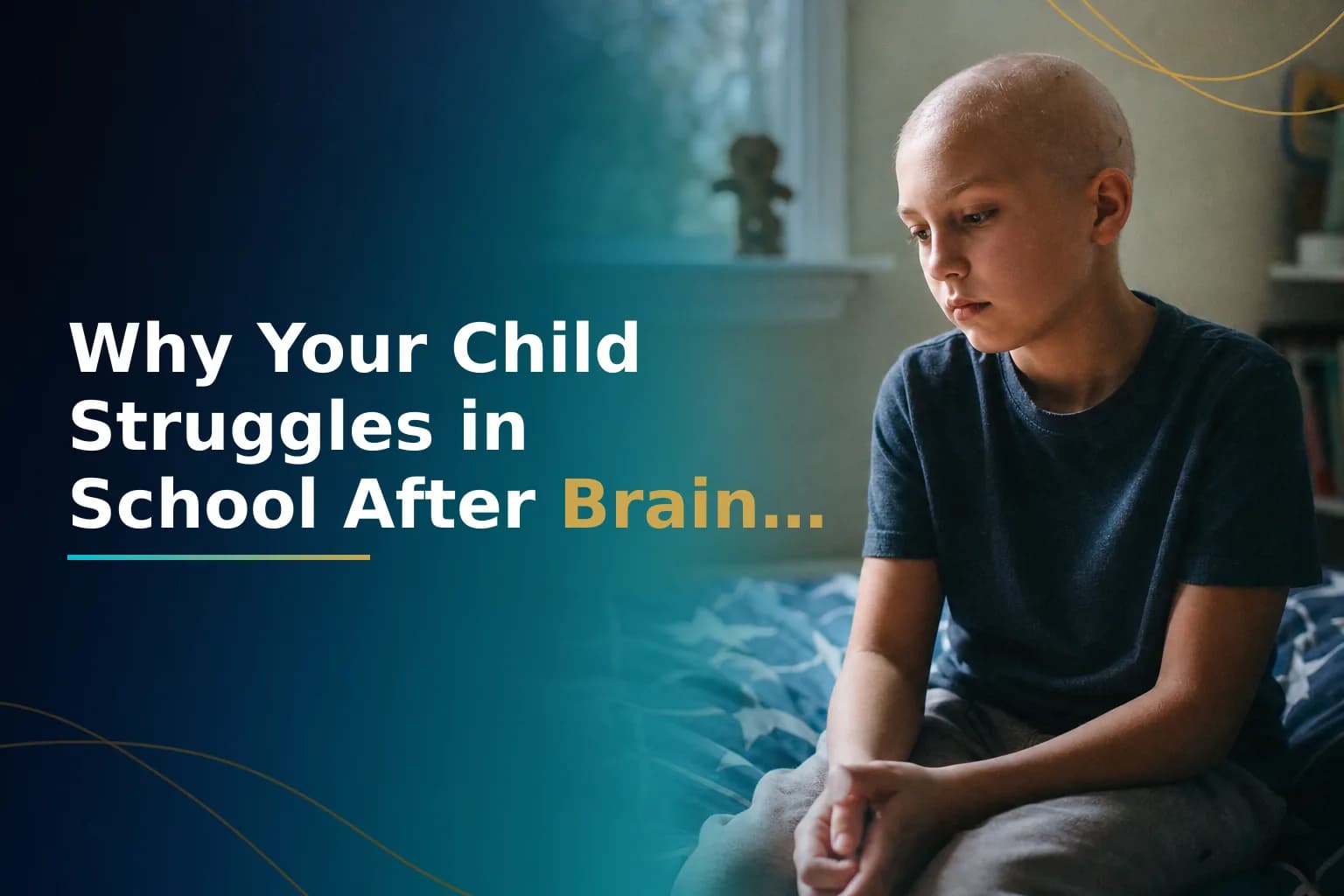
Your child finished treatment. That is huge. But now a new challenge appears — homework that used to be easy feels impossible, reading seems harder than before, attention slips away in the middle of a lesson. You wonder: Is this the tumor? The treatment? Is it permanent?
You are not imagining it. Cognitive changes after pediatric glioblastoma and other high-grade brain tumors are real and well-documented. The good news is that these changes can be addressed. This article explains why these changes happen, what they look like in the classroom, and what you can do right now to help your child succeed in school.
Why the Developing Brain Is Especially Vulnerable
A child's brain is not a small adult brain. It is a rapidly growing organ that is constantly rewiring itself. White matter — the wiring that connects different brain regions — is still developing through adolescence. Any injury to the brain during childhood, whether from a tumor or its treatment, can disrupt systems that are not fully formed yet.
Research published on the NCBI Bookshelf notes that cranial radiation in pediatric glioblastoma is typically avoided before age three because of its potential to harm brain development in young children. Even in older children, the risks are significant.
It is also important to understand that cognitive difficulties may begin even before treatment starts. A study published in Pediatric Blood & Cancer found that children with brain tumors may show slower processing speed, memory problems, and attention difficulties even after surgery, before other treatments begin. The tumor itself, and the pressure it places on surrounding brain tissue, starts the process. Treatment then continues it.
The Three Main Treatment Causes
1. Radiation Therapy
Radiation is a key part of pediatric glioblastoma treatment. It is effective at targeting tumor cells, but it does not stop at tumor boundaries. Healthy brain tissue, including structures involved in memory and learning, also receives radiation.
A comprehensive review in the journal Journal of Personalized Medicine found that radiation is linked to late effects including cognitive decline, and that "IQ scores were lower in children with higher white matter damage from radiation." Higher radiation doses to certain brain regions are linked to greater loss of white matter volume over time. This white matter damage directly affects processing speed, memory, and higher-order thinking.
Younger children face greater risk. The earlier radiation occurs during brain development, the wider the window of disruption. Modern radiation techniques — including proton therapy and highly focused approaches — are designed to reduce dose to healthy tissue. Early research suggests they may improve cognitive outcomes compared to older methods.
2. Chemotherapy
Chemotherapy drugs reach the brain and can damage the cells that support nerve communication. Research on chemotherapy and the pediatric brain (NIH/PMC) has shown that these drugs can harm the brain in several ways: direct damage to the cells that insulate nerve fibers, inflammatory responses, and reduced blood flow to brain structures. Studies link chemotherapy exposure to smaller gray and white matter volumes, which are linked to measurable cognitive problems.
Intrathecal chemotherapy — drugs delivered directly into the spinal fluid — carries particular risk. Agents such as methotrexate and cytarabine have been linked to cognitive delays in children treated for brain tumors.
3. Surgery
Surgery removes the tumor, but the brain region where the tumor was located, and the path the surgeon takes to reach it, may be functionally important. Tumor location matters greatly. A glioblastoma near the frontal lobe may affect planning and organization. One near the temporal lobe may disrupt memory and language. One in or near the back of the brain may cause what is sometimes called "posterior fossa syndrome" — speech, movement, and behavior changes seen in some children after surgery in that area.
Research tracking infants and young children after brain tumor surgery found that "changes in cognitive functioning over time depended on tumor location and surgical factors," showing how much the location inside the skull affects a child's cognitive outcome.
What Cognitive Late Effects Look Like
Late effects can be subtle. They may not show up right away — some do not become obvious until a child reaches a new grade level that demands skills the injury disrupted. Parents and teachers often notice the gap growing over time rather than all at once.
Common patterns include:
- Slowed processing speed. Your child understands the material but needs much more time to complete tasks. They fall behind in timed tests or fast-paced classroom discussions.
- Attention and concentration difficulties. Staying on task, filtering out distractions, and sustaining focus across a school day become harder.
- Working memory problems. Your child can learn something but struggles to hold multiple pieces of information in mind at once — making multi-step math, following complex instructions, or note-taking feel overwhelming.
- Verbal fluency and language issues. Difficulty finding words, slower reading speed, and reduced reading comprehension may appear.
- Fine motor challenges. Handwriting, using scissors, or other tasks requiring precise hand movements may decline or develop more slowly.
- Executive function deficits. Planning, organizing a project, switching between tasks, and managing time may all be harder.
- Social and emotional changes. Anxiety, withdrawal, irritability, and difficulty reading social cues can affect peer relationships and classroom behavior.
A published comparison of pediatric cancer survivors and healthy children (NIH/PMC) identified that "core problems in short-term and working memory, visual-spatial skills, verbal fluency, and fine motor skills" explain lower intellectual and academic achievement in brain tumor survivors — at rates worse than survivors of other childhood cancers.
These are not character flaws. They are not laziness. They are the brain's response to injury during a critical period of growth.
The Hidden Timeline Problem
One of the most difficult aspects of cognitive late effects is that they may show up much later. A child may seem fine in the first year after treatment, then begin to fall behind in grades 3 or 4 when abstract reasoning, reading comprehension, and multi-step problem solving demand the exact circuits that were disrupted. As noted by Roswell Park Comprehensive Cancer Center, "academic and social problems could appear immediately, but others may not show up for several years."
This is why ongoing monitoring — not just a single assessment after treatment ends — is so important. Expert guidelines suggest that all childhood cancer survivors at risk for cognitive problems should receive a baseline evaluation when entering long-term follow-up, with re-evaluation recommended during school transitions or when new difficulties emerge.
Neuropsychological Testing: The Map You Need
Before you can build a plan to support your child, you need to know exactly what is affected and how much. Neuropsychological testing provides that information.
The American Brain Tumor Association (ABTA) explains that neuropsychological testing assesses processing speed, attention, visual-motor integration, planning and organizing skills, visual and verbal memory, reading comprehension, math calculation, and applied abilities. The results should be included in your child's school records and used in any educational support plan.
Testing can be requested through your child's oncology center, a hospital-based neuropsychologist, or through the school system. It is worth pursuing both options. School-based evaluations determine eligibility for services; hospital-based evaluations provide deeper clinical information specific to brain tumor survivors.
The IEP and 504 Plan: Your Child's Legal Rights
Once a cognitive or academic need is identified, your child has formal legal options to ensure the school supports them. In the United States, two frameworks apply:
- An Individualized Education Program (IEP) is created under the Individuals with Disabilities Education Act (IDEA). According to the ABTA, the IEP sets specific educational goals and describes the accommodations and services your child will receive. Once in place, the school is legally required to provide those services — which may include occupational therapy, speech therapy, or counseling. The plan can be changed at any time during the school year.
- A 504 Plan is less intensive but still powerful. The National Brain Tumor Society (NBTS) describes a 504 Plan as providing accommodations that allow students with disabilities to access the same education as their peers — typically including extra time on tests, modified assignments, preferential seating, or access to assistive technology. An IEP, by contrast, provides both accommodations and specialized instruction.
Experts note that nearly every student who has had a brain tumor is likely to benefit from one of these plans. The results of your child's neuropsychological evaluation should directly inform which option is more appropriate and what specific accommodations to request.
Practical Classroom Strategies That Help
Beyond the formal legal framework, there are concrete classroom adjustments that research and clinical experience support:
- Extended time on all assignments and assessments — not just tests
- Reduced homework load or broken-up assignments to prevent exhaustion
- Preferential seating (near the front, away from distractions)
- Written instructions rather than verbal-only directions
- Frequent check-ins from the teacher to confirm understanding
- Use of graphic organizers, color-coded notes, and visual supports
- Rest breaks during the school day — fatigue makes every cognitive problem worse
- Access to recorded lessons so your child can review at their own pace
- Reduced course load or a shorter school day during re-entry and recovery
Working together is essential. Duke's Tisch Brain Tumor Center advises that collaboration between the medical team, school staff, and family can help identify additional supports such as neuropsychological testing, tutoring, or counseling. Teachers often do not understand how brain tumor treatment affects learning — it is appropriate and necessary to bring documentation from the oncology team and request a meeting with school staff.
Cognitive Rehabilitation: Active Intervention Beyond Accommodation
Accommodations reduce barriers. Cognitive rehabilitation works to rebuild skills. Both are needed.
Emerging evidence supports several intervention approaches for pediatric brain tumor survivors:
- Computerized cognitive training — structured programs targeting working memory, attention, and processing speed. Clinical trials (see ClinicalTrials.gov) are actively studying these approaches in pediatric cancer survivors, with the goal of identifying training-induced improvements in both cognitive performance and white matter structure.
- Attention and working memory training — therapist-guided programs that build cognitive strategies, not just performance on specific tasks. Research has explored two-hour weekly sessions over several months as a structured format for this work.
- Physical exercise — aerobic activity has emerging support as a way to promote brain healing and improve cognitive outcomes, including executive function, in pediatric survivors. It also reduces fatigue and improves mood.
- Speech and language therapy — for children with word-finding difficulties, reading challenges, or verbal fluency deficits after tumor or treatment effects in language-related areas.
- Occupational therapy — to address fine motor difficulties, visual-motor integration, and daily activities that affect school performance.
Research supports starting cognitive intervention early — not waiting until problems become severe. Early identification and action during the treatment and re-entry phase may prevent academic difficulties before they compound.
The Emotional and Social Dimension
Cognitive changes do not exist in isolation. A child who struggles to keep up with peers often also struggles emotionally. Anxiety, reduced self-confidence, social withdrawal, and frustration are common. Peers may not understand why a child who was once bright now seems different. Friendships can fracture during the treatment and recovery period.
Emotional support belongs in the plan alongside academic support. Regular sessions with a school counselor or pediatric psychologist, peer support connections, and creative outlets such as art and music can help a child process the experience and rebuild a sense of identity that is not defined solely by academic performance.
Parents also play a role in helping their child understand cognitive changes. Explaining that these are brain-based challenges — not personal failures — can reduce shame and increase willingness to use accommodations and ask for help.
For caregivers navigating the emotional weight of this alongside their own stress, see our guide on Caregiver Burnout During Glioblastoma Treatment: How to Recognize It and Ask for Help.
What Parents Often Don't Know (But Should)
Many parents report that their child's oncology team did not fully explain the educational and cognitive challenges to expect after treatment, or the legal frameworks available to address them. Research confirms this gap: studies have found that parents wanted more information on educational rights and school reintegration challenges from their oncology team but rarely received it.
Here is what you should proactively request:
- A neuropsychological evaluation — ask your neuro-oncologist for a referral at treatment completion and again at each school transition
- Documentation from your medical team that the school can use to justify accommodations
- A referral to a hospital-school liaison or survivorship program if one is available at your treatment center
- Information about cognitive rehabilitation programs in your area or through telehealth
- Contact with a social worker who can guide you through the IEP or 504 process
You may also want to explore our broader discussion of Newly Diagnosed Glioblastoma: What to Expect in the First 30 Days After Diagnosis for context on assembling a full care team that includes pediatric neuropsychology and survivorship specialists from the beginning.
And for families researching how tumor biology and treatment decisions interact with long-term outcomes — including the molecular markers that drive therapeutic choices for pediatric high-grade gliomas — our article on Understanding Your GBM Molecular Profile: IDH, MGMT, EGFR and Why They Matter provides a useful foundation.
When to Talk to Your Doctor
Talk to your child's neuro-oncology team or pediatrician right away if you notice any of the following:
- A sudden change in school performance, attention, or behavior
- New difficulties with speech, word-finding, or reading
- Significant fatigue that limits the ability to attend or participate in school
- Emotional changes — anxiety, withdrawal, or persistent low mood — that were not present before
- Your child has not had a neuropsychological evaluation since completing treatment
Ask specifically for a referral to a pediatric neuropsychologist and a survivorship program. You do not need to wait for problems to become severe before taking action.
This article is for general information and is not a substitute for medical advice. Always consult your oncologist or care team about your specific situation.