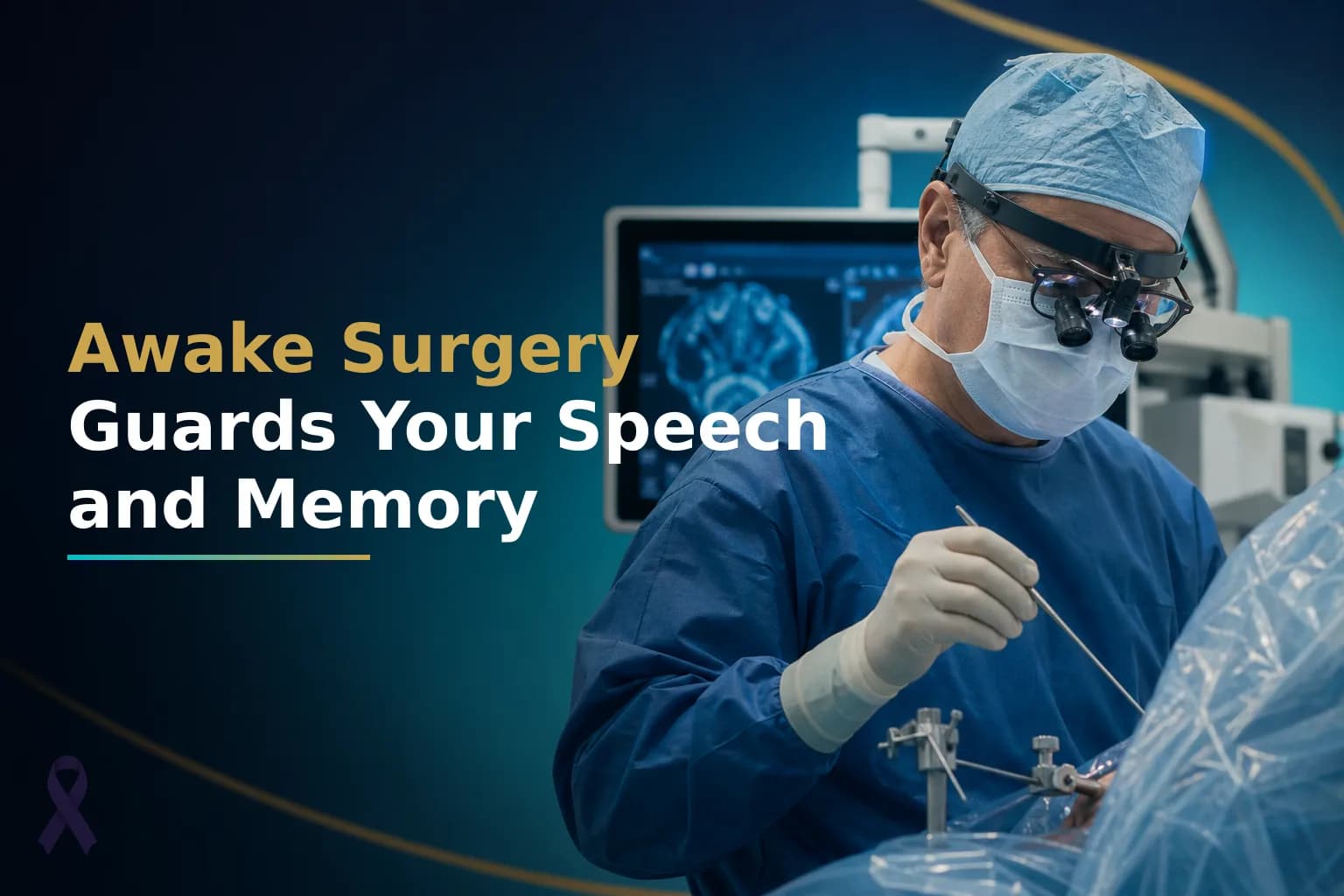
Why Surgical Resection Matters for Anaplastic Astrocytoma
Anaplastic astrocytoma is a grade III brain tumor. It grows faster than lower-grade gliomas and spreads into surrounding tissue. Surgery is the first step in treatment. The goal is to remove as much tumor as safely possible. Doctors call this the extent of resection.
Removing more tumor is linked to longer survival in anaplastic gliomas, though the exact benefit depends on molecular factors like IDH mutation status. Studies on recurrence patterns after maximal resection show that patients with more complete tumor removal do better than those with less complete surgery, as long as brain function is preserved.
The challenge: anaplastic astrocytomas often grow in or near the brain's most critical areas. Aggressive removal in these zones risks permanent neurological damage. Awake craniotomy with intraoperative brain mapping helps surgeons remove the tumor while protecting brain function.
What Are Eloquent Brain Areas?
Neurosurgeons use the word eloquent to describe regions of the brain that control functions you cannot afford to lose permanently. These include:
- Language and speech: Broca's area, which governs speaking, and Wernicke's area, which handles understanding, located in the dominant hemisphere
- Motor function: The primary motor cortex, which controls voluntary movement of the face, hands, arms, and legs
- Sensory processing: The sensory cortex, which handles touch, pressure, and awareness of body position
- Visual pathways: Including the optic radiations that carry visual signals from the eyes toward the occipital lobe
About 46 to 61 percent of gliomas grow in eloquent regions of the brain. This is why high-volume centers have made awake surgery standard practice for these tumors.
Brain imaging before surgery—including functional MRI and diffusion tensor imaging—can estimate where eloquent functions are located. But the brain is plastic. Tumor growth can shift function away from its normal location. The only way to know for sure where a critical area begins is to test the patient directly, in real time, with the skull open. That is what intraoperative brain mapping does.
What Is Intraoperative Brain Mapping?
Intraoperative brain mapping identifies which areas of exposed brain tissue control specific functions. The most established method is direct electrical stimulation, or DES.
During DES, the neurosurgeon places a small electrode on the surface of the brain and delivers a brief, low-current electrical pulse. This temporarily disrupts function in that small zone—similar to pressing pause on a specific region. If stimulating a particular spot causes the patient to lose a word, stutter, or freeze mid-sentence, the team knows that zone controls speech. If it produces an involuntary hand movement, the motor strip is nearby.
The surgeon marks functional zones with small numbered tags placed directly on the brain surface. These create a personalized map—a real-time guide showing where resection must stop. Awake surgery with direct electrical stimulation and real-time cognitive monitoring is recognized as a reliable way to maximize tumor removal while protecting brain function.
Mapping can target a range of tasks depending on where the tumor sits:
- Naming objects and counting aloud to identify language-critical cortex
- Reading sentences to test language comprehension pathways
- Repetitive hand or finger movements to locate the motor strip
- Visuospatial tasks when tumors are near parietal or occipital regions
- Working memory and attention tasks for tumors in prefrontal areas
A neuropsychologist or speech-language therapist is usually present in the operating room throughout the awake phase. They guide the patient through tasks in real time while the surgeon probes the cortex and marks functional sites.
What Actually Happens During Awake Craniotomy?
The idea of being awake during brain surgery understandably raises anxiety. The procedure is carefully managed from start to finish, and most patients report the experience was more tolerable than they had feared. The National Brain Tumor Society's patient guide to awake craniotomy walks through each stage in accessible detail.
Here is how the process typically unfolds:
- Before surgery: You meet with a neuropsychologist for baseline testing of language, memory, and motor function. The anesthesia team explains the sedation plan and what you will be asked to do when awake.
- Opening phase (asleep): Surgery begins under sedation or general anesthesia. The surgeon opens the scalp, temporarily removes a section of skull, and exposes the brain's outer covering. Local anesthetic numbs the scalp and surrounding tissues. You are sedated through this most uncomfortable phase.
- Awake mapping phase: Sedation is reduced or stopped. You are oriented and asked to perform pre-planned tasks. The surgeon maps the exposed cortex, noting which sites produce responses. The tumor is then resected with the personalized map guiding where resection must stop.
- Closing phase (sedated): Once resection is complete, sedation is restored. The skull section is replaced and the scalp is closed.
The awake phase typically lasts one to three hours. Your team monitors you closely throughout. If anxiety, significant discomfort, or seizure activity appears, they can respond immediately—including converting to a fully asleep approach if needed, using the mapping information already gathered.
Real-Time Cognitive Monitoring During Resection
Surgeons have used basic awake cortical mapping for decades. Newer approaches use continuous real-time cognitive monitoring throughout the resection, not just a one-time assessment before cutting.
In this approach, the patient performs tasks continuously as the surgeon works deeper into the tumor toward the subcortical white matter. When the surgeon approaches a major fiber tract, subtle changes in speech fluency or naming speed may appear before any permanent deficit develops. This gives the surgeon a live warning signal. Research on integrating neuropsychological assessment during awake craniotomy suggests this continuous monitoring may improve functional outcomes compared to surface cortical mapping alone.
Subcortical pathways commonly mapped in this way include:
- The corticospinal tract—the main highway for voluntary limb movement
- The arcuate fasciculus—connects regions involved in speech repetition and language production
- The inferior fronto-occipital fasciculus—involved in semantic language processing
- The optic radiations—maintaining visual field integrity
Protecting these deep fiber tracts is just as important as protecting the cortical surface. Many permanent neurological deficits after glioma surgery come from subcortical injury.
Who Is a Candidate for Awake Craniotomy?
Not all patients with anaplastic astrocytoma are candidates for awake craniotomy. The decision depends on several factors:
- Tumor location: Awake surgery is most useful when the tumor is in or adjacent to eloquent cortex or major white matter tracts—particularly in the frontal, temporal, parietal, or insular lobes of the dominant hemisphere.
- Ability to cooperate: Awake craniotomy requires following instructions and performing tasks during surgery. Severe anxiety, claustrophobia, or impaired cooperation are considerations the team weighs carefully during pre-surgical evaluation.
- Language and cognitive baseline: Patients with significant pre-existing language deficits can still undergo mapping, but tasks must be adapted to their baseline performance before surgery.
- Overall health: This is generally offered to patients who can tolerate a longer procedure. Older patients and those with significant medical conditions are considered individually.
- Center expertise: Awake craniotomy requires an experienced anesthesia team, an intraoperative neuropsychologist or speech therapist, and a neurosurgeon with regular volume in the procedure. It should be performed at a center with documented experience and outcomes data.
Patients who cannot undergo awake surgery may benefit from intraoperative neurophysiological monitoring—such as motor evoked potentials—performed under general anesthesia. However, awake language mapping protects speech more effectively than monitoring alone.
How Does Awake Mapping Combine With Other Surgical Technologies?
High-volume centers combine awake craniotomy with other intraoperative tools:
- Neuronavigation: A GPS-like system that overlays pre-operative MRI onto the surgical field in real time, guiding the surgeon around tumor margins and adjacent anatomy.
- Intraoperative MRI: Some centers have MRI scanners integrated into the operating suite, allowing mid-surgery imaging to confirm how much tumor remains before closing.
- Fluorescence guidance (5-ALA): A compound given before surgery that makes tumor cells glow pink under a special surgical light, helping distinguish infiltrating tumor from healthy brain tissue. Our article on fluorescence-guided surgery for glioma using 5-ALA dye explains this technique in depth.
- Ultrasound guidance: Real-time ultrasound during surgery can help locate residual tumor in some settings.
Combining neuronavigation, awake mapping, and (where available) fluorescence guidance or intraoperative MRI offers the best current approach for safe maximal resection at specialized centers.
What Are the Risks?
Awake craniotomy shares the risks of any open brain surgery, plus some specific to the procedure:
- Intraoperative seizures: Cortical stimulation can trigger brief seizure activity in some patients. The team monitors closely and can stop a seizure quickly by irrigating the cortex with cold saline.
- Inability to complete the awake phase: A small number of patients cannot finish the mapping phase due to anxiety or confusion. The team will convert to an asleep approach if this happens, using monitoring tools to guide the remaining resection.
- Temporary neurological deficits: Some worsening of speech or motor function in the first days after surgery is common. In most patients, these early deficits improve substantially within weeks to months as brain swelling resolves.
- Permanent neurological deficits: These can still occur even when awake mapping is used—particularly with tumors deeply intertwined with functional pathways. Mapping reduces this risk. It does not eliminate it entirely.
Awake mapping cannot prevent all deficits. Its goal is to give the surgical team the real-time information they need so every resection choice is informed—based on your brain's actual needs, not general rules.
Questions to Ask Your Neurosurgeon Before Agreeing to Awake Craniotomy
- How many awake craniotomies does your team perform each year?
- What is your center's rate of permanent speech or motor deficits after awake mapping for glioma?
- Will a neuropsychologist or speech-language therapist be present in the operating room during the mapping phase?
- What sedation protocol does your anesthesia team use, and what is the plan if I cannot cooperate?
- Will you use fluorescence guidance or intraoperative imaging alongside awake mapping for my case?
- Based on my pre-operative imaging, which specific functions are at greatest risk near my tumor?
Remember that surgery alone rarely controls anaplastic astrocytoma long-term. Radiation and chemotherapy are almost always needed afterward. Our article on why surgery alone fails for anaplastic astrocytoma explains the rationale for combined-modality treatment after resection and why the extent of resection matters even in that context.
After Surgery: Recovery and Rehabilitation
Most patients spend several days in the hospital after awake craniotomy. Fatigue, temporary speech changes, and some motor weakness in the first days are common. These usually improve over the following weeks as the brain heals and swelling goes down.
Before discharge, your team performs a formal speech and language assessment and repeats it at follow-up visits. If deficits appear, start speech therapy and occupational or physical therapy as soon as possible. Research shows that starting rehabilitation early, while the patient is medically stable, helps the brain recover in the months after surgery.
Cognitive changes (including memory, processing speed, and attention) may persist into the treatment phase after surgery. The surgery, radiation, and chemotherapy that follow all can affect cognitive function. Our article on cognitive fog and memory problems during anaplastic astrocytoma chemoradiation covers how these changes tend to evolve and what strategies may help manage them.
When to Talk to Your Doctor
Talk to your neurosurgical team before surgery if you have concerns about being awake during the procedure, including significant anxiety, claustrophobia, or difficulty with sedation or anesthesia in the past. Ask your oncologist how the extent of resection relates to your specific tumor profile, especially your IDH mutation status, and whether your tumor's location makes awake craniotomy the most appropriate surgical approach. If your current surgeon does not regularly perform awake brain mapping, it is reasonable to seek a second opinion at a high-volume neuro-oncology center before committing to a surgical plan.
This article is for general information and is not a substitute for medical advice. Always consult your oncologist or care team about your specific situation.