The Question That Matters Most When Treatment Has Stopped Working
When glioblastoma comes back, treatment decisions change. Surgery, radiation, and chemotherapy no longer follow the same path. Patients and caregivers stop asking what the standard protocol says. They ask why the tumor kept growing and what to try next.
PTEN loss may answer that question. If your pathology report or molecular test mentions PTEN deletion, reduced expression, or a mutation, this matters. It is not a minor detail. It is central to how your tumor works. It explains why some standard treatments stopped working and which targeted treatments or clinical trials might help.
This article is for patients facing recurrence and for caregivers researching options when their loved one cannot do this research themselves.
What PTEN Does and Why Its Loss Changes Everything
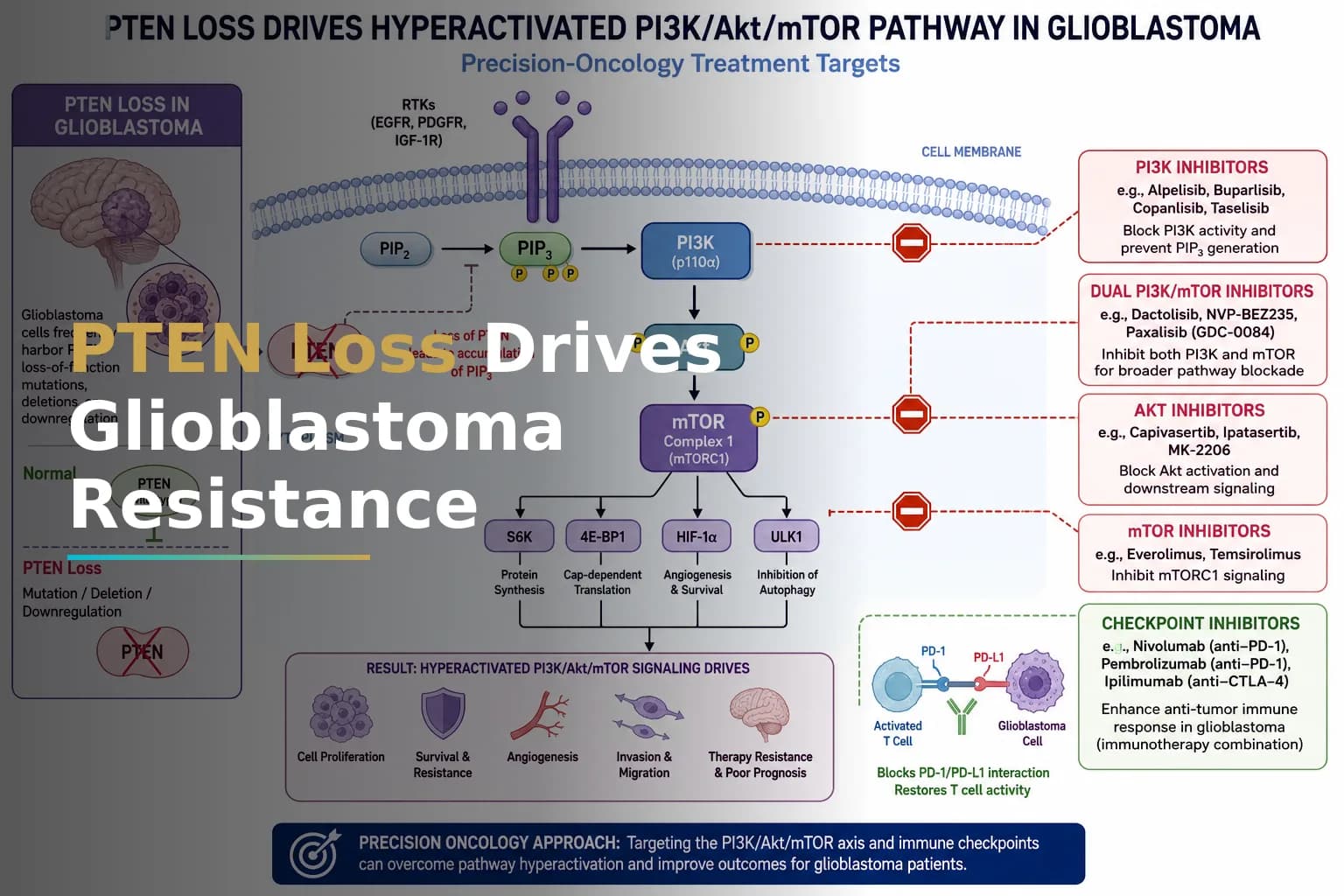
PTEN stands for Phosphatase and Tensin Homolog. In a normal brain cell, PTEN acts like a brake. When a cell gets growth signals, a pathway called PI3K/Akt/mTOR speeds up cell division and survival. PTEN slows that process down. It stops cells from dividing too much.
When tumor cells delete or mutate PTEN, the brake disappears. The PI3K/Akt/mTOR pathway runs without limits. Cells divide faster, survive stress, and resist the signals that normally kill them. Research on this pathway and targeted therapy in glioblastoma shows it drives tumor growth and treatment resistance. PTEN loss is one of the most common ways tumors activate this pathway.
How Common Is PTEN Loss in Glioblastoma
PTEN changes are not rare. Research shows that PTEN deletions, mutations, and expression loss happen in about 40 to 60 percent of glioblastoma cases, according to studies on PTEN deletion and the glioblastoma immune system. This makes it one of the most commonly altered genes in this cancer type.
This matters for treatment. If your molecular report does not mention PTEN status, there is a real chance this change is present but was not tested. Because PTEN loss is well-studied in glioblastoma, knowing your PTEN status opens access to specific clinical trials that require this change.
Why PTEN Loss Drives Treatment Resistance
PTEN loss creates resistance to multiple types of treatment. Understanding each type helps explain why past treatments may have failed and which new strategies might work:
- Chemotherapy resistance: When Akt is overactive, tumor cells survive even with chemotherapy like temozolomide. These cells repair drug damage better and avoid cell death more effectively than normal cells.
- Radiation resistance: Overactive Akt signaling makes radiation therapy less effective in high-grade glioma. Cells with this change recover from radiation damage faster than healthy tissue around them, making radiation less powerful.
- Immunotherapy resistance: PTEN loss increases PD-L1 levels on tumor cells and in tumor particles through a PI3K-dependent pathway. This blocks checkpoint inhibitor immunotherapies, which target PD-L1. PTEN-deficient tumors may be harder to treat with this class of drugs.
- Immune system suppression: Research on immune cells in PTEN-deficient glioblastoma found that PTEN loss kills immune cells in and around the tumor. This prevents the immune system from attacking the tumor, even when checkpoint pathways are treated.
These overlapping mechanisms explain why PTEN-mutant glioblastoma is aggressive. They also explain why PTEN status matters at recurrence, when the tumor has already survived standard therapy.
What Standard Pathology Reports Often Do Not Include
A standard glioblastoma pathology report confirms cell type, WHO grade, IDH status, and often MGMT methylation. These markers matter. But they cover only part of the molecular information available from tumor tissue.
PTEN deletion is not routinely tested in basic molecular panels at most hospitals. Neither is the full picture of mutations that occur with PTEN loss. EGFR amplification, CDKN2A/B deletion, TERT promoter mutation, and TP53 alteration each change how PTEN loss affects drug response and trial eligibility.
A tumor with PTEN loss and EGFR amplification may respond differently to treatment than one with PTEN loss and TP53 mutation. Standard reports do not usually show these interactions in depth. Comprehensive molecular testing is designed to fill this gap. For a patient guide to understanding what your molecular report contains and how its findings connect to treatment decisions, interpreting your glioblastoma molecular report covers key markers and pathway interactions in accessible language.
The Role of Molecular Profiling and Tumor Testing at Recurrence
Glioblastoma changes over time. The tumor that comes back is not always genetically identical to the one removed at surgery. Between the first surgery and recurrence, glioblastoma develops new mutations, loses old ones, and shifts its resistance pathways in response to treatments already survived. PTEN status and the mutations around it may have changed in ways that matter for treatment.
This is why comprehensive molecular testing at recurrence is increasingly recommended in precision neuro-oncology. Whole Exome Sequencing shows all DNA-level mutations in the recurrent tumor. RNA Sequencing shows which genes are actively driving growth now. Drug sensitivity analysis uses this information to see how specific agents might work against the tumor's current biology, rather than relying on general patterns that may not fit your tumor.
A pilot study on whole exome sequencing for personalizing glioblastoma treatment found that sequencing-guided drug combinations were significantly more effective in glioblastoma models than single drugs alone. This shows the potential value of biology-informed treatment selection at recurrence.
For patients weighing salvage options and wanting to know which agents or trials match their tumor's current biology, drug sensitivity analysis for recurrent glioblastoma explains how this approach works and what it reveals.
Where Precision Targeting of PTEN-Loss GBM Stands Today
Directly replacing PTEN is not yet possible. But targeting the pathway that PTEN normally controls—the PI3K/Akt/mTOR cascade—has been studied for more than a decade, with earlier failures leading to better current approaches.
First-generation mTOR inhibitors like temsirolimus showed limited benefit in early glioblastoma trials. Poor penetration to the brain and quick emergence of workaround pathways limited success. A 2024 review of evolving molecular therapy strategies in glioblastoma describes newer dual PI3K/mTOR inhibitors and selective Akt inhibitors as more promising. Early evidence suggests combining Akt inhibition with PD-L1 checkpoint therapy may restore immune sensitivity in PTEN-deficient tumors. This strategy could help patients who did not respond to prior immunotherapy.
Several active clinical trials now require confirmed PTEN alteration for enrollment. Patients with molecular testing showing PTEN deletion may qualify for trial options not visible in a standard consultation. Patients without confirmed PTEN status may be excluded from trials they could otherwise enter.
What International Patients Need to Know
Patients and caregivers across the world regularly seek additional expert review after a glioblastoma diagnosis or recurrence. Not because their local oncology teams are insufficient, but because PTEN-loss glioblastoma complexity often requires specialist interpretation beyond standard consultations.
Geography is not a barrier to this analysis. Pathology reports, molecular test results, surgical notes, and MRI scans can be reviewed remotely by precision oncology specialists. Initial consultations can happen virtually. Many families start with remote case review, which then guides conversations with their treating physicians about next-line options, trial eligibility, and biology-informed strategies.
What matters most is whether tumor analysis has been thorough enough to give you and your care team a complete picture. Expertise in PTEN-loss biology, its co-mutation interactions, and its salvage therapy implications matters more than proximity to any particular institution.
What Reports Should You Gather Before Seeking an Expert Review
If you are considering a precision oncology case review, gather these documents before your consultation for the most complete assessment:
- Pathology Report: The diagnostic report including cell type, WHO grade, and IDH status.
- Histopathology Report: The detailed tissue analysis from the laboratory.
- MRI Brain Reports: Pre-surgery, post-surgery, and recent imaging with radiologist notes.
- Surgical Notes: The operative record showing extent of tumor removal and findings.
- Molecular Testing Results: Any NGS panel, FISH, immunohistochemistry, or gene tests performed, including PTEN, MGMT, IDH, EGFR, TERT, CDKN2A/B, and related markers.
- Current Treatment Plan: Details of ongoing or recent therapy, including radiation dose and chemotherapy cycles completed.
- Previous Treatment History: All past therapies, observed responses, and reasons for change or stopping.
A thorough review of these materials may surface biological insights not yet discussed in treatment conversations. This is especially true if comprehensive molecular testing was not done at diagnosis or has not been repeated since recurrence. Many families seeking clarity before major treatment decisions find that detailed analysis of their molecular data raises important questions to discuss with their care team.
Decisions Families Often Regret After Recurrence
The urgency after recurrence is real, and pressure to act quickly can lead to decisions made without complete biological information. Several patterns reduce the quality of decision-making at this stage:
- Starting a second-line treatment without first confirming whether the tumor's current molecular profile makes it a good candidate for that drug, or whether an alternative might work better.
- Not requesting new molecular testing of the recurrent tumor. If surgery was years ago or comprehensive sequencing was not done initially, the current tumor may carry different actionable mutations.
- Assuming that clinical trial access requires traveling to a specific institution in person. Many biomarker-stratified trials allow remote eligibility screening, and some allow participation from any location with local laboratory support.
- Searching for treatment based on tumor type alone rather than tumor biology. Two glioblastoma patients with different molecular profiles may have very different precision-oncology options, even at the same treatment center.
Questions Worth Raising With Your Neuro-Oncologist
These questions can help structure a productive conversation about PTEN loss and next-line treatment with your care team:
- Was PTEN deletion or loss of expression specifically tested in my tumor, and if so, what was the result?
- If PTEN was not tested, is there enough remaining tissue for additional molecular analysis?
- Given PTEN loss, which current clinical trials might I be eligible for, particularly those targeting the PI3K/Akt/mTOR pathway or using biomarker-stratified immunotherapy?
- Should new biopsy or comprehensive molecular testing of the recurrent tumor be considered, and would those results change the treatment plan?
- How does my PTEN status interact with my MGMT methylation status and EGFR profile in terms of expected response to current salvage options?
If your tumor also carries a TP53 alteration—a mutation that frequently occurs with PTEN loss in glioblastoma—understanding how these two changes affect drug response adds important context. TP53 mutation in glioblastoma covers the biological mechanisms and precision-therapy implications of this related marker.
Next Steps: Understanding Your Tumor Biology More Completely
Every glioblastoma has a unique molecular signature. If PTEN loss has been found in your tumor, or if comprehensive molecular testing has not yet been done, understanding the full biological picture may open conversations about options not visible in standard reporting.
If you or a loved one has been diagnosed with glioblastoma or is now facing recurrence, gather pathology reports, MRI scans, surgical notes, and molecular test results. A precision oncology team can review these materials remotely, identify biological insights relevant to your case, and help you formulate questions to ask your treating physicians.
Patients from the UK, US, Australia, Canada, Germany, France, UAE, and New Zealand often start with a virtual consultation and report review. Understanding your tumor's biology may guide more informed conversations with your physicians about which next-line options match your specific molecular profile.
When to talk to your doctor: If your molecular test results have not been reviewed in detail since initial diagnosis, or if you are now facing recurrence without a complete picture of your tumor's current mutations, these are the right times to ask your treating team about comprehensive molecular testing and precision oncology case review.
This article is for general information and is not a substitute for medical advice. Always consult your oncologist or care team about your specific situation.