If you have heard the term Tumor Treating Fields from your neuro-oncologist, or come across the device name Optune in a GBM patient group, you are probably asking one question: does it actually help, and is it worth the daily effort?
Tumor Treating Fields (TTFields) is a non-drug, non-radiation treatment for glioblastoma. It uses alternating electric fields delivered through adhesive patches on the scalp to disrupt how tumor cells divide. Adding it to standard maintenance chemotherapy - after the initial six weeks of chemoradiation - is supported by a phase III clinical trial and has a Category 1 recommendation from the National Comprehensive Cancer Network (NCCN), whose guidelines doctors worldwide follow for standard cancer treatment. This article explains the mechanism, what the evidence shows, and what daily life with the device actually looks like.
What Are Tumor Treating Fields?
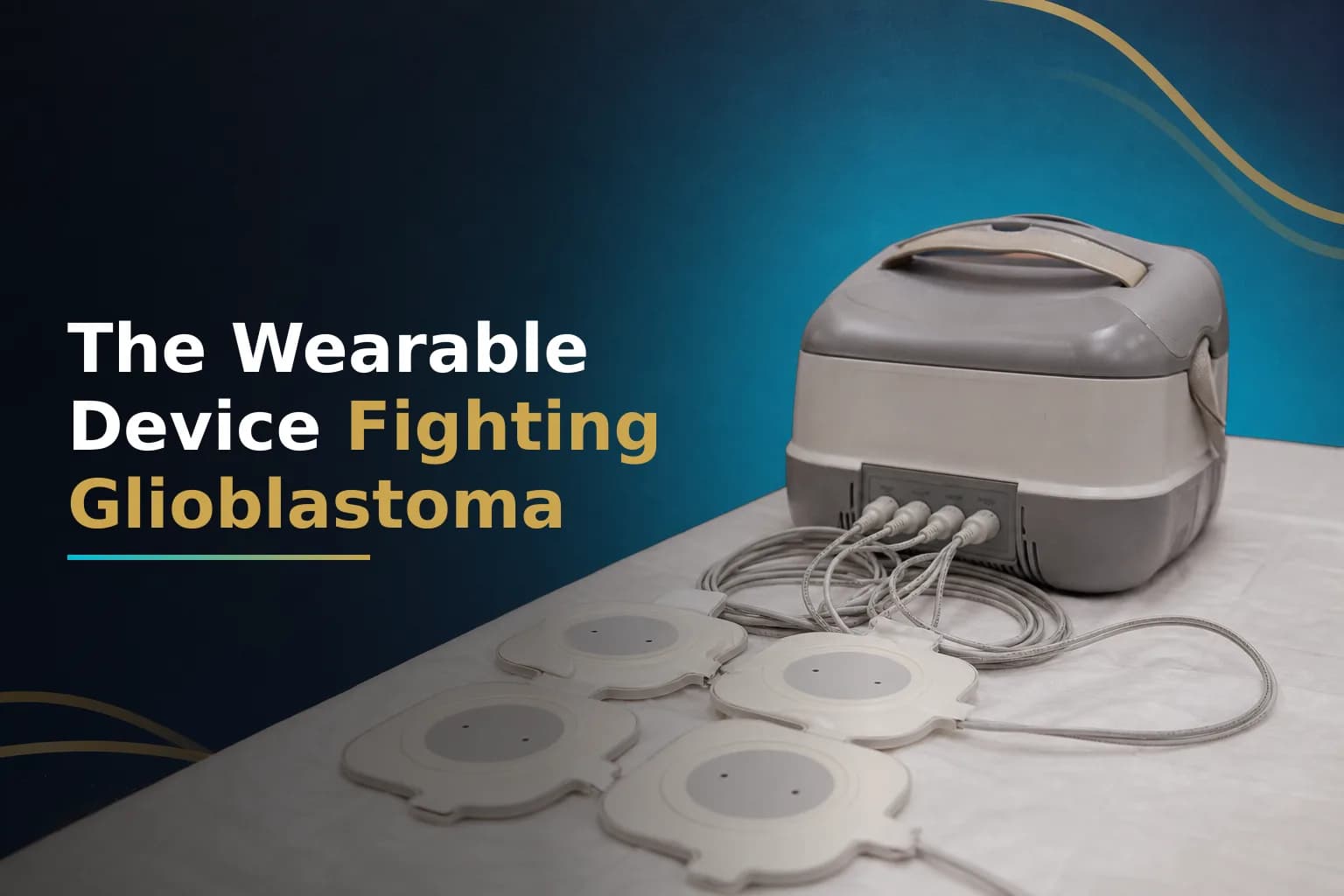
TTFields delivers electric fields at a frequency of 200 kilohertz (kHz) through four transducer arrays - thin, adhesive electrode patches placed directly on a shaved scalp. These arrays connect by thin wires to a portable generator roughly the size of a large book, which the patient carries in a shoulder bag during the day or places on a bedside table while charging overnight.
The 200 kHz frequency is calibrated specifically for GBM tumor cells. At that frequency, the electric fields disrupt two protein structures inside actively dividing cells: microtubules and septin fibers. Both are essential structures that cells use to physically pull apart and form two viable daughter cells. When those proteins are disrupted, the dividing cell cannot complete the process - a result researchers call mitotic catastrophe. The cell either dies or produces non-viable daughter cells.
Normal brain cells are not actively dividing, so they are largely unaffected. GBM cells divide aggressively and are far more exposed to this disruption. That selectivity is a key reason TTFields adds comparatively little systemic toxicity to an already demanding treatment course. A detailed overview of the mechanism and new research is available in a review of TTFields therapy in glioblastoma published in BMJ Open.
How TTFields Fits Into the GBM Treatment Timeline
Standard initial treatment for newly diagnosed GBM follows the Stupp protocol: surgery first, then six weeks of simultaneous radiation therapy and temozolomide chemotherapy, followed by maintenance cycles of temozolomide taken orally at home. TTFields is introduced at the maintenance phase - after chemoradiation ends - and runs alongside temozolomide. It does not replace chemotherapy. It is an addition to it.
The device typically begins at the start of maintenance treatment and continues for as long as the tumor remains stable or responsive and the patient can tolerate the daily demands. For a detailed look at how temozolomide works during both phases and how to manage its side effects, see Temozolomide for Glioblastoma: How It Works, Side Effects, and Managing Them.
How Does TTFields Plus Chemotherapy Compare to Chemotherapy Alone?
The primary evidence for TTFields in newly diagnosed GBM is the EF-14 phase III randomized controlled trial, which compared TTFields plus maintenance temozolomide to temozolomide alone after chemoradiation. The National Brain Tumor Society published commentary on the final EF-14 results, noting the importance of a survival benefit in a disease where advances have historically been incremental. The table below summarizes the key outcomes.
| Measure | TTFields + Temozolomide | Temozolomide Alone |
|---|---|---|
| Median overall survival | 20.9 months | 16.0 months |
| Median progression-free survival | 6.7 months | 4.0 months |
| 5-year overall survival rate | 13% | 5% |
| Main additional side effects | Scalp skin irritation under arrays (mostly mild to moderate) | No device-related skin effects |
| Daily device burden | Wearable device; target at least 18 hours per day | None |
| NCCN recommendation (newly diagnosed GBM) | Category 1 - in combination with temozolomide | Standard chemotherapy comparator |
Sources: EF-14 post-hoc analysis, PMC; National Brain Tumor Society commentary on EF-14 final results. Survival figures from the EF-14 final analysis (Stupp et al., 2017).
Adding TTFields extended median overall survival by roughly five months and more than doubled the proportion of patients alive at five years. In a disease where median survival with standard treatment has historically been around 15 months, those are clinically meaningful numbers - with the important caveat that group medians are not individual predictions. Survival in GBM varies widely by age, molecular profile, and extent of resection.
For a grounded understanding of how to read survival statistics as an individual patient rather than as a trial population, see What Median Survival Really Means in Glioblastoma.
What Does Wearing the Device Actually Look Like?
This is where caregivers and patients need honest, practical information. The device places real demands on daily life, and those demands compound over a treatment course that can run for many months.
The scalp must be fully shaved before the arrays are applied and must stay shaved throughout treatment - regrowth interferes with electrical contact. Array changes happen roughly every three to four days. At each change, the patches are repositioned slightly, shifting pressure points to reduce skin irritation from continuous contact in one spot.
The four transducer array patches are placed on the scalp in a layout determined by the precise size and location of the tumor, mapped from the patient's own MRI. Each patch contains nine small ceramic disks. Thin wires connect them to a portable generator unit that runs on battery (for mobility) or from a wall socket overnight. The manufacturer, Novocure, provides trained clinical liaison nurses who assist with array placement, device setup, and scalp care throughout treatment.
The recommended target is at least 18 hours of device use per day. Most patients keep it on overnight and through most daytime activities, removing it only for showers and array changes. Some adapt to the routine more easily than expected; others find the sustained connection to a device physically and psychologically demanding over months of use.
For international patients or those living far from a major cancer centre, make sure to confirm before starting that Novocure technical and clinical support is available in your location. Some patients who travel for treatment access the device during their in-country stay and arrange remote monitoring for continuation at home.
Does MGMT Methylation Status Affect Who Benefits From TTFields?
MGMT methylation - the molecular marker that predicts sensitivity to temozolomide chemotherapy - does not appear to limit TTFields benefit. Subgroup analyses from the EF-14 trial found survival improvement in patients with both methylated and unmethylated MGMT promoters, though the absolute benefit varied between subgroups. This is particularly relevant for patients with unmethylated MGMT, who tend to respond less well to temozolomide alone and may have more to gain from adding a second treatment approach.
If you are not yet clear on what your MGMT result means for your overall treatment strategy, What Your Glioblastoma Pathology Report Really Means explains the key molecular markers in plain language.
What Are the Side Effects of Tumor Treating Fields?
The side effects of TTFields are primarily dermatologic - confined to the skin under the transducer arrays. A peer-reviewed analysis of dermatologic adverse events in TTFields patients identifies contact dermatitis, localized redness, and skin irritation as the most common problems. Most are mild to moderate. Management typically involves topical corticosteroid creams, skin-barrier products, and careful repositioning of arrays at each change. Superficial skin infections or small erosions occur less commonly but should be reported to the care team promptly.
Systemically, TTFields does not add significant toxicity. In the EF-14 trial, the rate of serious system-wide adverse events was similar in both groups - 48% with TTFields plus temozolomide versus 44% with temozolomide alone - meaning the device does not meaningfully worsen the systemic side-effect burden of chemotherapy.
Keeping your scalp shaved is emotionally difficult for many patients. For many - particularly younger adults and women - this is one of the hardest aspects of TTFields use. Some neuro-oncology teams can connect patients and families with oncology social work or psychological support to address it alongside the practical device demands.
Why Daily Wear Time Changes the Outcome
A key fact about TTFields is that daily compliance directly correlates with survival. This relationship is well-documented and significant.
A subgroup analysis of the EF-14 trial, reported in a study on compliance and outcomes in TTFields therapy, found that patients who wore the device more than 90% of the recommended daily time had a median overall survival of 24.9 months and a 5-year survival rate of 29.3%. Patients with compliance below 50% saw substantially less benefit.
This is one of the few variables in GBM treatment where a patient-controlled behavior has a measurable impact on survival. It also means that the support structure around the patient - caregiver availability, home setup, and practical problem-solving around daily device use - is both a clinical and practical concern.
Can TTFields Be Used at Recurrence?
TTFields received its initial FDA approval for recurrent GBM before being approved for newly diagnosed disease. In the recurrent setting, the evidence is less definitive than the EF-14 data, and the device is typically used as one component of a broader salvage approach rather than as a standalone treatment. It is sometimes combined with bevacizumab or incorporated into clinical trial protocols at recurrence. If you have not previously used TTFields and are now at first or subsequent recurrence, raise it specifically with your neuro-oncologist as part of a full review of available options.
Questions to Raise Before Starting TTFields
These are worth discussing explicitly with your clinical team before committing to the device:
- Is Novocure device support available in your country or city, and what does remote support look like in practice?
- What does your insurance or health system cover for TTFields, and what is the direct cost to you?
- Does your tumor's precise location and size affect how the arrays need to be placed?
- Are there open clinical trials combining TTFields with an additional agent - such as an immunotherapy - that you may qualify for?
- Does your current living situation and caregiver support allow the sustained daily compliance that produces the best outcomes?
If you are evaluating TTFields as part of a broader second-opinion process - particularly as an international patient researching options before committing to a treatment path - an expert can review your full case first. You can consult the Art of Healing Cancer team on what your treatment options actually look like, including how TTFields fits your molecular profile and disease stage.
When to Talk to Your Doctor
Raise TTFields with your neuro-oncologist before completing chemoradiation, so you can arrange device access before maintenance begins. If you are at recurrence and have not yet used TTFields, ask about it specifically during any salvage treatment review. During device use, contact your care team promptly if you develop spreading skin redness, open sores, signs of infection under the arrays, or symptoms that make sustained compliance difficult - do not discontinue the device on your own without clinical guidance.
This article is for general information and is not a substitute for medical advice. Always consult your oncologist or care team about your specific situation.